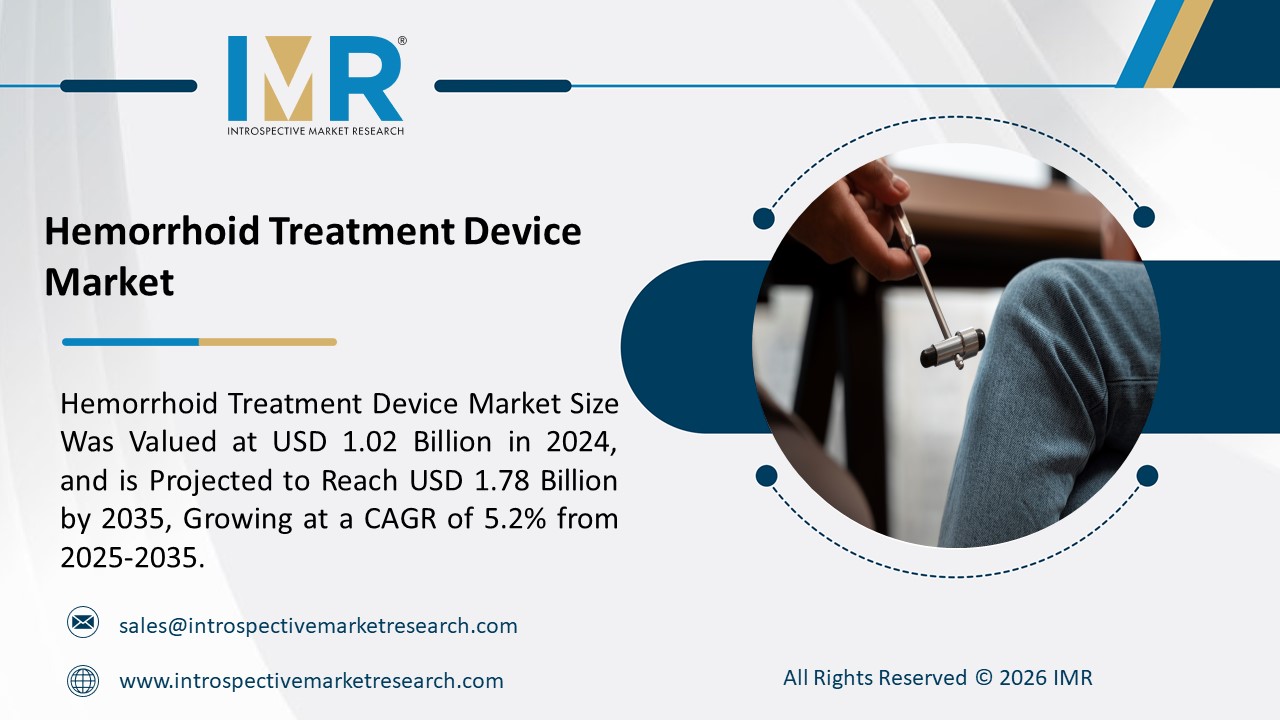
According to a new report published by Introspective Market Research, titled, “Hemorrhoid Treatment Device Market by Device Type, Treatment Type, and End User,” The Global Hemorrhoid Treatment Device Market Size Was Valued at USD 1.02 Billion in 2024 and is Projected to Reach USD 1.78 Billion by 2035, Growing at a CAGR of 5.2%.
The hemorrhoid treatment device market comprises specialized medical instruments designed for the minimally invasive management of hemorrhoids, a common medical condition characterized by swollen veins in the rectum and anus. Key device categories include rubber band ligators, infrared coagulators, bipolar energy devices, suture devices, and cryotherapy units. These modern devices offer significant advantages over traditional invasive surgery, such as hemorrhoidectomy, by reducing procedural pain, shortening recovery time, minimizing complications like incontinence, and enabling outpatient or office-based procedures. This shift aligns with the growing demand for efficient, less traumatic treatment options.
The primary growth driver for the hemorrhoid treatment device market is the rising global prevalence of hemorrhoids, fueled by key lifestyle and demographic trends. An increase in sedentary desk jobs, poor dietary habits low in fiber, rising obesity rates, and an aging population all contribute significantly to the incidence of this condition. As hemorrhoids become more common, patient awareness and willingness to seek treatment are also increasing, moving beyond home remedies to professional medical intervention. This expanding patient pool, combined with a strong clinical preference for minimally invasive techniques that offer faster recovery and lower complication rates compared to traditional surgery, creates sustained demand for advanced treatment devices, ensuring steady market expansion.
A significant market opportunity lies in the continued innovation and development of next-generation, office-based procedural devices that are even more efficient, user-friendly, and cost-effective. There is considerable potential for devices that further reduce procedure time, integrate real-time imaging or feedback for improved accuracy, or combine multiple treatment modalities (e.g., ligation with coagulation) in a single platform. Expanding into emerging economies with large underserved patient populations and growing healthcare infrastructure also presents a major growth frontier. Furthermore, enhancing direct-to-consumer education through digital channels to destigmatize the condition and inform patients about modern treatment options can drive earlier diagnosis and procedure volumes.
Hemorrhoid Treatment Device Market, Segmentation
The Hemorrhoid Treatment Device Market is segmented on the basis of Device Type, Treatment Type, and End User.
Device Type
The Device Type segment is further classified into Ligation Devices, Infrared Coagulators, Bipolar Energy Devices, Suture Devices, Cryotherapy Devices, and Others. Among these, the Ligation Devices sub-segment accounted for the highest market share in 2024. Rubber band ligation devices dominate due to their established efficacy, simplicity, and cost-effectiveness for treating Grade I-III internal hemorrhoids. The procedure is widely performed in outpatient settings, requires minimal specialized training, and has a long-proven track record of success with low recurrence rates. The high procedural volume for this first-line treatment option solidifies ligation devices as the market leader.
End User
The End User segment is further classified into Hospitals, Ambulatory Surgical Centers (ASCs), and Specialty Clinics. Among these, the Hospitals sub-segment accounted for the highest market share in 2024. Hospitals remain the dominant setting as they handle the highest volume of patients, including more complex or severe cases (Grade IV) that may require surgical backup. They also serve as the primary adoption centers for new technologies and train new practitioners. The comprehensive infrastructure and availability of multiple specialists in a hospital setting make it the most common point of care for hemorrhoid treatment procedures globally.
Some of The Leading/Active Market Players Are-
- Boston Scientific Corporation (USA)
- Medtronic plc (Ireland)
- Johnson & Johnson (Ethicon) (USA)
- CONMED Corporation (USA)
- Olympus Corporation (Japan)
- Karl Storz SE & Co. KG (Germany)
- Cook Medical LLC (USA)
- Teleflex Incorporated (USA)
- OBP Medical Corporation (USA)
- Sklar Surgical Instruments (USA)
- Integra LifeSciences Holdings Corporation (USA)
- B. Braun Melsungen AG (Germany)
- Medline Industries, LP (USA)
- Happersberger Otopront GmbH (Germany)
- A.M.I. GmbH (Austria)
and other active players.
Key Industry Developments
In February 2024, Boston Scientific received expanded FDA clearance for its Resolution 360° Clip, a mechanical hemostatic clip, for use in gastrointestinal bleeding, including hemorrhoidal cases, showcasing its expansion within the lower GI bleeding market.
This development highlights the trend of major medical device companies leveraging their existing vascular or GI platforms to address adjacent procedural needs in proctology, offering clinicians versatile tools for managing hemorrhoidal bleeding with familiar technology.
In January 2024, Medtronic launched the HemoPexx™ Hemorrhoid Circular Stapler in key international markets, designed for stapled hemorrhoidopexy (PPH) procedures with enhanced ergonomics and a lower staple height profile.
This launch focuses on the surgical segment of the market, aiming to improve a established minimally invasive surgical technique. It reflects ongoing R&D aimed at optimizing existing devices to improve patient outcomes and surgeon experience in the operating room.
Key Findings of the Study
- Ligation Devices (e.g., rubber band ligators) are the largest device category.
- Hospitals are the leading end-user segment for hemorrhoid treatment procedures.
- Market growth is driven by rising hemorrhoid prevalence due to lifestyle factors and an aging population.
- North America holds the largest market share, with Asia-Pacific expected to witness significant growth.
- The key market trend is the strong and growing preference for minimally invasive treatment options over traditional surgery.