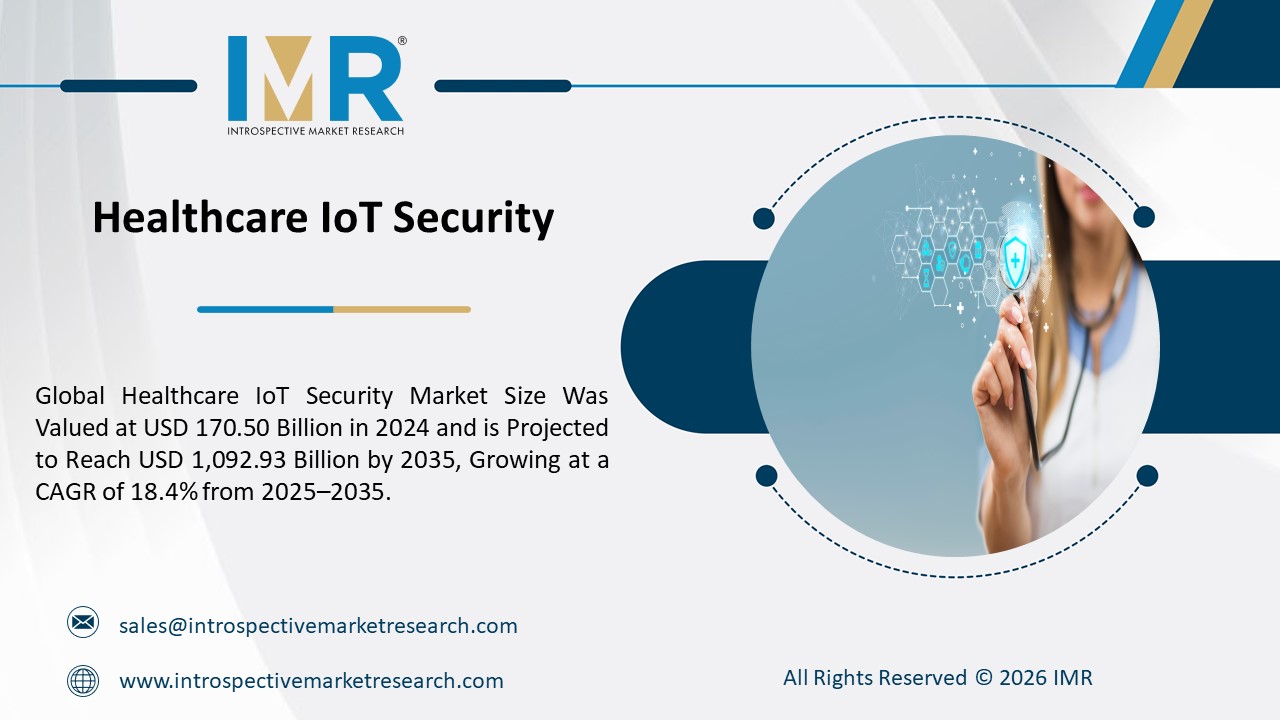
“According to a new report published by Introspective Market Research, titled, Healthcare IoT Security Market by Component, Security Type, and End User, The Global Healthcare IoT Security Market Size Was Valued at USD 170.50 Billion in 2024 and is Projected to Reach USD 1,092.93 Billion by 2035, Growing at a CAGR of 18.4% from 2025–2035.”
The Healthcare IoT Security Market is witnessing rapid expansion as healthcare providers increasingly adopt connected medical devices, remote patient monitoring systems, and smart hospital infrastructure. Healthcare IoT security solutions are designed to protect sensitive patient data, connected medical devices, and healthcare networks from cyber threats, unauthorized access, and data breaches. These solutions offer significant advantages over traditional IT security by enabling real-time threat detection, device authentication, and end-to-end data encryption across complex IoT ecosystems.
Rising digitization of healthcare services, coupled with the growing use of wearable devices, implantable sensors, and telehealth platforms, has heightened the need for robust security frameworks. Healthcare IoT security plays a critical role in ensuring regulatory compliance, maintaining patient trust, and safeguarding operational continuity in hospitals and healthcare facilities.
Furthermore, increasing incidents of cyberattacks targeting healthcare infrastructure, along with stringent data protection regulations, are compelling healthcare organizations to invest in advanced IoT security solutions. As a result, the market is expected to experience strong growth throughout the forecast period, supported by technological advancements and increasing cybersecurity awareness.
Market Segmentation
The Healthcare IoT Security Market is segmented into Component, Security Type, and End User.
- By Component, the market is categorized into Solutions and Services.
- By Security Type, the market is categorized into Network Security, Endpoint Security, Application Security, and Cloud Security.
- By End User, the market is categorized into Hospitals & Clinics, Pharmaceutical & Biotechnology Companies, Medical Device Manufacturers, and Home Healthcare Providers.
Growth Driver
The primary growth driver of the Healthcare IoT Security Market is the rapid proliferation of connected medical devices and digital healthcare platforms. Hospitals and healthcare providers are increasingly deploying IoT-enabled devices for real-time patient monitoring, diagnostics, and asset management, significantly expanding the attack surface for cyber threats. High-profile data breaches and ransomware attacks targeting healthcare systems have intensified the demand for advanced IoT security solutions. Additionally, regulatory mandates related to patient data protection are pushing organizations to strengthen their cybersecurity infrastructure, thereby accelerating market growth.
Market Opportunity
A major market opportunity lies in the integration of artificial intelligence and machine learning into healthcare IoT security solutions. AI-driven security platforms enable predictive threat analysis, automated incident response, and continuous monitoring of connected devices. As healthcare systems transition toward cloud-based and remote care models, vendors offering scalable, AI-powered IoT security solutions stand to gain a competitive advantage. Emerging markets, where digital healthcare adoption is rising rapidly, further present lucrative growth opportunities for market players during the forecast period.
Detailed Segmentation
Healthcare IoT Security Market, Segmentation
The Healthcare IoT Security Market is segmented on the basis of Component, Security Type, and End User.
Component
The Component segment is further classified into Solutions and Services. Among these, the Solutions sub-segment accounted for the highest market share in 2024. Healthcare organizations are increasingly investing in comprehensive security platforms that offer device authentication, encryption, intrusion detection, and real-time monitoring. These solutions provide centralized visibility and control over connected medical devices, enabling faster threat detection and response. The growing complexity of healthcare IoT environments continues to drive demand for advanced, integrated security solutions.
Security Type
The Security Type segment is further classified into Network Security, Endpoint Security, Application Security, and Cloud Security. Among these, the Endpoint Security sub-segment accounted for the highest market share in 2024. The increasing number of connected medical devices and wearables has made endpoints the most vulnerable entry points for cyberattacks. Endpoint security solutions help protect devices from malware, unauthorized access, and data tampering, ensuring safe and uninterrupted healthcare operations.
Some of The Leading/Active Market Players Are-
• Cisco Systems, Inc. (USA)
• IBM Corporation (USA)
• Palo Alto Networks, Inc. (USA)
• Fortinet, Inc. (USA)
• Check Point Software Technologies Ltd. (Israel)
• McAfee Corp. (USA)
• Trend Micro Incorporated (Japan)
• Symantec Corporation (USA)
• Sophos Group plc (UK)
• FireEye, Inc. (USA)
• ARM Limited (UK)
• Thales Group (France)
• Microsoft Corporation (USA)
• Broadcom Inc. (USA)
• Siemens Healthineers (Germany)
and other active players.
Key Industry Developments
In March 2024, a leading cybersecurity firm launched an AI-powered IoT security platform tailored for healthcare environments to address rising cyber threats.
The solution integrates machine learning algorithms to monitor connected medical devices, detect anomalies, and automate threat mitigation, enhancing overall healthcare cybersecurity resilience.
In September 2024, a global healthcare technology company partnered with a cloud security provider to strengthen IoT security for remote patient monitoring systems.
The collaboration focuses on improving data encryption, secure device connectivity, and regulatory compliance across cloud-based healthcare IoT networks.
Key Findings of the Study
• Solutions and endpoint security dominate the market
• North America leads due to advanced healthcare IT infrastructure
• Rising cyber threats drive market growth
• AI-enabled IoT security is a key emerging trend