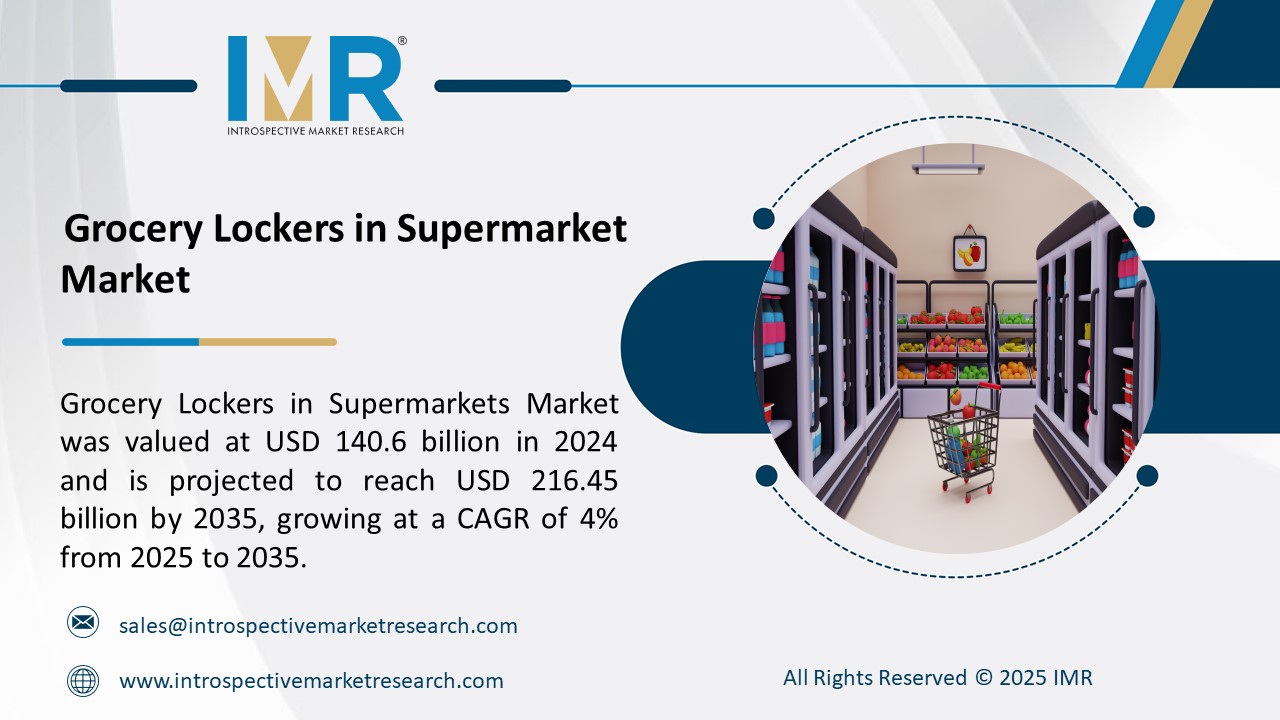
According to a new report published by Introspective Market Research, titled, “Grocery Lockers in Supermarkets Market by Component, Deployment, and Supermarket Type,” The Global Grocery Lockers in Supermarkets Market Size Was Valued at USD 140.6 Billion in 2024 and is Projected to Reach USD 216.45 Billion by 2035, Growing at a CAGR of 4% From 2025–2035.
The Grocery Lockers in Supermarkets market comprises automated, temperature-controlled storage units installed by retailers to facilitate convenient order pickup for customers. This service offers a significant advantage over traditional in-store shopping or standard curbside pickup by providing a completely contactless, 24/7 collection point. Customers can retrieve pre-packed online orders at any time using a unique code, bypassing store queues and eliminating the need for precise pickup timing, which streamlines the last-mile delivery process for retailers. These locker systems serve as a critical bridge between online grocery ordering and physical retail, enhancing operational efficiency and customer satisfaction. Their primary use is to manage the surge in e-commerce orders, reduce congestion at customer service desks, and serve as convenient hubs for returns and exchanges. Major supermarket chains, hypermarkets, and warehouse clubs are rapidly adopting this technology to create a seamless omnichannel experience, reduce labor costs associated with order handoff, and capture market share in the competitive online grocery sector.
The fundamental growth driver for the grocery locker market is the continued, permanent expansion of online grocery shopping, which has elevated "click-and-collect" from a niche service to a mainstream expectation. Consumers now demand ultimate convenience the ability to shop online and pick up orders on their own schedule without leaving their cars or navigating busy stores. For retailers, lockers are a strategic solution to efficiently manage high order volumes, reduce last-mile delivery costs by consolidating pickup, and reclaim valuable parking and curbside space that was previously clogged with traditional pickup lanes, thereby improving the experience for all customers.
A pivotal market opportunity lies in the evolution of lockers into advanced, multi-temperature automated micro-fulfillment centers. Next-generation systems are being developed to not only store orders but also dynamically assemble them in real-time from inventory housed within the locker structure itself. This technology allows supermarkets to offer instant, "on-demand" pickup for a curated selection of high-demand items, compete directly with instant delivery apps, and utilize parking lot space as profitable, automated retail points. This transforms lockers from passive storage into active revenue-generating assets.
Grocery Lockers in Supermarkets Market, Segmentation
The Grocery Lockers in Supermarkets Market is segmented on the basis of Component, Deployment, and Supermarket Type.
Component
The Component segment is further classified into Hardware, Software, and Services. Among these, the Hardware sub-segment accounted for the highest market share in 2024. This dominance is driven by the substantial capital expenditure required for the physical locker units, which are the core tangible asset of the solution. Hardware includes not just the insulated, compartmentalized lockers but also integrated touchscreen kiosks, payment systems, and advanced refrigeration units for chilled and frozen goods. As retailers scale their pickup networks, the initial and ongoing investment in durable, reliable, and technologically integrated hardware forms the largest portion of market spend.
Supermarket Type
The Supermarket Type segment is further classified into Hypermarkets & Supermarkets, Warehouse Clubs, and Others. Among these, the Hypermarkets & Supermarkets sub-segment accounted for the highest market share in 2024. These large-format stores are the primary adopters due to their vast customer base, extensive online grocery offerings, and the strategic need to manage high pickup volumes efficiently. They have the physical space (in parking lots) and the capital to invest in locker banks as a competitive necessity to enhance service, reduce in-store foot traffic for pickups, and defend their market share against pure-play online grocers and convenience-driven alternatives.
Some of The Leading/Active Market Players Are-
• LockTec GmbH (Germany)
• LockitUSA (US)
• Bell and Howell (US)
• Package Nexus (US)
• Smiota, Inc. (US)
• Ricoh USA, Inc. (US)
• Parcel Pending by Quadient (US)
• Vlocker (US)
• Mobile Locker Co. (Australia)
• AstraLocker (US)
• Veloxity (US)
• American Locker (US)
• and other active players.
Key Industry Developments
In March 2024, Parcel Pending by Quadient launched its "Smart Food Locker" system with AI-powered predictive stocking for supermarkets. The system analyzes real-time sales data and upcoming pickup reservations to suggest optimal pre-stocking of popular items, aiming to reduce wait times to under 30 seconds and increase order throughput for retailers during peak hours.
In February 2024, a major partnership was announced between a national supermarket chain and a locker hardware provider to deploy outdoor, multi-temperature lockers at commuter train stations. This initiative aims to capture the "grab-and-go" dinner market by allowing commuters to pick up pre-ordered groceries on their way home, expanding the supermarket's reach beyond its physical store footprint and tapping into new customer occasions.
Key Findings of the Study
• Hardware components and Hypermarkets & Supermarkets were the dominant market segments.
• North America held the largest revenue share, driven by high online grocery penetration.
• The sustained growth of online grocery and click-and-collect services is the key driver.
• Market trends include the integration of AI for operations and deployment beyond store parking lots into high-traffic urban locations