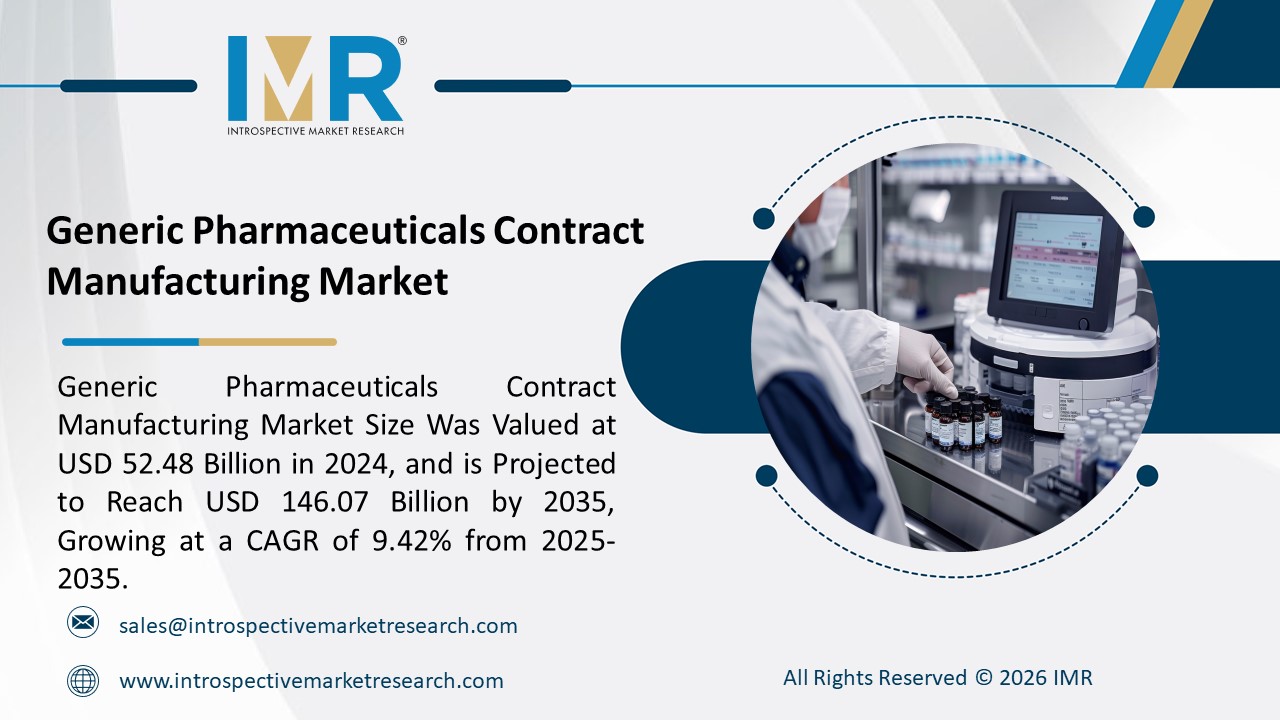
According to a new report published by Introspective Market Research, titled, “Generic Pharmaceuticals Contract Manufacturing Market by Product Type, Service Type, and Dosage Form,” The Global Generic Pharmaceuticals Contract Manufacturing Market Size Was Valued at USD 52.48 Billion in 2024 and is Projected to Reach USD 146.07 Billion by 2035, Growing at a CAGR of 9.42%.
The generic pharmaceuticals contract manufacturing market comprises the outsourcing of drug production by pharmaceutical companies (sponsors) to specialized third-party organizations (CMOs/CDMOs). This encompasses the manufacturing of finished dosage forms (FDFs) and active pharmaceutical ingredients (APIs) for off-patent, bioequivalent drugs. The primary advantage of contract manufacturing over building in-house capacity is the significant reduction in capital expenditure, operational flexibility, and access to specialized expertise and regulatory-compliant facilities. This allows generic drug companies to accelerate time-to-market, manage supply chain risks, and focus internal resources on core competencies like R&D, marketing, and distribution.
The paramount growth driver for the generic contract manufacturing market is the relentless "patent cliff," where a significant volume of branded drugs lose patent exclusivity each year, opening the floodgates for generic competition. This creates a massive, recurring pipeline of generic drug opportunities that sponsors aim to commercialize rapidly and cost-effectively. To capitalize on this, generic companies heavily rely on CMOs to avoid the prohibitive costs and time delays of building new manufacturing plants. Additionally, stringent global regulatory requirements for generic approval necessitate manufacturing in highly compliant facilities, which established CMOs already possess. This convergence of market opportunity, capital efficiency, and regulatory necessity drives sustained, high-volume demand for contract manufacturing services.
A major market opportunity lies in the development of advanced and complex dosage forms, particularly high-value injectables (including pre-filled syringes, auto-injectors) and complex oral solids (controlled-release, orally disintegrating tablets). As the low-hanging fruit of simple generic pills becomes increasingly commoditized, competition intensifies. CMOs that invest in advanced aseptic fill-finish capabilities, lyophilization, and specialized packaging can capture a premium, high-growth segment. Furthermore, there is significant potential in offering integrated end-to-end services from API synthesis and formulation development to regulatory support and commercial packaging becoming a strategic "one-stop-shop" partner for sponsors, thereby securing long-term contracts and improving profit margins.
Generic Pharmaceuticals Contract Manufacturing Market, Segmentation
The Generic Pharmaceuticals Contract Manufacturing Market is segmented on the basis of Product Type, Service Type, and Dosage Form.
Product Type
The Product Type segment is further classified into Active Pharmaceutical Ingredients (APIs) and Finished Dosage Forms (FDFs). Among these, the Finished Dosage Forms sub-segment accounted for the highest market share in 2024. This dominance is due to the higher value addition and complexity involved in converting APIs into the final, patient-ready product (tablets, capsules, injectables). FDF manufacturing requires significant capital investment in specialized equipment, stringent quality control, and complex packaging, making outsourcing particularly attractive. The high volume and recurring nature of FDF production for commercialized generics solidify this segment as the larger revenue contributor.
Dosage Form
The Dosage Form segment is further classified into Solid Dosage Forms, Liquid Dosage Forms, Semi-solid Dosage Forms, and Injectable Dosage Forms. Among these, the Solid Dosage Forms sub-segment accounted for the highest market share in 2024. Solid oral doses (tablets and capsules) represent the largest volume of generic prescriptions globally due to their stability, ease of administration, and patient compliance. They are also among the most cost-effective forms to manufacture at scale. The sheer volume of generic tablets and capsules produced annually, combined with the continuous pipeline of new solid oral generic approvals, ensures this segment's leading market position.
Some of The Leading/Active Market Players Are-
- Viatris Inc. (USA)
- Teva Pharmaceutical Industries Ltd. (Israel)
- Sun Pharmaceutical Industries Ltd. (India)
- Aurobindo Pharma Ltd. (India)
- Dr. Reddy’s Laboratories Ltd. (India)
- Lupin Limited (India)
- Pfizer CentreOne (USA)
- Lonza Group Ltd. (Switzerland)
- Catalent, Inc. (USA)
- Recipharm AB (Sweden)
- Jubilant Pharmova Limited (India)
- Siegfried Holding AG (Switzerland)
- FAREVA SA (France)
- Piramal Pharma Solutions (India)
- Alcami Corporation (USA)
and other active players.
Key Industry Developments
In February 2024, Catalent announced a major expansion of its high-speed vial filling and packaging capacity at its biologics facility in Indiana, USA, specifically to meet growing demand for complex injectable generics and biosimilars.
This investment highlights the strategic shift of leading CDMOs towards high-barrier, high-value manufacturing capabilities, moving beyond traditional oral solid doses to capture more profitable segments of the generic and biosimilar market where capacity is constrained.
In January 2024, Sun Pharmaceutical strengthened its internal contract manufacturing arm by entering a long-term agreement to manufacture and supply generic products for a large U.S.-based pharmaceutical company, leveraging its extensive in-house manufacturing network.
This development reflects the trend of large, vertically-integrated generic manufacturers leveraging their excess capacity to act as CMOs for other companies, creating a competitive hybrid model that combines the scale of a manufacturer with the service model of a contract partner.
Key Findings of the Study
- Finished Dosage Form manufacturing is the largest product-type segment.
- Solid Dosage Forms (tablets, capsules) dominate the market by dosage form.
- Growth is primarily driven by the ongoing patent cliff and the need for cost-efficient, scalable production.
- North America is the largest regional market, with Asia-Pacific being a major manufacturing hub.
- Specialization in complex dosage forms and offering integrated end-to-end services are key competitive trends.