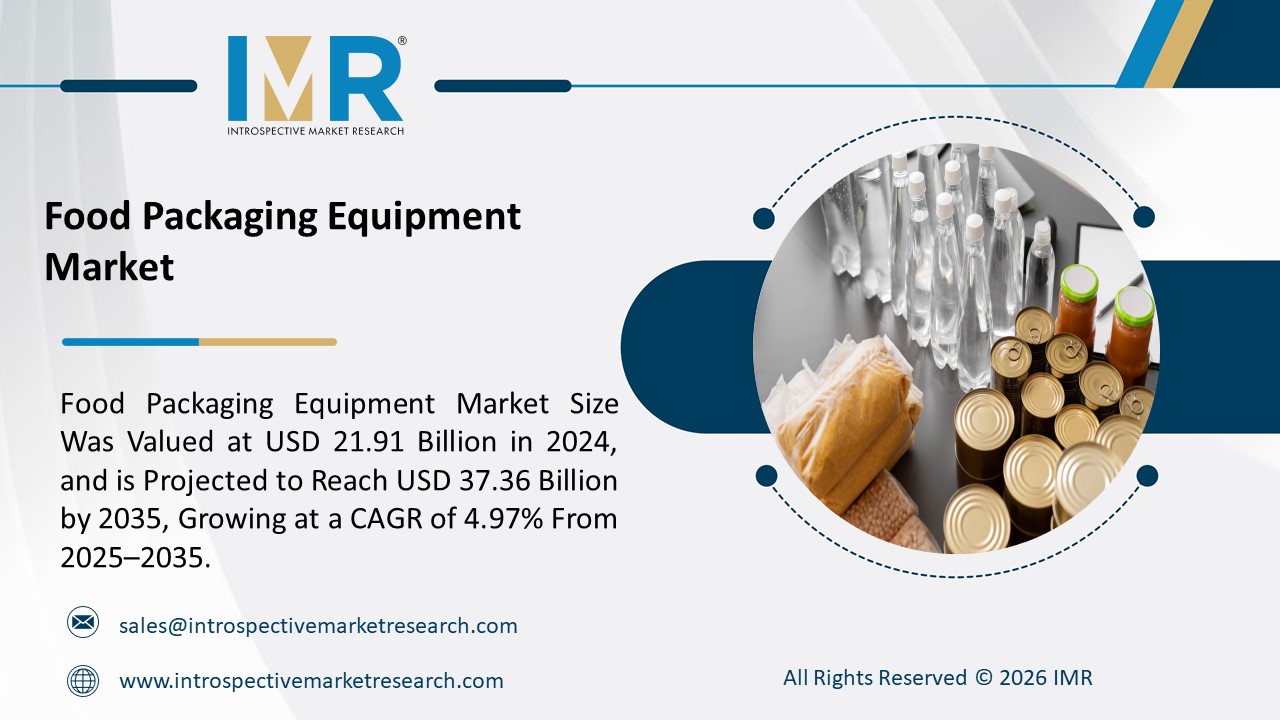
According to a new report published by Introspective Market Research, titled, “Food Packaging Equipment Market by Machine Type, Automation, and Application,” The Global Food Packaging Equipment Market Size Was Valued at USD 21.91 Billion in 2024 and is Projected to Reach USD 37.36 Billion by 2035, Growing at a CAGR of 4.97% From 2025–2035.
The Food Packaging Equipment market encompasses a wide range of machinery and automated systems designed to package, seal, label, and handle food products efficiently and safely. This includes fillers, form-fill-seal machines, labelers, cappers, palletizers, and integrated packaging lines. Modern equipment offers significant advantages over traditional manual or semi-automated methods, providing unparalleled speed, precision, and consistency. These systems minimize human contact with food, enhance hygiene, reduce product waste, and optimize labor costs. The primary use of this equipment is to ensure food safety, extend shelf life, and maintain product quality throughout the supply chain. Key industries driving demand include baked goods, dairy products, beverages, meat and poultry, snacks, and ready-to-eat meals. As consumer demand for convenience, product variety, and sustainable packaging grows, food manufacturers increasingly rely on sophisticated packaging machinery to adapt quickly, meet stringent regulatory standards, and maintain competitiveness in a fast-paced market.
The primary growth driver for the food packaging equipment market is the escalating consumer demand for convenience foods, coupled with stringent global food safety regulations. The rise of on-the-go consumption, single-serve portions, and e-commerce grocery has forced manufacturers to invest in high-speed, flexible packaging lines capable of handling diverse formats and materials. Simultaneously, regulations like the FDA's FSMA mandate stringent hygiene and traceability standards, which automated, enclosed packaging systems are best positioned to meet, reducing contamination risks and ensuring compliance across complex global supply chains.
A significant market opportunity lies in the integration of Industry 4.0 technologies, such as IoT sensors, AI, and machine vision, into packaging lines. Smart equipment that enables predictive maintenance, real-time quality monitoring, and data-driven optimization presents a major growth avenue. This digital transformation allows manufacturers to minimize unplanned downtime, reduce material waste through precise control, and achieve full production traceability. Investing in smart, connected packaging lines offers a compelling ROI by boosting Overall Equipment Effectiveness (OEE) and facilitating agile, data-informed manufacturing decisions.
Food Packaging Equipment Market, Segmentation
The Food Packaging Equipment Market is segmented on the basis of Machine Type, Automation, and Application.
Machine Type
The Machine Type segment is further classified into Filling, Labeling, Form-Fill-Seal, Wrapping & Bundling, and Palletizing. Among these, the Filling equipment sub-segment accounted for the highest market share in 2024. This dominance is attributed to filling being a fundamental and versatile step in almost every food packaging process, applicable to liquids, powders, granules, and solids. Continuous innovation in volumetric, auger, and net-weight filling technologies ensures accuracy, minimizes product giveaway, and meets high-speed production demands across applications from beverages to sauces and snacks, making it an essential and consistently high-investment category for manufacturers.
Automation
The Automation segment is further classified into Fully Automatic and Semi-Automatic. Among these, the Fully Automatic sub-segment accounted for the highest market share in 2024. The shift towards fully automatic systems is driven by the critical need for higher throughput, reduced labor dependency, and enhanced hygiene in large-scale food production. These integrated lines offer superior speed, precision, and consistency while significantly lowering operational costs and human error over the long term. Their adoption is essential for manufacturers aiming to scale production, ensure uniform quality, and meet the volumes required by modern retail and distribution channels.
Some of The Leading/Active Market Players Are-
• Tetra Pak International SA (Switzerland)
• GEA Group Aktiengesellschaft (Germany)
• Krones AG (Germany)
• Coesia S.p.A. (Italy)
• JBT Corporation (US)
• Barry-Wehmiller Group, Inc. (US)
• Syntegon Technology GmbH (Germany)
• The ADM Group (UK)
• Ishida Co., Ltd. (Japan)
• ProMach, Inc. (US)
• MULTIVAC Group (Germany)
• Sacmi Imola S.C. (Italy)
• and other active players.
Key Industry Developments
In March 2024, Tetra Pak launched a new generation of low-carbon packaging lines featuring connected digital services. This system integrates carbon footprint tracking directly into the production data, allowing dairy and juice producers to monitor and report the environmental impact of their packaging operations in real-time, aligning with corporate sustainability goals.
In January 2024, Syntegon Technology announced a strategic partnership with a major AI software firm to enhance its inspection systems. The collaboration focuses on integrating advanced machine vision and AI to improve detection of micro-contaminants and packaging defects in products like snacks and pharmaceuticals, aiming to set new benchmarks for production line quality assurance and safety.
Key Findings of the Study
Filling equipment and Fully Automatic systems were the dominant segments by share.
The Asia-Pacific region led the market, driven by rapid expansion of food processing capacities.
Rising demand for convenience foods and strict safety mandates are key growth drivers.
Market trends are focused on smart, connected equipment and sustainable packaging solutions.