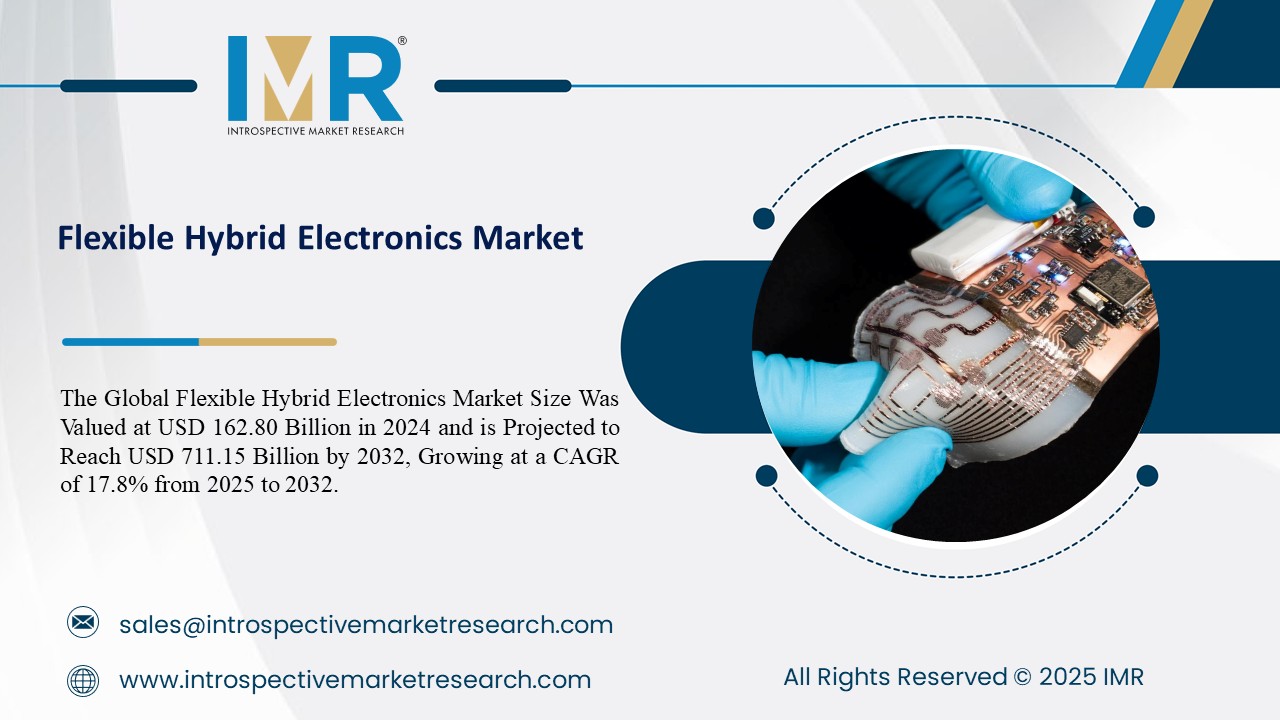
According to a new report published by Introspective Market Research, titled, Flexible Hybrid Electronics Market by Component, Application, and End-Use Industry, The Global Flexible Hybrid Electronics Market Size Was Valued at USD 162.80 Billion in 2024 and is Projected to Reach USD 711.15 Billion by 2032, Growing at a CAGR of 17.8% from 2025 to 2032. The Global Flexible Hybrid Electronics (FHE) Market is experiencing exponential growth as industries increasingly demand lightweight, cost-effective, and high-performance electronic solutions. FHE combines the advantages of flexible substrates with advanced semiconductor devices, resulting in products that are thinner, lighter, and more adaptable compared to traditional rigid electronics.
Flexible Hybrid Electronics are widely applied in healthcare wearables, smart packaging, automotive sensors, aerospace components, and consumer electronics. Their ability to bend, stretch, and conform to unique surfaces while maintaining robust performance makes them a transformative innovation in next-generation electronic devices.
The technology bridges the gap between printed electronics and conventional integrated circuits, enabling cost savings, design flexibility, and wider functionality. As industries continue to move toward IoT-driven, miniaturized, and energy-efficient solutions, FHE is set to play a crucial role in shaping the future of electronics manufacturing.
The Flexible Hybrid Electronics Market is segmented into Component, Application, and End-Use Industry. By Component, the market is categorized into (Sensors, Memory Devices, Display, Power Sources, and Others). By Application, the market is categorized into (Wearables, Smart Packaging, IoT Devices, Medical Devices, and Others). By End-Use Industry, the market is categorized into (Healthcare, Consumer Electronics, Automotive, Aerospace & Defence, and Others).
A major driver of the Flexible Hybrid Electronics Market is the rising adoption of wearables and smart medical devices. With consumers increasingly prioritizing health monitoring and real-time data tracking, demand for lightweight, flexible, and highly functional electronics has surged. FHE-based devices deliver accuracy, comfort, and integration with digital healthcare systems. The push toward remote healthcare, aging populations, and personalized medicine is accelerating investments in FHE, making it a key technology in modern healthcare solutions.
An important opportunity lies in the growing adoption of smart packaging across industries. Brands are leveraging FHE-enabled packaging to integrate features such as product authentication, freshness indicators, and interactive consumer engagement. These smart solutions provide companies with enhanced supply chain visibility while offering consumers innovative value-added experiences. With the global push toward sustainability and connected commerce, FHE-powered packaging opens new avenues for differentiation, customer loyalty, and regulatory compliance.
Flexible Hybrid Electronics Market, Segmentation
The Flexible Hybrid Electronics Market is segmented on the basis of Component, Application, and End-Use Industry.
Component
The Component segment is further classified into Sensors, Memory Devices, Display, Power Sources, and Others. Among these, the Sensors sub-segment accounted for the highest market share in 2024. Sensors are widely used in medical devices, wearables, and IoT solutions due to their ability to collect and transmit real-time data efficiently. Their flexibility and miniaturized design make them indispensable in healthcare and consumer electronics, driving widespread adoption.
Application
The Application segment is further classified into Wearables, Smart Packaging, IoT Devices, Medical Devices, and Others. Among these, the Wearables sub-segment accounted for the highest market share in 2024. Wearables, including fitness trackers, smartwatches, and health monitors, rely heavily on FHE for lightweight construction and adaptability. Increasing consumer interest in health monitoring, coupled with seamless integration into daily life, has positioned wearables as a dominant FHE application.
Some of The Leading/Active Market Players Are-
-
E Ink Holdings (Taiwan)
- PARC, A Xerox Company (USA)
- American Semiconductor (USA)
- Brewer Science, Inc. (USA)
- Tacto-Tek Oy (Finland)
- Next-Flex (USA)
- Flex-Enable (UK)
- PragmatIC Semiconductor (UK)
- MC10, Inc. (USA)
- Enfucell Oy (Finland)
- DuPont de Nemours, Inc. (USA)
…and other active players.
Key Industry Developments
-
In March 2025, Next Flex announced the expansion of its Flexible Hybrid Electronics pilot production facility in California to accelerate commercialization of medical and automotive FHE applications.
The expansion includes advanced prototyping capabilities, industry collaborations, and workforce training programs. This development aims to bridge the gap between R&D and mass production, helping FHE achieve scalability in healthcare wearables, automotive safety systems, and aerospace applications. - In January 2025, DuPont introduced a new line of conductive inks optimized for Flexible Hybrid Electronics.
The innovation enhances conductivity, flexibility, and environmental resistance, making it suitable for large-scale FHE manufacturing in sectors such as smart packaging and IoT devices. DuPont’s launch highlights increasing industry emphasis on material science to drive adoption of FHE in consumer and industrial markets.
Key Findings of the Study
-
Sensors dominate the component segment due to widespread use in IoT and healthcare.
- Wearables lead the application segment, fueled by consumer adoption of smart health devices.
- North America and Asia-Pacific are the leading regions for FHE adoption.
- Key growth is driven by innovations in healthcare and smart packaging.
- Sustainability and miniaturization trends are shaping market opportunities.