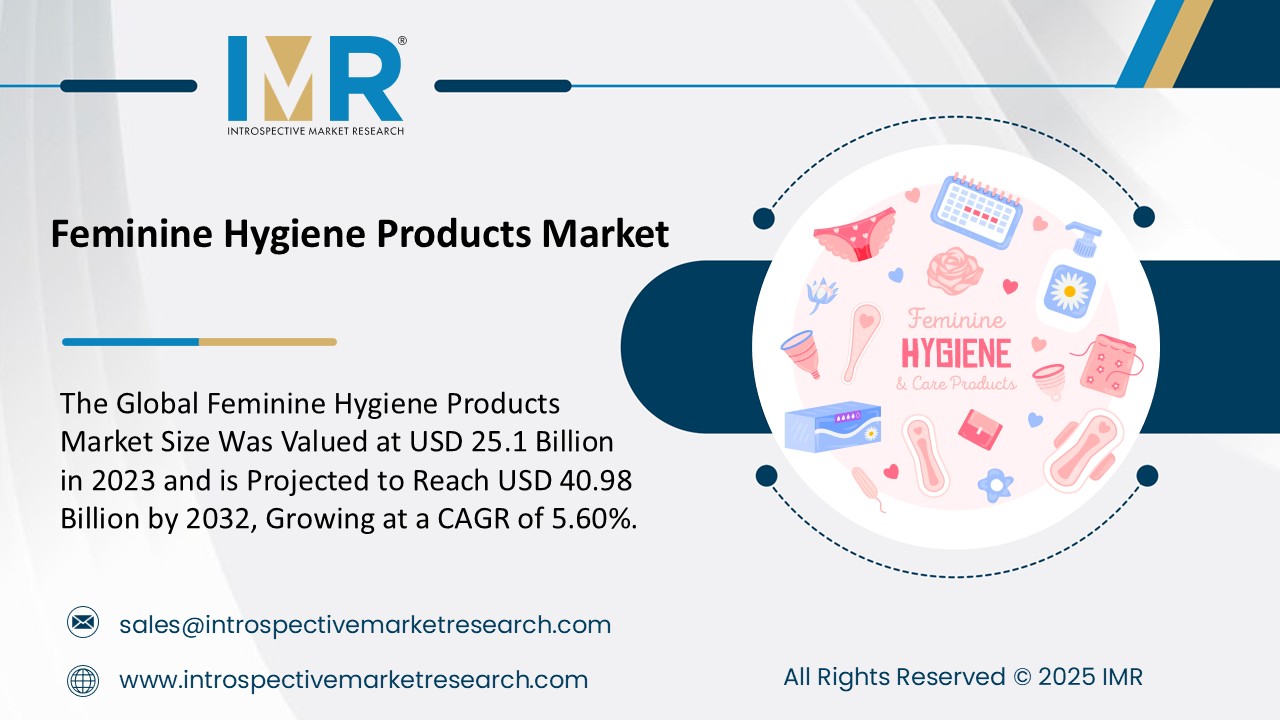
According to a new report published by Introspective Market Research, titled, Feminine Hygiene Products Market by Product Type, Distribution Channel, and Region, The Global Feminine Hygiene Products Market Size Was Valued at USD 25.1 Billion in 2023 and is Projected to Reach USD 40.98 Billion by 2032, Growing at a CAGR of 5.60%. The Feminine Hygiene Products Market is a crucial segment of the global personal care industry, encompassing a diverse range of products designed for menstrual care, sanitation, and everyday cleanliness. Products such as sanitary napkins, tampons, pantyliners, menstrual cups, and feminine hygiene washes have become indispensable in promoting women's health, dignity, and participation in daily activities. Modern market trends emphasize comfort, safety, eco-friendliness, and convenience—giving rise to sustainable options like biodegradable pads and reusable menstrual cups alongside traditional disposable products.
Rising awareness around menstrual health, coupled with government initiatives and robust NGO campaigns, has significantly improved education, access, and acceptance of feminine hygiene products, especially in developing regions. The market serves major industries, including retail, e-commerce, healthcare, and education, facilitating better hygiene and well-being for women and girls worldwide.
The Feminine Hygiene Products Market is segmented into Product Type, Distribution Channel, and Region.
By Product Type, the market is categorized into Sanitary Napkins/Pads, Tampons, Pantyliners, Menstrual Cups, and Others.
By Distribution Channel, the market is categorized into Supermarkets/Hypermarkets, Pharmacies, Online Retail, and Others.
By Region, the market is segmented into Asia Pacific, North America, Europe, and Rest of the World.
A prominent growth driver for the Feminine Hygiene Products Market is the rising awareness and education surrounding menstrual hygiene, fueled by international campaigns and supportive government initiatives. These efforts have destigmatized menstruation, promoted healthier habits, and expanded access to sanitary products. Such drivers are particularly impactful in underserved and rural communities, where increased availability of affordable products is transforming hygiene standards.
A significant market opportunity is the increasing demand for sustainable and reusable feminine hygiene products. Manufacturers investing in organic raw materials, biodegradable packaging, and eco-friendly innovations are gaining traction among environmentally conscious consumers. Furthermore, the elimination of taxes on feminine products and growing online retail channels are broadening market reach and accelerating adoption in emerging economies.
Feminine Hygiene Products Market, Segmentation
The Feminine Hygiene Products Market is segmented on the basis of Product Type, Distribution Channel, and Region.
Product Type
The Product Type segment is further classified into Sanitary Napkins/Pads, Tampons, Pantyliners, Menstrual Cups, and Others. Among these, the Sanitary Napkins/Pads sub-segment accounted for the highest market share in 2025. Sanitary pads’ dominance is attributed to their widespread availability, ease of use, affordability, and the extensive education and outreach from public and private sectors. Innovations such as ultra-thin, organic, and biodegradable pads have resonated with modern consumers and fueled segment expansion.
Distribution Channel
The Distribution Channel segment is further classified into Supermarkets/Hypermarkets, Pharmacies, Online Retail, and Others. Among these, Supermarkets/Hypermarkets held the largest market share in 2025. The accessibility, broad product variety, and discount incentives offered by these channels have made them the favored destination for consumers purchasing feminine hygiene products, particularly in developed regions.
Some of The Leading/Active Market Players Are
- Procter & Gamble (USA)
- Kimberly-Clark Corporation (USA)
- Johnson & Johnson (USA)
- Unicharm Corporation (Japan)
- Edgewell Personal Care Company (USA)
- Ontex Group NV (Belgium)
- Essity AB (Sweden)
- Kao Corporation (Japan)
- Hengan International (China)
- Lil-Lets Group (UK)
- Nobel Hygiene (India)
- SCA (Sweden)
- Quanzhou Hengxin Group (China)
- Daio Paper Corporation (Japan)
- Sofy (Japan)
- Other active players.
Key Industry Developments
In March 2025, Procter & Gamble expanded its ‘Always Keeping Girls in School’ program globally, aiming to provide millions of girls in underserved regions with free sanitary products and menstrual health education. This initiative is expected to boost awareness, increase product uptake, and support ongoing efforts to end period poverty worldwide.
In July 2025, Essity AB introduced a new range of biodegradable sanitary napkins targeting eco-conscious consumers in Europe. The innovation features plant-based materials and recyclable packaging, aligning with rising consumer demand for sustainable hygiene solutions and strengthening Essity’s market presence.
Key Findings of the Study
- Sanitary napkins/pads and supermarkets/hypermarkets segments dominate the market.
- Asia Pacific leads with over 50% regional share, driven by population growth and awareness programs.
- Major growth drivers are awareness campaigns and innovation in eco-friendly products.
- Sustainability, affordability, and digital retail are key market trends.
- Leading players actively invest in outreach and product innovation.