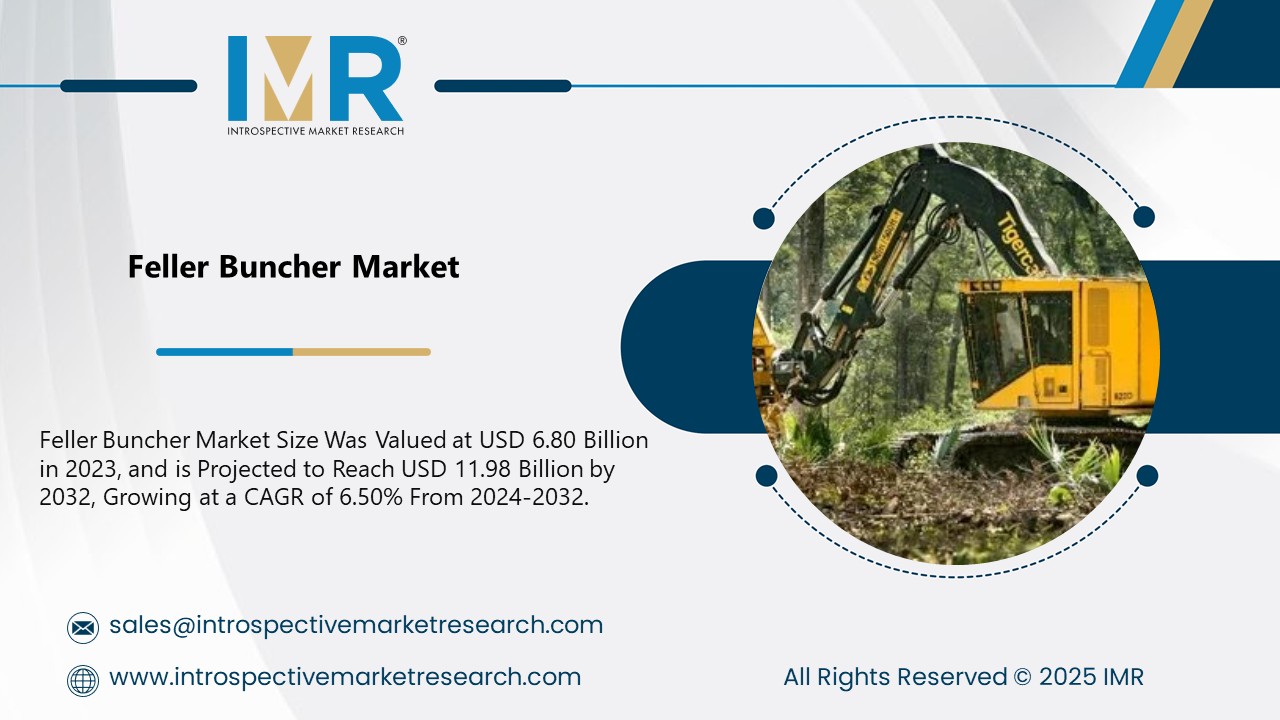
According to a new report published by Introspective Market Research, titled, Feller Buncher Market by Type, Wheel Type, and Application, The Global Feller Buncher Market Size Was Valued at USD 6.80 Billion in 2023 and is Projected to Reach USD 11.98 Billion by 2032, Growing at a CAGR of 6.50%. The Feller Buncher Market encompasses heavy machinery designed for efficiently cutting down (felling) trees and gathering them into bunches, a crucial first step in mechanized logging operations. These powerful machines significantly improve productivity and safety in forestry by replacing manual felling with high-speed, precise mechanical processes, minimizing human risk and labor intensity in challenging forest environments.
Feller bunchers offer distinct advantages over traditional manual felling by increasing output, reducing operational costs, and improving safety standards in logging. Their ability to handle various tree sizes and terrains, combined with advanced features like GPS and telematics, makes them indispensable for modern, sustainable forestry practices. These machines are predominantly utilized in large-scale commercial logging, pulpwood harvesting, biomass production, and forest management across diverse geographical regions.
One key growth driver for the Feller Buncher Market is the increasing global demand for wood and wood-based products. This demand is fueled by population growth, urbanization, and the expanding construction sector, alongside the rising use of wood for pulp, paper, and bioenergy. As resource consumption intensifies, forestry operations are under pressure to increase efficiency and output. Feller bunchers provide the mechanized solution needed to meet these demands by rapidly and safely harvesting timber, making them critical assets in the modern forestry supply chain and directly propelling market expansion.
A significant market opportunity within the Feller Buncher Market lies in the development and adoption of electric or hybrid feller bunchers. With growing environmental concerns and stricter emission regulations globally, there is an increasing demand for sustainable and eco-friendly forestry equipment. Electric or hybrid models offer reduced fuel consumption, lower operational noise, and significantly decreased carbon emissions compared to traditional diesel-powered machines. This not only aligns with corporate sustainability goals but also provides cost savings on fuel and maintenance, presenting a compelling value proposition for forestry companies looking to modernize their fleets and minimize their environmental footprint in an increasingly green-conscious industry.
Feller Buncher Market, Segmentation
The Feller Buncher Market is segmented on the basis of Type, Wheel Type, and Application.
Type
- The Type segment is further classified into Tracked Feller Bunchers and Wheeled Feller Bunchers. Among these, the Tracked Feller Bunchers sub-segment accounted for the highest market share in 2023. Tracked feller bunchers dominate the market due to their superior stability, traction, and ability to operate effectively in challenging terrains, including steep slopes, wet conditions, and uneven ground. Their greater flotation reduces ground disturbance, making them suitable for environmentally sensitive areas. While slower than wheeled counterparts, their robustness and versatility in demanding forestry applications, particularly in clear-cutting and dense forest environments, solidify their leading position.
Wheel Type
- The Wheel Type segment is further classified into 3-Wheel, 4-Wheel, and 6-Wheel. Among these, the 6-Wheel sub-segment accounted for the highest market share in 2023. 6-wheel feller bunchers are favored for their excellent balance of stability, traction, and maneuverability, particularly in varied forest conditions. The additional set of wheels provides enhanced grip and distributes the machine's weight more evenly, reducing ground pressure and improving performance on soft or undulating terrain. This configuration offers greater stability for felling large trees and better weight distribution when bunching, making it a highly versatile and efficient choice for many logging operations.
Some of The Leading/Active Market Players Are-
- John Deere (USA)
- Caterpillar Inc. (USA)
- Komatsu Forest AB (Sweden)
- Tigercat International Inc. (Canada)
- Ponsse Plc (Finland)
- Fabtek (USA)
- Barker Manufacturing (USA)
- Weiler Forestry, Inc. (USA)
- Risley Equipment Inc. (Canada)
- Pro Pac Industries Ltd. (Canada)
- Waratah Forestry Equipment (a John Deere company) (New Zealand)
- SP Maskiner (Sweden)
- Valmet (Finland)
- Sennebogen Maschinenfabrik GmbH (Germany)
- Peterson Pacific Corp. (USA)
- and other active players.
Key Industry Developments
- In April 2023, John Deere introduced its new G-Series Feller Bunchers, featuring enhanced engine performance and improved operator comfort. These models incorporate advanced hydraulics and telematics for better fuel efficiency and predictive maintenance.This launch aims to provide forestry professionals with more powerful and productive machines, reducing operational costs and maximizing uptime. John Deere's focus on integrating smart technology reflects the growing trend towards efficiency and data-driven management in the logging industry.
- In January 2024, Tigercat International Inc. unveiled a prototype electric feller buncher at a major forestry trade show. This innovative machine promises zero emissions and significantly reduced noise levels, representing a step towards more sustainable logging practices.Tigercat's development of an electric model addresses the increasing environmental regulations and industry demand for greener equipment. This move positions the company at the forefront of sustainable forestry solutions, aiming to offer operators an eco-friendly alternative without compromising power or productivity.
Key Findings of the Study
- Tracked feller bunchers and 6-wheel configurations hold dominant market shares.
- North America and Europe are leading regions due to advanced forestry practices.
- Growing global demand for wood products is the primary market driver.
- Key trends include increased automation, telematics integration, and sustainable equipment.
- Significant opportunities exist in the development and adoption of electric/hybrid models.