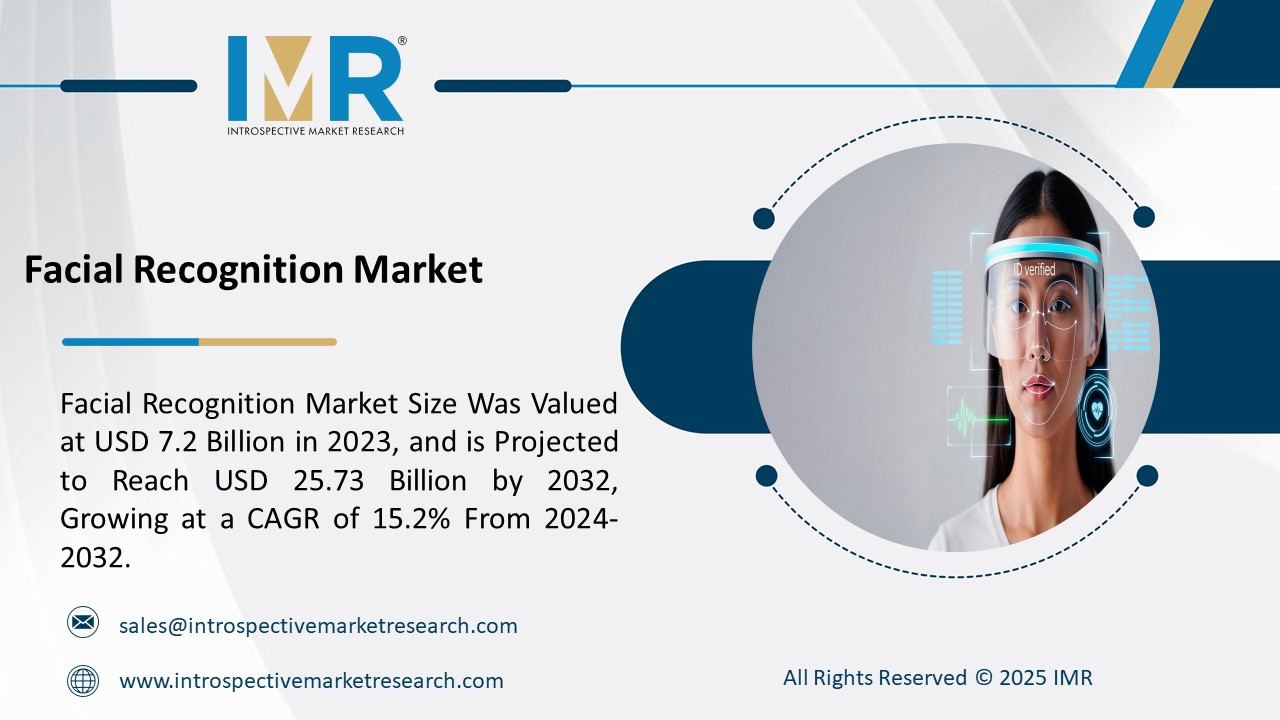
According to a new report published by Introspective Market Research, titled, Facial Recognition Market by Component, Application, and End-Use Industry, The Global Facial Recognition Market Size Was Valued at USD 7.2 Billion in 2023 and is Projected to Reach USD 25.73 Billion by 2032, Growing at a CAGR of 15.2%. The global facial recognition market is gaining remarkable momentum, driven by increasing adoption of advanced security solutions across government, commercial, and consumer applications. Facial recognition technology leverages artificial intelligence (AI) and machine learning to identify individuals by analyzing facial features, providing a secure, contactless, and efficient solution for identity verification.
Compared to traditional authentication methods such as passwords and ID cards, facial recognition offers faster processing, higher accuracy, and reduced risk of identity theft. This technology is now widely deployed in airports, banking systems, healthcare, retail, and law enforcement. With governments and enterprises investing heavily in biometric security, the market is poised to expand rapidly, particularly with innovations in 3D sensing, cloud-based recognition, and mobile-based applications.
One of the key growth drivers of the facial recognition market is the increasing demand for advanced security and surveillance systems. Governments worldwide are implementing large-scale surveillance projects to ensure public safety and counter terrorism threats. Airports, transportation hubs, and smart cities are adopting facial recognition to monitor crowd movement, identify suspects, and strengthen security frameworks. Additionally, enterprises are deploying these systems for workplace access control and fraud prevention. The accuracy, scalability, and real-time detection capabilities of modern facial recognition solutions position them as a cornerstone of next-generation security systems.
A significant opportunity lies in the integration of facial recognition with consumer electronics and digital payments. With the proliferation of smartphones and IoT devices, facial recognition is being increasingly integrated into mobile applications, unlocking seamless identity verification for digital banking, e-commerce, and contactless payments. This trend is particularly strong in Asia-Pacific, where consumers demand faster and more secure authentication methods. Moreover, the combination of AI-driven facial recognition with augmented reality (AR) and virtual reality (VR) platforms presents new opportunities for personalized retail and entertainment experiences, expanding beyond traditional security use cases.
Facial Recognition Market, Segmentation
The Facial Recognition Market is segmented on the basis of Component, Application, and End-Use Industry.
Component
-
The Component segment is further classified into Software, Hardware, and Services. Among these, the Software sub-segment accounted for the highest market share in 2023.
- Software solutions dominate due to rapid advancements in AI and machine learning algorithms that improve recognition accuracy, even in challenging conditions such as poor lighting or altered appearances. Cloud-based software platforms enable scalability, remote access, and integration with mobile applications, making them the preferred choice for both enterprises and governments. The growing demand for real-time analytics and intelligent surveillance is further propelling the adoption of facial recognition software.
Application
- The Application segment is further classified into Security & Surveillance, Access Control, Identity Verification, and Others. Among these, the Security & Surveillance sub-segment accounted for the highest market share in 2023.
- The dominance of this segment is attributed to widespread adoption by law enforcement, border control, and public safety agencies. Facial recognition systems enable real-time monitoring, faster suspect identification, and proactive crime prevention, enhancing security in high-risk areas. With the rising number of smart city projects worldwide, the demand for surveillance-driven facial recognition systems is expected to escalate, reinforcing this application’s leading position.
Some of The Leading/Active Market Players Are-
-
NEC Corporation (Japan)
- Aware, Inc. (USA)
- IDEMIA (France)
- Cognitec Systems GmbH (Germany)
- FaceFirst, Inc. (USA)
- Herta Security (Spain)
- Thales Group (France)
- Daon, Inc. (USA)
- Onfido (UK)
- AnyVision Interactive Technologies Ltd. (Israel)
- Gemalto NV (Netherlands)
- iProov Ltd. (UK)
- TrueFace AI (USA)
- Techno Brain (Kenya)
- Innovatrics (Slovakia)
Key Industry Developments
-
In January 2024, NEC Corporation partnered with a major Asian government to deploy AI-powered facial recognition in national airports. The project aims to streamline passenger verification, reduce boarding time, and enhance overall airport security, positioning NEC as a leader in biometric travel solutions.
- In April 2024, IDEMIA launched its next-generation cloud-based facial recognition platform designed for financial institutions. The solution enhances fraud detection and provides seamless identity verification for digital banking, enabling secure and efficient customer onboarding and authentication processes.
Key Findings of the Study
-
Software dominated the component segment in 2023.
- Security & Surveillance remained the largest application segment.
- North America led adoption, followed by Asia-Pacific with rapid growth.
- Government security initiatives and digital banking drove demand.
- AI-powered innovations are shaping the future of the market.