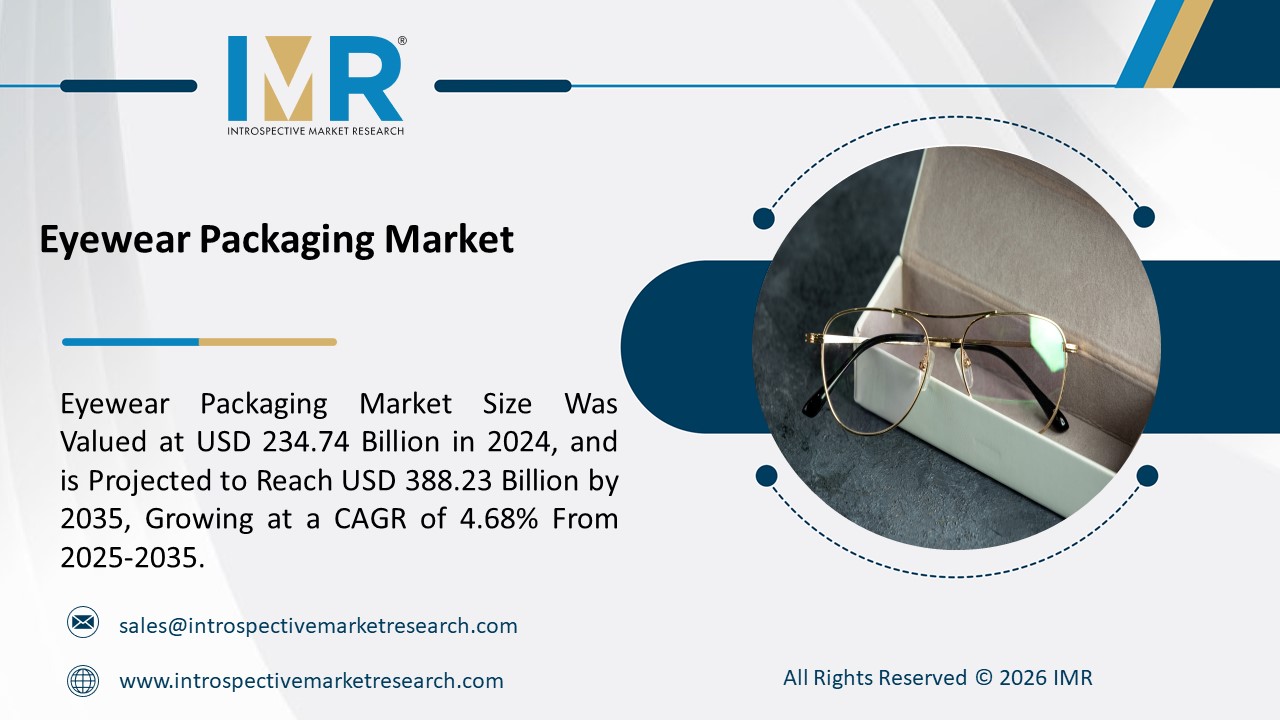
According to a new report published by Introspective Market Research, titled, “Eyewear Packaging Market by Product Type, Material, and Distribution Channel,” The Global Eyewear Packaging Market Size Was Valued at USD 234.74 Billion in 2024 and is Projected to Reach USD 388.23 Billion by 2035, Growing at a CAGR of 4.68% From 2025–2035.
The Eyewear Packaging market comprises the specialized cases, boxes, pouches, and display solutions designed to protect, present, and store prescription glasses, sunglasses, and contact lenses. Modern eyewear packaging goes far beyond basic functionality, serving as a critical brand touchpoint and a key component of the luxury unboxing experience. It offers significant advantages over generic packaging through the use of premium materials like molded foams, soft micro-suede linings, and sophisticated hinges that provide superior protection against scratches, impacts, and environmental damage. The primary uses of this packaging are to ensure product integrity throughout the supply chain, enhance in-store merchandising, and deliver a memorable customer experience that reinforces brand value and encourages reuse. Major industries driving demand include luxury fashion houses, optical retail chains, independent optometrists, and online eyewear retailers. As eyewear has evolved from a medical device to a core fashion accessory, the packaging has become instrumental in communicating quality, style, and brand identity at the crucial moment of purchase.
The principal growth driver for the eyewear packaging market is the powerful convergence of eyewear as a high-frequency fashion accessory and the explosive growth of Direct-to-Consumer (D2C) and online eyewear sales. Consumers now own multiple pairs of glasses and sunglasses for different occasions, treating them as essential style items. This drives repeat purchases and demand for distinctive, brand-specific packaging. Simultaneously, the rise of online try-on and purchase models makes packaging the first physical interaction a customer has with a brand, elevating its role from mere protection to a vital tool for building brand loyalty, justifying premium pricing, and reducing return rates through a flawless unboxing experience.
A significant market opportunity lies in the development of sustainable and smart packaging solutions. Driven by stringent environmental regulations and growing consumer eco-consciousness, there is surging demand for packaging made from recycled, biodegradable, or plant-based materials like mushroom foam, recycled PET, and FSC-certified paper. Furthermore, integrating smart elements such as NFC tags or QR codes on packaging allows brands to offer virtual try-ons, verify authenticity, access styling tips, or join loyalty programs, transforming the package into an interactive brand portal. Companies leading in these eco-innovative and connected packaging designs can capture a premium market segment and build deep, ongoing customer engagement.
Eyewear Packaging Market, Segmentation
The Eyewear Packaging Market is segmented on the basis of Product Type, Material, and Distribution Channel.
Product Type
The Product Type segment is further classified into Cases & Boxes, Pouches & Sleeves, and Display Stands & Trays. Among these, the Cases & Boxes sub-segment accounted for the highest market share in 2024. This dominance is attributed to cases and boxes being the universal, essential packaging solution provided with every pair of eyewear sold, both for prescription glasses and sunglasses. They serve the dual critical function of safe storage for the consumer and elegant presentation for the retailer. The segment is driven by continuous innovation in design, from slim, hard-shell travel cases to luxurious, gift-style boxes for high-end fashion brands, making it a non-discretionary, high-volume category.
Distribution Channel
The Distribution Channel segment is further classified into Online Retail and Offline Retail. Among these, the Offline Retail sub-segment (encompassing optical stores and brand boutiques) accounted for the highest market share in 2024. Physical retail dominance persists because the majority of prescription eyewear sales still require professional fitting and adjustment in-store. In these settings, packaging is a direct part of the sales ceremony and merchandising strategy. High-end boutiques and optical chains invest heavily in custom, co-branded packaging to enhance perceived value, protect their inventory on display, and provide a tangible brand experience that online channels struggle to replicate fully at the same scale.
Some of The Leading/Active Market Players Are-
• Marchon Eyewear, Inc. (USA) [Packaging Division]
• MFG Tray (USA)
• T.H.E.M. (USA)
• Nefab Group (Sweden)
• GPI (USA)
• Paxon (USA)
• ClearVision Optical (USA)
• WestRock Company (USA)
• DS Smith (UK)
• EVA International (USA)
• DIC Corporation (Japan)
• UFP Technologies, Inc. (USA)
• and other active players.
Key Industry Developments
In March 2024, luxury conglomerate LVMH mandated that all its eyewear brands, including Dior and Fendi, transition to 100% recycled and FSC-certified paper packaging by 2026. This landmark corporate policy is driving massive investment and innovation in sustainable material sourcing and design within the luxury packaging supply chain, setting a new industry standard.
In January 2024, a leading online eyewear retailer partnered with a packaging tech firm to launch "Smart Cases" with embedded low-energy Bluetooth. The case pairs with a mobile app to remind users where they last placed their glasses, track case opening/closing to monitor wear habits, and even offer discounts on lens cleaning products, adding functionality and fostering brand interaction post-purchase.
Key Findings of the Study
• Cases & Boxes and the Offline Retail channel held the dominant market shares.
• The Asia-Pacific region was the largest and fastest-growing market, fueled by massive optical manufacturing and retail expansion.
• The dual drivers of eyewear fashionization and D2C/online sales growth are propelling the market.
• Key trends are a strong shift toward sustainable materials and the integration of smart technology into packaging.