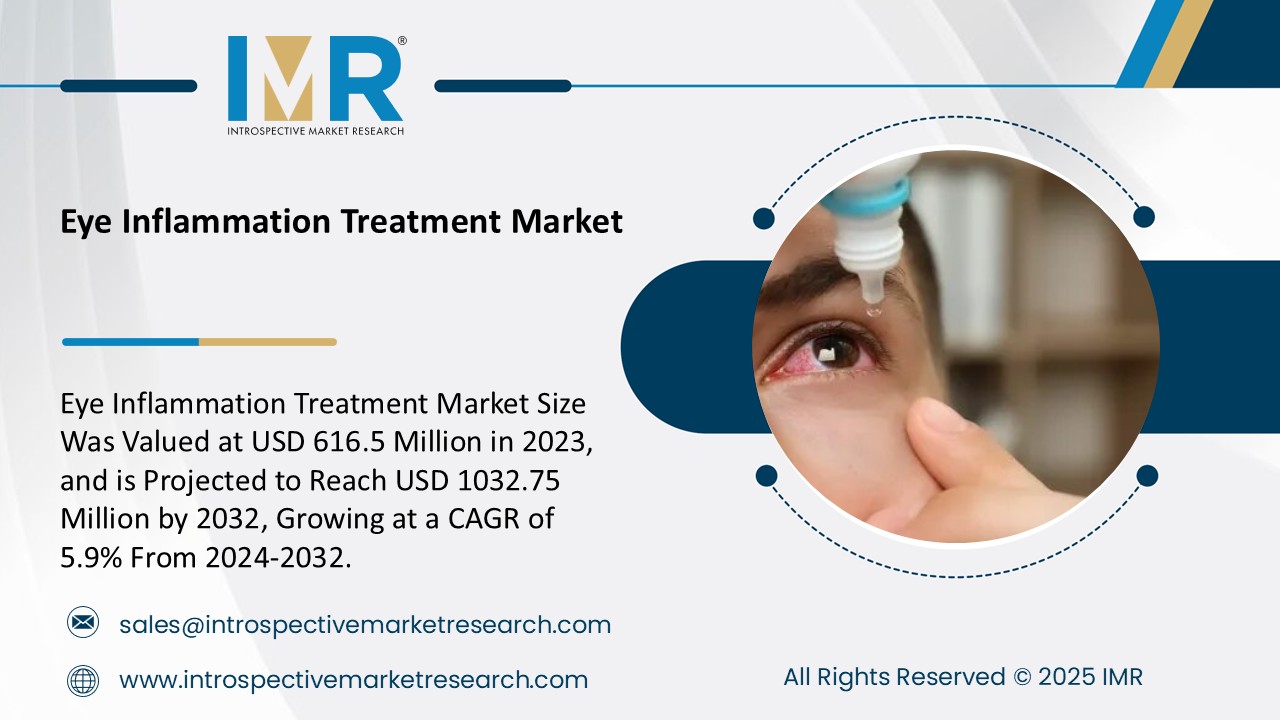
According to a new report published by Introspective Market Research, titled, Eye Inflammation Treatment Market by Drug Class, Disease Type, and Distribution Channel, The Global Eye Inflammation Treatment Market Size Was Valued at USD 616.5 Million in 2023 and is Projected to Reach USD 1,032.75 Million by 2032, Growing at a CAGR of 5.9%. The global eye inflammation treatment market is witnessing steady growth driven by the rising incidence of eye-related disorders, infections, and allergies across various age groups. Eye inflammation, which includes conditions like conjunctivitis, keratitis, and uveitis, is typically caused by infections, autoimmune disorders, or environmental irritants. The increasing exposure to pollutants and digital screens, along with a growing aging population, has significantly contributed to the rising prevalence of inflammatory eye diseases.
Advanced treatment options such as corticosteroids, non-steroidal anti-inflammatory drugs (NSAIDs), immunosuppressants, and biologics are being increasingly adopted for effective symptom control and prevention of long-term vision damage. The demand for topical and injectable medications is growing due to their targeted therapeutic action and minimal systemic side effects. Additionally, advancements in drug delivery technologies and the emergence of biosimilars are enhancing treatment efficacy and expanding market potential across both developed and developing regions.
The Eye Inflammation Treatment Market is segmented into Drug Class, Disease Type, and Distribution Channel. By Drug Class, the market is categorized into (Corticosteroids, NSAIDs, Immunosuppressants, Biologics, Others). By Disease Type, the market is categorized into (Conjunctivitis, Keratitis, Uveitis, Others). By Distribution Channel, the market is categorized into (Hospital Pharmacies, Retail Pharmacies, Online Pharmacies).
A key growth driver for the eye inflammation treatment market is the increasing prevalence of eye disorders due to prolonged screen time and environmental pollution. With the digital revolution accelerating globally, cases of dry eye syndrome and inflammation-related conditions are rising sharply among both adults and children. Concurrently, increased patient awareness and improvements in ophthalmic diagnostics have led to earlier and more accurate detection, allowing for timely treatment intervention. These factors, combined with growing access to healthcare in emerging economies, are propelling market expansion.
One major opportunity within the eye inflammation treatment market lies in the innovation of targeted biologic therapies and sustained-release drug delivery systems. Biologic drugs, which offer precision treatment with fewer side effects, are being explored for chronic inflammatory eye conditions such as uveitis. Moreover, advancements in ocular drug delivery, such as intravitreal implants and nano-formulations, are enabling longer-lasting effects and improved patient compliance. The combination of research initiatives and regulatory support for ophthalmic innovations creates significant opportunities for both established pharmaceutical firms and biotech startups.
Eye Inflammation Treatment Market, Segmentation
The Eye Inflammation Treatment Market is segmented on the basis of Drug Class, Disease Type, and Distribution Channel.
Segment A
he Drug Class segment is further classified into Corticosteroids, NSAIDs, Immunosuppressants, Biologics, and Others. Among these, the Corticosteroids sub-segment accounted for the highest market share in 2023. Corticosteroids are widely prescribed due to their powerful anti-inflammatory effects and rapid relief of symptoms. Available in topical, injectable, and oral forms, corticosteroids are the first line of treatment in both acute and chronic cases of eye inflammation. Their broad efficacy, widespread availability, and low cost contribute to their dominant market position.
Segment B
The Disease Type segment is further classified into Conjunctivitis, Keratitis, Uveitis, and Others. Among these, the Conjunctivitis sub-segment accounted for the highest market share in 2023. Conjunctivitis, commonly known as pink eye, affects millions of people annually due to its infectious nature and ease of transmission. It can be caused by allergens, bacteria, or viruses and is particularly common in densely populated and humid regions. The rising incidence of allergic and viral conjunctivitis, especially in children, drives strong demand for effective and accessible treatment solutions.
Some of The Leading/Active Market Players Are–
- Novartis AG (Switzerland)
- AbbVie Inc. (USA)
- Pfizer Inc. (USA)
- Bausch Health Companies Inc. (Canada)
- Allergan (USA)
- Santen Pharmaceutical Co., Ltd. (Japan)
- Sun Pharmaceutical Industries Ltd. (India)
- Alcon Inc. (Switzerland)
- Johnson & Johnson (USA)
- Akorn Pharmaceuticals (USA)
- Teva Pharmaceutical Industries Ltd. (Israel)
- Aerie Pharmaceuticals Inc. (USA)
- and other active players.
Key Industry Developments
In May 2024, AbbVie received FDA approval for a new biologic therapy targeting uveitis in adult patients.
This approval marks a significant advancement in the treatment of chronic non-infectious uveitis, offering a targeted immunomodulatory option with fewer side effects compared to traditional corticosteroids. The launch is expected to strengthen AbbVie’s position in the specialty ophthalmic drug segment.
In July 2024, Novartis announced the launch of an extended-release corticosteroid eye drop for managing post-surgical eye inflammation.
The product, developed with innovative sustained-release technology, reduces the need for frequent dosing and improves treatment compliance. This launch supports Novartis' ongoing strategy to innovate patient-centric drug delivery methods in ophthalmology.
Key Findings of the Study
- Corticosteroids dominated the drug class segment due to fast symptom relief and accessibility.
- Conjunctivitis led the disease type category with the highest incidence rate globally.
- North America held a major market share due to advanced healthcare systems and product innovation.
- Biologics and drug delivery advancements present lucrative opportunities for market players.