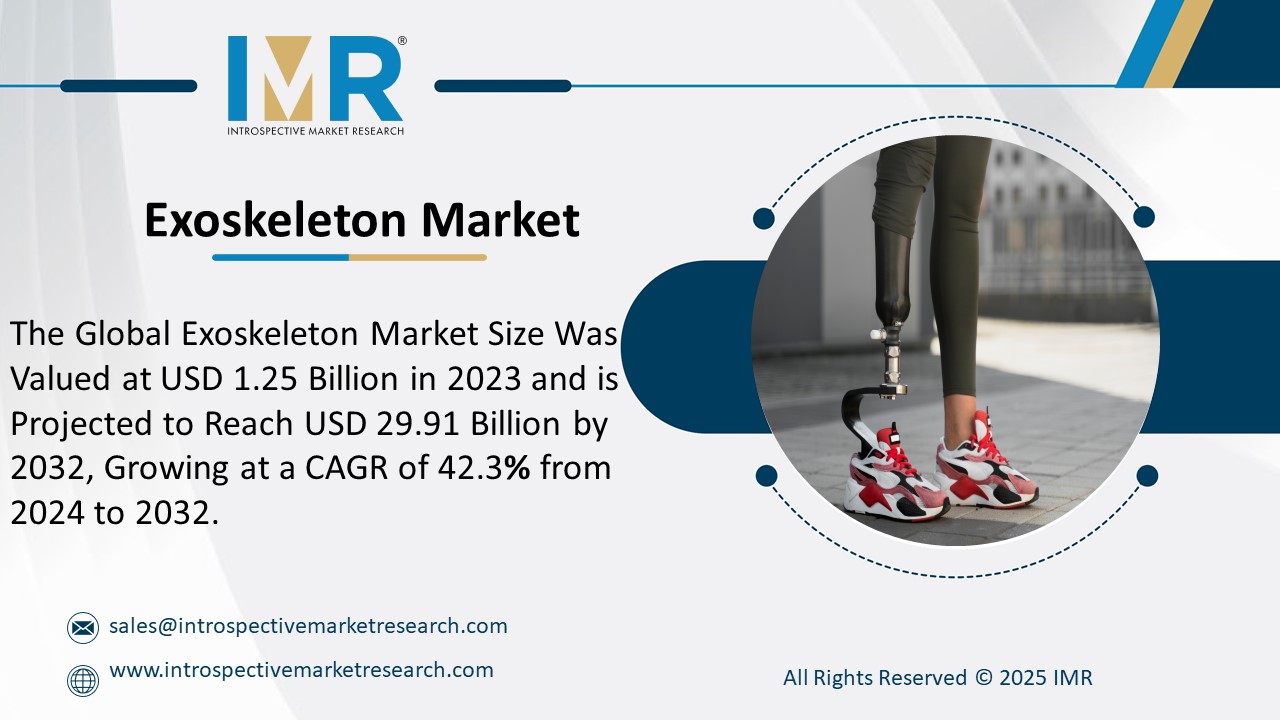
According to a new report published by Introspective Market Research, titled, Exoskeleton Market by Type, Mobility, and Application, the Global Exoskeleton Market Size Was Valued at USD 1.25 Billion in 2023 and is Projected to Reach USD 29.91 Billion by 2032, Growing at a CAGR of 42.3% from 2024 to 2032. The Exoskeleton Market is witnessing exponential growth as wearable robotic technologies become increasingly integrated across healthcare, industrial, and defense sectors. Exoskeletons are mechanical frameworks designed to augment human strength, mobility, and endurance, offering significant benefits in rehabilitation, injury prevention, and physical assistance. These systems help individuals with mobility impairments regain movement and assist industrial workers in performing physically demanding tasks efficiently and safely.
Technological advancements in materials science, sensors, and AI-driven control systems have led to lightweight, energy-efficient, and user-friendly exoskeleton designs. The shift from rigid mechanical structures to soft robotics and flexible designs has expanded usability across various end-user segments. Moreover, the increasing incidence of spinal cord injuries, neurological disorders, and the aging global population are driving demand for rehabilitation and assistive exoskeletons.
With rising adoption in defense and manufacturing for load-bearing and performance enhancement applications, the market continues to evolve rapidly. Government initiatives supporting rehabilitation technology, alongside growing private investments in wearable robotics startups, are creating a strong growth ecosystem for the global exoskeleton industry.
The Exoskeleton Market is segmented into Type, Mobility, and Application. By Type, the market is categorized into Powered Exoskeletons and Passive Exoskeletons. By Mobility, it is segmented into Stationary and Mobile. By Application, it is categorized into Healthcare, Industrial, Defense, and Others.
A primary growth driver for the Exoskeleton Market is the rising demand for rehabilitation devices and mobility assistance solutions. With an increasing number of individuals affected by spinal cord injuries, stroke, and age-related mobility issues, exoskeletons are becoming a vital part of modern physical therapy. These devices enable improved gait training, muscle strength restoration, and faster recovery times compared to traditional rehabilitation methods. Furthermore, advancements in robotics and artificial intelligence have enhanced the precision, comfort, and usability of exoskeletons, making them more accessible for both clinical and personal use worldwide.
A major market opportunity lies in expanding industrial and defense applications of exoskeleton technology. Industries such as manufacturing, construction, and logistics are adopting exoskeletons to enhance worker safety, reduce fatigue, and improve efficiency during repetitive or heavy-lifting tasks. In defense, exoskeletons are being developed to augment soldier strength, endurance, and load-carrying capabilities. As governments and corporations invest in workforce safety and productivity, the commercial potential for industrial exoskeletons is expanding rapidly. Additionally, the integration of IoT and AI in wearable robotics presents new opportunities for smart, data-driven exoskeleton solutions in the coming decade.
Exoskeleton Market, Segmentation
The Exoskeleton Market is segmented on the basis of Type, Mobility, and Application.
Type:
The Type segment is further classified into Powered Exoskeletons and Passive Exoskeletons. Among these, the Powered Exoskeleton segment accounted for the highest market share in 2023. These systems use electric motors, sensors, and actuators to assist movement and enhance strength. They are widely used in medical rehabilitation and industrial applications, offering superior mobility assistance and adaptability for diverse physical conditions.
Application:
The Application segment is categorized into Healthcare, Industrial, Defense, and Others. Among these, the Healthcare segment dominated the market in 2023. Exoskeletons in rehabilitation centers and hospitals aid patients in recovering from neurological injuries, improving walking ability, and promoting muscle re-education. Their proven efficacy in post-stroke recovery and mobility enhancement continues to boost adoption within the medical field globally.
Some of The Leading/Active Market Players Are
- Ekso Bionics Holdings, Inc. (United States)
- ReWalk Robotics Ltd. (Israel)
- CYBERDYNE Inc. (Japan)
- Ottobock SE & Co. KGaA (Germany)
- Parker Hannifin Corporation (United States)
- Lockheed Martin Corporation (United States)
- B-Temia Inc. (Canada)
- SuitX (United States)
- Sarcos Technology and Robotics Corporation (United States)
- Honda Motor Co., Ltd. (Japan)
- Hyundai Motor Company (South Korea)
- Fourier Intelligence (China)
- DIH Medical (Switzerland)
- Other active players.
Key Industry Developments
-
In June 2024, Ekso Bionics launched EksoNR 2.0, an upgraded robotic exoskeleton for neurorehabilitation.
The new model enhances patient mobility, offers cloud-based data analytics for therapists, and integrates adaptive AI, allowing customized therapy sessions and improved recovery outcomes for stroke and spinal injury patients. - In October 2023, Hyundai Motor Company unveiled a wearable industrial exoskeleton (VEX) designed to support assembly line workers.
The lightweight, battery-powered device reduces strain on the upper body and shoulders, improving efficiency and workplace safety in automotive manufacturing facilities.
Key Findings of the Study
- Powered Exoskeletons lead the market in 2023.
- Healthcare remains the dominant application segment.
- North America and Asia-Pacific are key revenue-generating regions.
- Demand driven by rehabilitation, industrial safety, and defense innovation.
- AI-integrated and lightweight exoskeletons represent the next growth frontier.