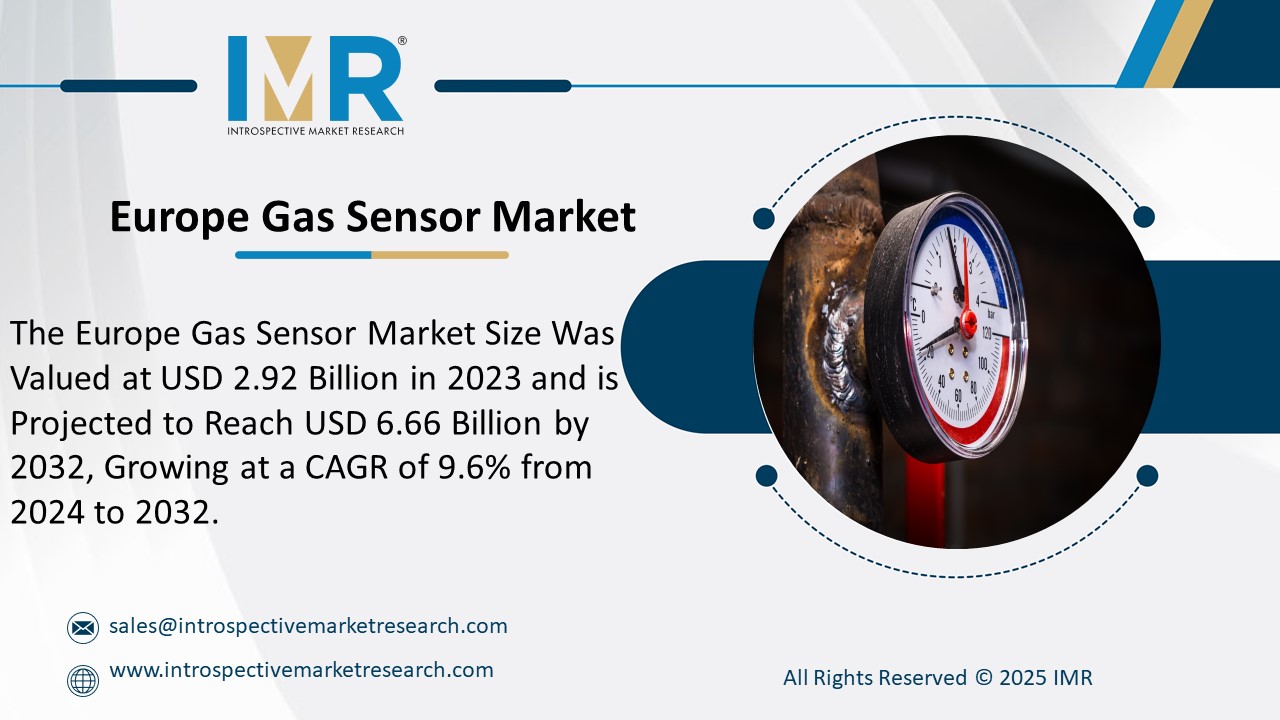
According to a new report published by Introspective Market Research, titled, Europe Gas Sensor Market by Sensor Type, Application, and End-Use Industry, The Global Europe Gas Sensor Market Size Was Valued at USD 2.92 Billion in 2023 and is Projected to Reach USD 6.66 Billion by 2032, Growing at a CAGR of 9.6% from 2024 to 2032. The Europe Gas Sensor Market is witnessing significant growth due to increasing industrialization, environmental monitoring requirements, and stringent safety regulations across various sectors. Gas sensors are devices that detect and measure the presence of gases in the environment, ensuring the safety of workplaces, residential areas, and critical infrastructures. These sensors are widely used in industrial plants, automotive systems, environmental monitoring, and healthcare applications to detect toxic, combustible, and greenhouse gases.
Gas sensors offer advantages over traditional monitoring methods by providing real-time, precise, and automated measurements. Unlike manual detection methods, modern gas sensors can be integrated into IoT-enabled systems for continuous monitoring, early warning, and data logging. This capability enhances operational efficiency, reduces human error, and ensures compliance with environmental and occupational safety regulations.
The growing emphasis on industrial safety, energy efficiency, and emission control, combined with the adoption of smart cities and connected devices, is driving market adoption. Additionally, technological advancements in sensor miniaturization, wireless connectivity, and multi-gas detection are opening new avenues for market expansion in Europe.
The Europe Gas Sensor Market is segmented into Sensor Type, Application, and End-Use Industry. By Sensor Type: (Electrochemical, Semiconductor, Catalytic, Infrared, Optical) By Application: (Air Quality Monitoring, Industrial Safety, Automotive Emission Monitoring, HVAC Systems, Others) By End-Use Industry: (Automotive, Oil & Gas, Chemical & Petrochemical, Healthcare, Environmental Monitoring, Others)
A key growth driver of the Europe Gas Sensor Market is the increasing demand for industrial safety and compliance with stringent environmental regulations. Governments and regulatory bodies in Europe are enforcing strict air quality standards and emission control measures, driving the adoption of gas sensing technologies. Industrial facilities and automotive sectors are implementing advanced sensors to monitor toxic and combustible gases continuously, prevent accidents, and ensure workplace safety. This focus on proactive risk management and regulatory compliance is pushing manufacturers to deploy highly sensitive, multi-gas, and connected sensor systems, significantly contributing to market growth in Europe.
A major market opportunity lies in the integration of IoT and smart sensor technologies for real-time environmental and industrial monitoring. Connected gas sensors enable remote data collection, predictive maintenance, and automated alerts, making them indispensable in smart factories, smart buildings, and smart cities. Additionally, rising awareness about air pollution and the need for energy-efficient operations is creating a growing demand for portable and wireless gas sensors. Companies investing in advanced sensor technologies and IoT-enabled solutions have the opportunity to capture untapped segments in automotive, healthcare, and environmental monitoring sectors, further boosting market expansion in Europe.
Europe Gas Sensor Market, Segmentation
The Europe Gas Sensor Market is segmented on the basis of Sensor Type, Application, and End-Use Industry.
Sensor Type
The Sensor Type segment is further classified into Electrochemical, Semiconductor, Catalytic, Infrared, and Optical. Among these, the Electrochemical sub-segment accounted for the highest market share in 2023. Electrochemical sensors are highly preferred due to their accuracy, low power consumption, and suitability for detecting toxic gases like CO, NO2, and O3. These sensors are widely deployed in industrial safety equipment, automotive emission systems, and environmental monitoring devices. Their reliability, long operational life, and compliance with safety standards make them a dominant choice in Europe.
Application
The Application segment is further classified into Air Quality Monitoring, Industrial Safety, Automotive Emission Monitoring, HVAC Systems, and Others. Among these, the Industrial Safety sub-segment accounted for the highest market share in 2023. Industrial safety applications include monitoring flammable, toxic, and hazardous gases in factories, chemical plants, and oil & gas facilities. Continuous gas detection systems reduce the risk of accidents, enhance employee safety, and ensure compliance with regulatory standards. Industrial sectors are increasingly adopting automated, IoT-connected gas sensors to prevent accidents, minimize operational downtime, and protect equipment and infrastructure.
Some of The Leading/Active Market Players Are-
- Honeywell International Inc. (United States)
- Siemens AG (Germany)
- Figaro Engineering Inc. (Japan)
- Bosch Sensortec GmbH (Germany)
- Amphenol Advanced Sensors (United States)
- Alphasense Ltd. (United Kingdom)
- City Technology Ltd. (United Kingdom)
- Sensirion AG (Switzerland)
- Dynament Ltd. (United Kingdom)
- Membrapor AG (Switzerland)
- SGX Sensortech Ltd. (United Kingdom)
- Drägerwerk AG & Co. KGaA (Germany)
- Figaro Engineering Inc. (Japan)
- STMicroelectronics N.V. (Switzerland)
- other active players.
Key Industry Developments
-
In January 2024, Honeywell International introduced a new line of connected gas sensors designed for industrial IoT applications.
These sensors provide real-time monitoring, predictive maintenance alerts, and wireless integration with cloud-based analytics platforms. This development enhances industrial safety, reduces operational downtime, and ensures regulatory compliance. The launch strengthens Honeywell’s position in Europe’s industrial sensor market by offering scalable, high-accuracy gas detection solutions for factories and refineries. - In June 2024, Siemens AG expanded its gas sensor portfolio with multi-gas detection systems for environmental monitoring applications.
The new systems are equipped with wireless connectivity and advanced data analytics, allowing authorities and businesses to monitor air quality in urban and industrial areas efficiently. By integrating IoT-enabled gas sensors into smart city frameworks, Siemens is addressing regulatory pressures and increasing public demand for pollution control, thereby gaining a competitive advantage in Europe’s gas sensor market.
Key Findings of the Study
- Electrochemical sensors dominate the Europe Gas Sensor Market.
- Industrial safety applications account for the largest market share.
- IoT integration and smart sensor technologies are key growth opportunities.
- Regulatory compliance and environmental monitoring are driving market adoption.
- Europe remains a leading region due to stringent safety and emission standards.