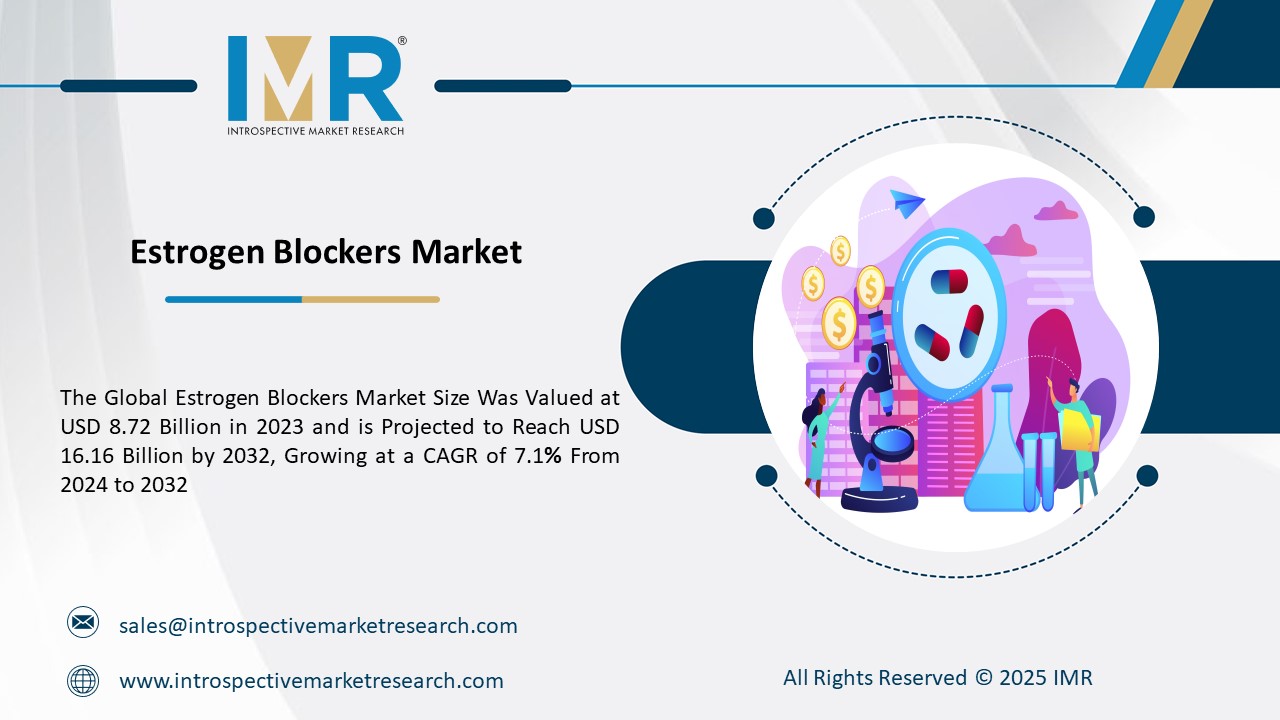
According to a new report published by Introspective Market Research, titled, “Estrogen Blockers Market by Type, Route of Administration, and End-User,” The Global Estrogen Blockers Market Size Was Valued at USD 8.72 Billion in 2023 and is Projected to Reach USD 16.16 Billion by 2032, Growing at a CAGR of 7.1% From 2024 to 2032.The Estrogen Blockers Market is experiencing significant growth driven by the rising prevalence of hormone-related disorders and the increasing use of these drugs in oncology, men’s health, and sports nutrition. Estrogen blockers are compounds that inhibit the action or production of estrogen, helping regulate hormonal balance in both men and women. These drugs are crucial in the treatment of estrogen-sensitive cancers, such as breast cancer, and are also used to support testosterone therapy and mitigate side effects from anabolic steroid use.
The growing awareness regarding hormone therapy, the increasing adoption of precision medicine, and technological advancements in drug formulation are driving market expansion. Additionally, lifestyle changes, a rise in obesity rates, and the aging global population have resulted in a higher incidence of hormonal imbalances, creating a robust demand for estrogen-blocking drugs and supplements.
The Estrogen Blockers Market is segmented into Type, Route of Administration, and End-User.
-
By Type: Selective Estrogen Receptor Modulators (SERMs), Aromatase Inhibitors, and Others
-
By Route of Administration: Oral, Injectable, and Topical
-
By End-User: Hospitals, Clinics, and Homecare
A key driver fueling market growth is the rising prevalence of estrogen-dependent cancers, particularly breast cancer. Increasing awareness of hormone therapy and early detection initiatives have led to higher treatment rates using estrogen blockers such as aromatase inhibitors and SERMs. Pharmaceutical companies are investing heavily in R&D to develop safer, more effective formulations with fewer side effects, further boosting adoption across healthcare facilities worldwide.
An emerging opportunity lies in the growing adoption of estrogen blockers in male health and fitness applications. As awareness about testosterone optimization and post-cycle therapy increases, particularly among athletes and fitness enthusiasts, demand for over-the-counter estrogen blockers is on the rise. Additionally, the integration of telemedicine and e-pharmacy platforms has made these therapies more accessible, creating new growth avenues for manufacturers and distributors globally.
Estrogen Blockers Market, Segmentation
The Estrogen Blockers Market is segmented on the basis of Type, Route of Administration, and End-User.
Type
The Type segment is further classified into Selective Estrogen Receptor Modulators (SERMs), Aromatase Inhibitors, and Others. Among these, the Aromatase Inhibitors sub-segment accounted for the highest market share in 2023, driven by their widespread use in the treatment of hormone-receptor-positive breast cancers in postmenopausal women and expanding research in oncology.
Route of Administration
The Route of Administration segment is further categorized into Oral, Injectable, and Topical. Among these, the Oral sub-segment dominated the market in 2023 due to ease of administration, high patient compliance, and the increasing availability of prescription and over-the-counter oral estrogen blockers.
Some of The Leading/Active Market Players Are:
- Pfizer Inc. (U.S.)
- Novartis AG (Switzerland)
- AstraZeneca plc (U.K.)
- Eli Lilly and Company (U.S.)
- Teva Pharmaceutical Industries Ltd. (Israel)
- Mylan N.V. (U.S.)
- Bayer AG (Germany)
- GlaxoSmithKline plc (U.K.)
- Sanofi S.A. (France)
- Sun Pharmaceutical Industries Ltd. (India)
- Hikma Pharmaceuticals PLC (U.K.)
- Accord Healthcare (U.S.)
- Other active players.
Key Industry Developments
- In May 2024, Pfizer announced promising results from a Phase III clinical trial for a novel aromatase inhibitor aimed at improving treatment outcomes in postmenopausal breast cancer patients, demonstrating superior efficacy with reduced side effects.
- In September 2023, Novartis AG expanded its oncology drug portfolio by launching a new estrogen receptor modulator in key Asian markets, targeting improved access to hormone therapy treatments in emerging economies.
Key Findings of the Study
- Aromatase inhibitors led the market share in 2023 due to their strong adoption in cancer therapy.
- Oral administration dominated for its convenience and patient adherence.
- North America remains the largest market, supported by advanced healthcare systems.
- Growing use of estrogen blockers in men’s health and fitness applications is boosting global demand.
- Rising R&D investment in oncology and hormonal therapeutics will sustain long-term market growth.