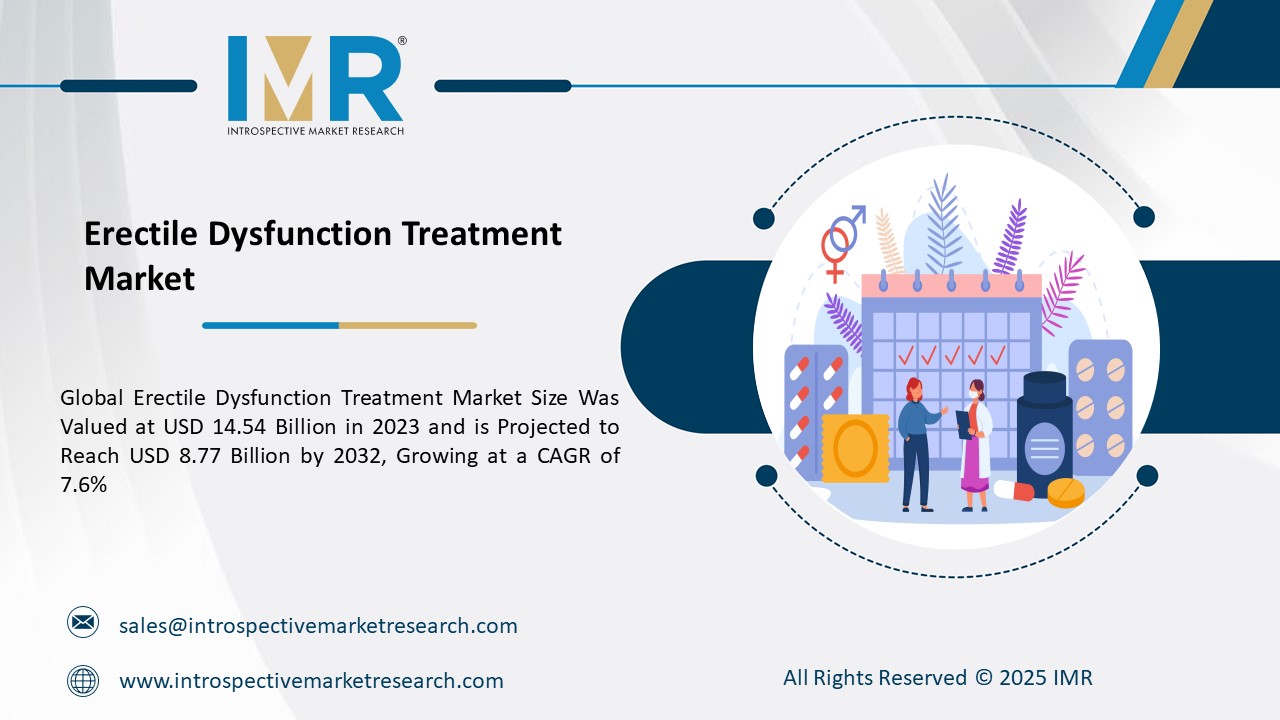
According to a new report published by Introspective Market Research, titled, Erectile Dysfunction Treatment Market by Treatment Type, Drug Class, and Distribution Channel, The Global Erectile Dysfunction Treatment Market Size Was Valued at USD 14.54 Billion in 2023 and is Projected to Reach USD 8.77 Billion by 2032, Growing at a CAGR of 7.6%.The global Erectile Dysfunction Treatment Market is undergoing significant expansion, driven by the increasing prevalence of chronic health conditions, aging populations, and a growing awareness of male sexual health. Erectile dysfunction (ED), defined by the consistent inability to maintain an erection sufficient for intercourse, is no longer viewed as merely a urological condition but as an important indicator of cardiovascular and metabolic health. Treatments for ED include oral medications (such as PDE5 inhibitors), vacuum constriction devices, penile implants, intracavernosal injections, and regenerative therapies like platelet-rich plasma and shockwave therapy.
Advances in pharmacology and medical devices, coupled with the destigmatization of male sexual health, have improved treatment accessibility worldwide. Pharmaceutical innovations are focusing on longer-acting and fewer side-effect formulations, while device manufacturers are investing in non-invasive options to improve patient satisfaction. Growing telemedicine channels and online pharmacies have also widened patient access to verified treatment products, making the ED treatment sector a prominent segment within the broader men’s health industry.
The Erectile Dysfunction Treatment Market is segmented into Treatment Type, Drug Class, and Distribution Channel.
-
By Treatment Type: Drugs (Oral, Injectable, Topical), Devices (Vacuum Pumps, Penile Implants, Shockwave Therapy Devices), and Others.
-
By Drug Class: Phosphodiesterase Type-5 (PDE5) Inhibitors, Prostaglandins, Alpha Blockers, and Others.
-
By Distribution Channel: Hospital Pharmacies, Retail Pharmacies, and Online Pharmacies.
A primary growth driver for the erectile dysfunction treatment market is the rising incidence of chronic conditions such as diabetes, cardiovascular diseases, hypertension, and obesity—all of which are closely linked to ED. Additionally, lifestyle-related factors, including stress, sedentary habits, and smoking, contribute significantly to the condition’s prevalence. Advances in pharmacological research have produced more efficacious and safer drugs, while increased openness toward discussing sexual health has resulted in greater treatment-seeking behavior globally.
A key market opportunity lies in the development of regenerative and personalized medicine approaches, such as stem cell and gene therapy, which promise long-term efficacy and fewer side effects compared to traditional medications. The increasing adoption of telehealth solutions and e-pharmacies also offers new growth pathways by providing discreet consultations and prescription fulfillment services. Moreover, the exploration of natural and nutraceutical alternatives is gaining traction, catering to a growing segment of consumers seeking holistic and plant-based therapies.
Erectile Dysfunction Treatment Market, Segmentation
The Erectile Dysfunction Treatment Market is segmented on the basis of Treatment Type, Drug Class, and Distribution Channel.
Treatment Type
The Treatment Type segment is further classified into Drugs, Devices, and Others. Among these, the Drugs sub-segment accounted for the highest market share in 2023. Oral PDE5 inhibitors such as Sildenafil (Viagra), Tadalafil (Cialis), and Vardenafil (Levitra) remain the first-line therapy globally due to their high success rates, ease of use, and proven safety profile. Continuous innovation and the availability of generic options have further enhanced market accessibility, especially in emerging economies.
Drug Class
The Drug Class segment is classified into Phosphodiesterase Type-5 (PDE5) Inhibitors, Prostaglandins, Alpha Blockers, and Others. The PDE5 Inhibitors sub-segment dominated the market in 2023, as they effectively enhance penile blood flow by relaxing vascular smooth muscles. Ongoing product differentiation efforts by pharmaceutical leaders aim to improve onset time, performance duration, and tolerance for patients with comorbidities such as diabetes or cardiovascular concerns.
Some of The Leading Market Players Are
- Pfizer Inc. (United States)
- Eli Lilly and Company (United States)
- Bayer AG (Germany)
- Teva Pharmaceutical Industries Ltd. (Israel)
- Sun Pharmaceutical Industries Ltd. (India)
- Cipla Ltd. (India)
- Sanofi S.A. (France)
- Vivus LLC (United States)
- Menarini Group (Italy)
- Dong-A ST Co., Ltd. (South Korea)
- Meda Pharmaceuticals (United States)
- Glenmark Pharmaceuticals (India)
- Boston Scientific Corporation (United States)
- Coloplast A/S (Denmark)
- Augusta Medical Systems (United States)
- Other active players.
Key Industry Developments
- In February 2025, Pfizer announced clinical success for its new orally disintegrating tablet formulation of Sildenafil, improving bioavailability and patient convenience.The innovation aims to enhance treatment adherence rates and expand access for patients seeking discreet, fast-acting ED treatments while minimizing gastrointestinal side effects.
- In October 2024, Boston Scientific entered into a strategic partnership with Coloplast to develop advanced, minimally invasive penile implant systems.This collaboration focuses on improving mechanical reliability, patient recovery times, and procedural safety, broadening the treatment scope for men resistant to pharmacological therapy.
Key Findings of the Study
- Drug-based treatments, particularly PDE5 inhibitors, dominate the global market.
- North America and Europe lead market growth due to advanced healthcare access and product innovation.
- Rising chronic diseases and lifestyle factors fuel treatment demand globally.
- Telemedicine, regenerative therapy, and innovative drug formulations represent key opportunities.