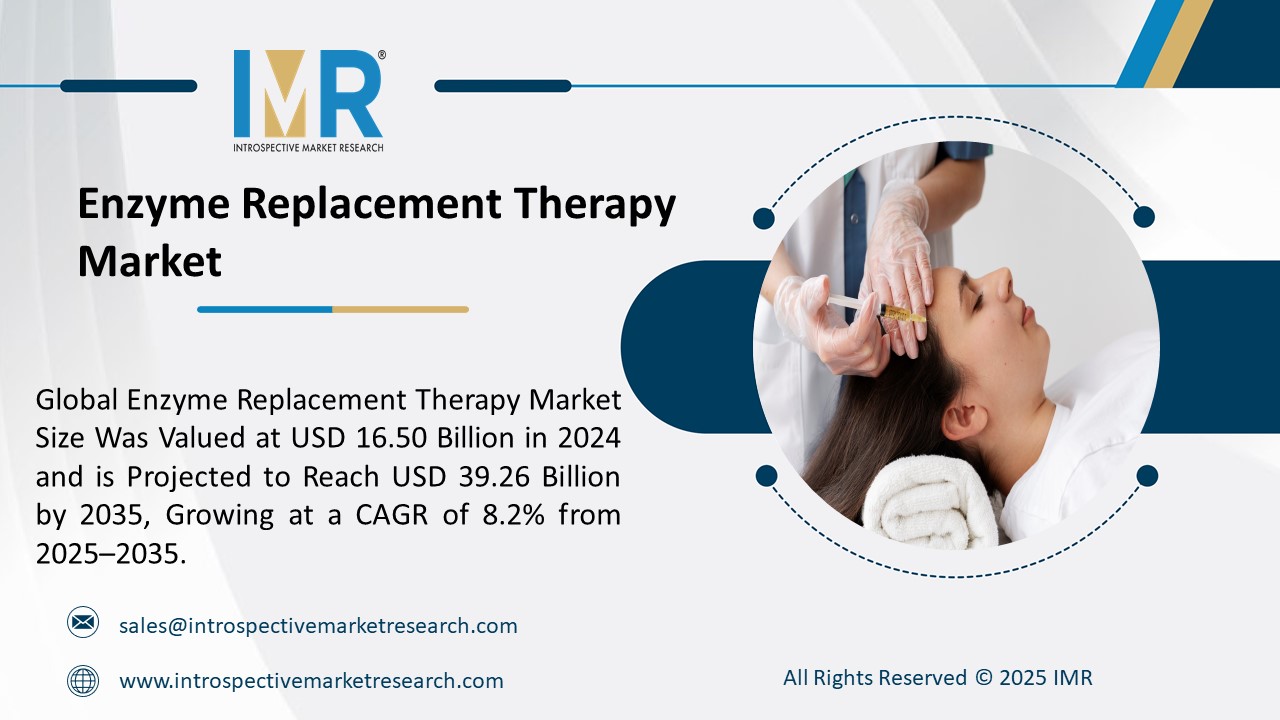
“According to a new report published by Introspective Market Research, titled, Enzyme Replacement Therapy Market by Therapy Type, Indication, and End User, The Global Enzyme Replacement Therapy Market Size Was Valued at USD 16.50 Billion in 2024 and is Projected to Reach USD 39.26 Billion by 2035, Growing at a CAGR of 8.2% from 2025–2035.”
The Enzyme Replacement Therapy (ERT) market focuses on biologic treatments designed to supplement or replace deficient enzymes in patients suffering from rare genetic and metabolic disorders. These therapies are primarily used in the treatment of lysosomal storage disorders such as Gaucher disease, Fabry disease, Pompe disease, and mucopolysaccharidoses. ERT offers a targeted therapeutic approach, addressing the underlying cause of disease rather than only managing symptoms, thereby improving patient outcomes and quality of life.
Advancements in biotechnology, recombinant DNA technology, and protein engineering have significantly enhanced the efficacy and safety of enzyme replacement therapies. Compared to conventional treatments, ERT provides disease-modifying benefits, slows disease progression, and reduces long-term complications. Continuous innovation has also led to improved formulations, dosing regimens, and delivery mechanisms.
The market is witnessing steady growth due to increased awareness of rare diseases, rising diagnosis rates, and expanding access to orphan drugs across developed and emerging economies. Supportive regulatory frameworks, incentives for orphan drug development, and growing investments in rare disease research continue to strengthen the global ERT market outlook.
Market Segmentation
The Enzyme Replacement Therapy Market is segmented into Therapy Type, Indication, and End User.
- By Therapy Type, the market is categorized into Lysosomal Enzyme Replacement, Non-Lysosomal Enzyme Replacement, and Recombinant Enzymes.
- By Indication, the market is categorized into Gaucher Disease, Fabry Disease, Pompe Disease, Mucopolysaccharidoses, and Others.
- By End User, the market is categorized into Hospitals, Specialty Clinics, and Research & Academic Institutes.
Growth Driver
One of the primary growth drivers of the Enzyme Replacement Therapy market is the rising prevalence and improved diagnosis of rare genetic disorders. Advances in genetic screening, newborn testing programs, and diagnostic technologies have significantly increased early detection rates of enzyme-deficiency disorders. Early diagnosis enables timely initiation of ERT, improving clinical outcomes and driving long-term therapy adoption. Additionally, increasing physician awareness and patient advocacy initiatives have strengthened treatment uptake, particularly in developed healthcare systems with established reimbursement frameworks.
Market Opportunity
A key opportunity in the Enzyme Replacement Therapy market lies in the expansion of treatment access across emerging economies. Many developing regions are improving healthcare infrastructure, rare disease policies, and reimbursement mechanisms, creating new growth avenues for ERT manufacturers. Furthermore, ongoing research into next-generation enzyme therapies, combination treatments, and alternative delivery methods such as oral and gene-assisted enzyme therapies presents significant potential to enhance efficacy, reduce costs, and broaden the patient base globally.
Detailed Segmentation
Enzyme Replacement Therapy Market, Segmentation
The Enzyme Replacement Therapy Market is segmented on the basis of Therapy Type, Indication, and End User.
Therapy Type
The Therapy Type segment is further classified into Lysosomal Enzyme Replacement, Non-Lysosomal Enzyme Replacement, and Recombinant Enzymes. Among these, the Lysosomal Enzyme Replacement sub-segment accounted for the highest market share in 2024. This dominance is attributed to the high prevalence of lysosomal storage disorders and the availability of multiple approved therapies targeting these conditions. Continuous clinical advancements and long-term efficacy data have reinforced the widespread adoption of lysosomal enzyme replacement therapies across global markets.
Indication
The Indication segment is further classified into Gaucher Disease, Fabry Disease, Pompe Disease, Mucopolysaccharidoses, and Others. Among these, the Gaucher Disease sub-segment accounted for the highest market share in 2024. This is due to established treatment protocols, early diagnosis rates, and the availability of multiple branded enzyme therapies. Long-term treatment adherence and strong clinical outcomes continue to support sustained demand within this indication.
Some of The Leading/Active Market Players Are-
-
Sanofi (France)
-
Roche (Switzerland)
-
Takeda Pharmaceutical Company (Japan)
-
Pfizer (USA)
-
BioMarin Pharmaceutical (USA)
-
Alexion Pharmaceuticals (USA)
-
Amicus Therapeutics (USA)
-
Ultragenyx Pharmaceutical (USA)
-
Sarepta Therapeutics (USA)
-
Protalix BioTherapeutics (Israel)
-
Recordati Rare Diseases (Italy)
-
JCR Pharmaceuticals (Japan)
-
and other active players.
Key Industry Developments
In March 2024, a leading biopharmaceutical company expanded its enzyme replacement therapy portfolio through regulatory approval for a next-generation formulation targeting lysosomal storage disorders.
The approval enhances treatment efficacy and patient convenience, reflecting ongoing innovation in rare disease therapeutics and strengthening the company’s competitive position in the global ERT market.
In October 2024, a major market player announced strategic investments in manufacturing capacity for recombinant enzymes.
This development aims to address growing global demand, improve supply chain resilience, and support long-term commercialization of enzyme replacement therapies across multiple regions.
Key Findings of the Study
-
Lysosomal enzyme replacement dominated the therapy type segment
-
Gaucher disease remained the leading indication globally
-
North America held the largest regional market share
-
Rising rare disease diagnosis is a key growth driver
-
Continued innovation is shaping future market trends