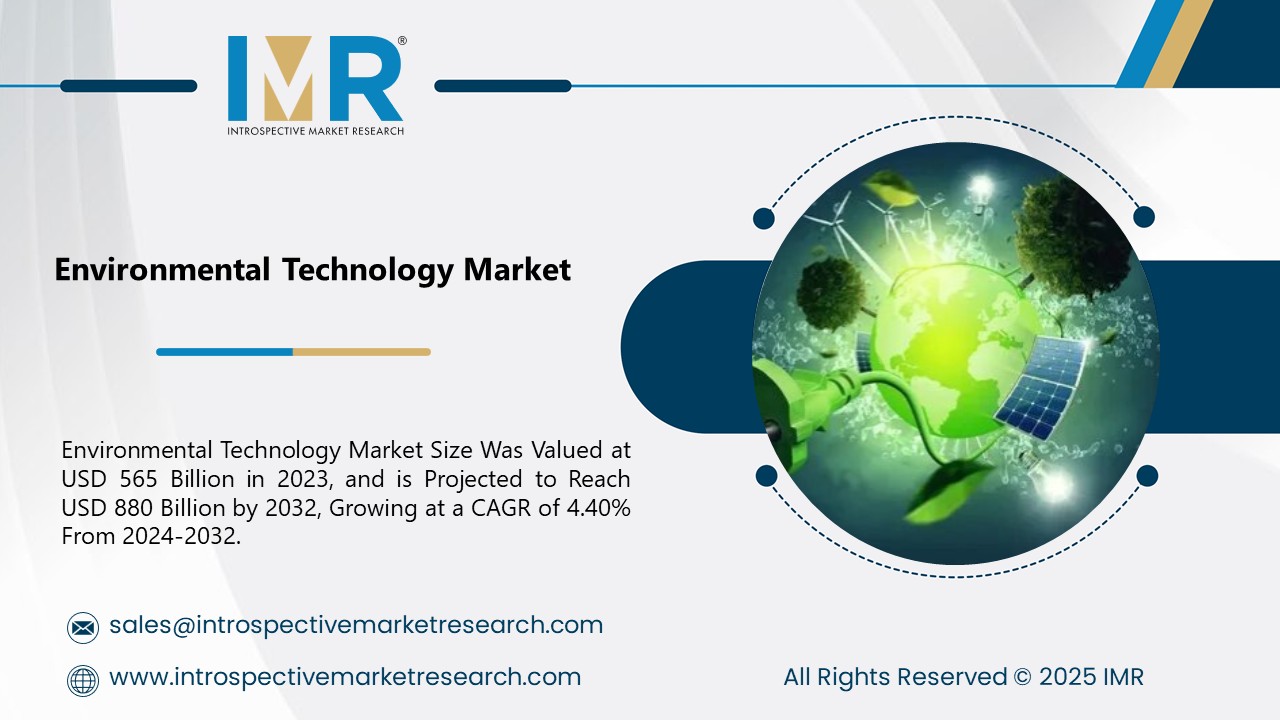
According to a new report published by Introspective Market Research, titled, Environmental Technology Market by Component, Application, and End-User, The Global Environmental Technology Market Size Was Valued at USD 565 Billion in 2023 and is Projected to Reach USD 880 Billion by 2032, Growing at a CAGR of 4.40%. The Environmental Technology Market encompasses a broad range of products, services, and processes designed to address environmental issues, promote sustainability, and conserve natural resources. This includes technologies for pollution control (air, water, soil), waste management and recycling, renewable energy generation, energy efficiency, sustainable agriculture, and environmental monitoring. The core aim is to minimize human impact on the environment while supporting economic development and improving public health.
These technologies offer crucial advantages over traditional industrial practices by reducing emissions, optimizing resource consumption, and mitigating ecological degradation. From advanced wastewater treatment systems and smart grids for renewable energy integration to carbon capture solutions and sustainable manufacturing processes, environmental technologies are pivotal in the transition towards a greener, more resilient global economy. They are increasingly adopted across diverse industries seeking to comply with regulations, enhance corporate social responsibility, and achieve operational efficiencies.
The Environmental Technology Market is segmented into Component, Application, and End-User. By Component, the market is categorized into (Solutions and Services). By Application, the market is categorized into (Pollution Control, Waste Management, Water & Wastewater Treatment, Renewable Energy, and Others). By End-User, the market is categorized into (Industrial, Residential, Commercial, and Government & Utilities).
A significant growth driver for the Environmental Technology Market is the escalating global concern over climate change and environmental degradation. Governments worldwide are implementing stricter environmental regulations and policies, coupled with incentives for adopting sustainable practices. This regulatory push, combined with rising public awareness and corporate social responsibility initiatives, is compelling industries and consumers alike to invest in environmental technologies. The urgent need to reduce carbon footprints, manage waste more effectively, and ensure clean air and water is driving sustained demand for innovative environmental solutions.
A key market opportunity lies in the rapid development and deployment of circular economy models. These models aim to minimize waste and maximize resource utilization by keeping products and materials in use for as long as possible. Environmental technologies, such as advanced recycling processes, industrial symbiosis platforms, and product-as-a-service models, are essential for enabling this shift. The transition from a linear "take-make-dispose" economy to a circular one presents vast opportunities for technologies that support reuse, repair, remanufacturing, and material recovery across various sectors.
Environmental Technology Market, Segmentation
The Environmental Technology Market is segmented on the basis of Component, Application, and and End-User.
Component
- The Component segment is further classified into Solutions and Services. Among these, the Solutions sub-segment accounted for the highest market share in 2023. Environmental solutions encompass the hardware and software technologies such as air purification systems, waste treatment facilities, renewable energy generation equipment, and monitoring devices. The dominance of solutions is driven by the direct implementation of physical and digital technologies required to directly address and mitigate environmental challenges across various industrial and public sectors.
Application
- The Application segment is further classified into Pollution Control, Waste Management, Water & Wastewater Treatment, Renewable Energy, and Others. Among these, the Water & Wastewater Treatment sub-segment accounted for the highest market share in 2023. The global emphasis on water security and public health drives significant investment in advanced water and wastewater treatment technologies. Growing populations, industrialization, and contamination concerns necessitate robust solutions for purifying drinking water and treating industrial and municipal wastewater before discharge, ensuring compliance with stringent environmental standards and safeguarding aquatic ecosystems.
Some of The Leading/Active Market Players Are-
- Veolia Environnement S.A. (France)
- Suez S.A. (France)
- Remondis AG & Co. KG (Germany)
- Waste Management, Inc. (USA)
- Republic Services, Inc. (USA)
- Xylem Inc. (USA)
- Ecolab Inc. (USA)
- GE Water & Process Technologies (USA)
- Siemens AG (Germany)
- Mitsubishi Heavy Industries, Ltd. (Japan)
- ABB Ltd. (Switzerland)
- Dow Inc. (USA)
- DuPont de Nemours, Inc. (USA)
- Thermax Limited (India)
- John Wood Group PLC (UK).
Key Industry Developments
- In March 2023, Xylem Inc. acquired Evoqua Water Technologies, creating a leading global platform for advanced water treatment solutions. This merger significantly expanded Xylem’s portfolio in digital water solutions and wastewater treatment.
The acquisition aimed to address the escalating global water challenges by combining expertise and resources, enabling the development and deployment of more comprehensive and innovative solutions for water scarcity, resilience, and affordability worldwide. - In July 2023, Veolia Environnement S.A. announced new investments in advanced recycling technologies, particularly for plastics and specialized industrial waste streams, to boost circular economy initiatives.
These investments are part of Veolia's strategy to expand its capacity for recovering valuable resources from waste, reducing landfill dependency, and contributing to a more sustainable industrial ecosystem by closing material loops and promoting resource efficiency.
Key Findings of the Study
- Solutions component leads, driven by direct technology implementation.
- Water & Wastewater Treatment is the dominant application segment.
- Europe holds a significant market share due to stringent environmental regulations.
- Key drivers include climate change concerns and regulatory pressures.