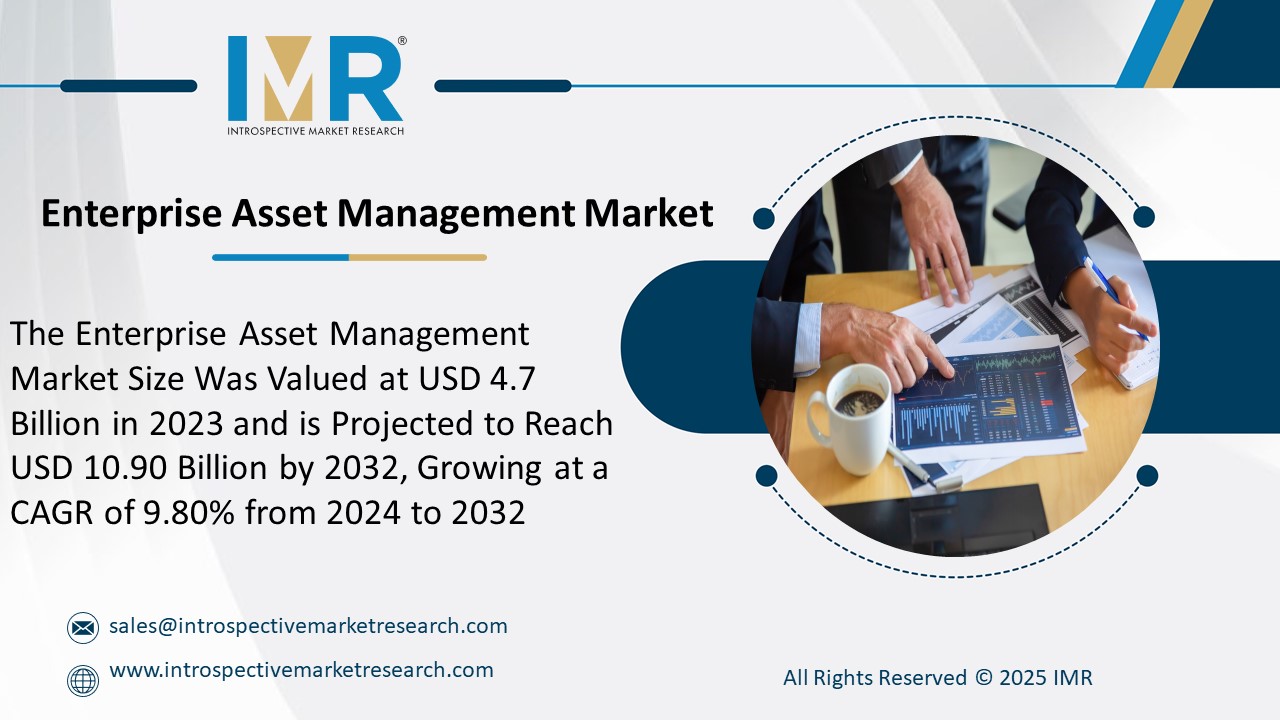
According to a new report published by Introspective Market Research, titled, Enterprise Asset Management Market by Deployment Type, Organization Size, Industry Vertical, and Region, The Global Enterprise Asset Management Market Size Was Valued at USD 4.7 Billion in 2023 and is Projected to Reach USD 10.90 Billion by 2032, Growing at a CAGR of 9.80% from 2024 to 2032. The Global Enterprise Asset Management (EAM) Market is witnessing strong growth as organizations increasingly adopt digital solutions to optimize the lifecycle of physical assets, improve operational efficiency, and reduce downtime. EAM software integrates processes related to maintenance, asset tracking, and performance monitoring, helping enterprises manage both critical and non-critical assets effectively.
Compared to traditional asset management approaches, EAM systems offer real-time monitoring, predictive maintenance, and data-driven decision-making. These solutions are vital across multiple industries including manufacturing, energy, transportation, utilities, and healthcare, where efficient asset management can significantly reduce costs and enhance productivity.
The market is driven by the growing need for operational excellence, regulatory compliance, and extended asset life. Integration with emerging technologies such as IoT, AI, and cloud platforms further enhances predictive maintenance capabilities and provides actionable insights, enabling companies to make informed strategic decisions.
The Enterprise Asset Management Market is segmented into Deployment Type, Organization Size, and Industry Vertical. By Deployment Type, the market is categorized into (On-Premises, Cloud). By Organization Size, the market is categorized into (Small & Medium Enterprises (SMEs), Large Enterprises). By Industry Vertical, the market is categorized into (Manufacturing, Energy & Utilities, Transportation & Logistics, Healthcare, Government & Defence, Others).
The EAM Market is primarily driven by the increasing focus on operational efficiency and cost optimization across industries. Organizations face rising maintenance costs and unplanned downtime, which directly impact productivity and profitability. EAM solutions provide real-time insights into asset performance, enabling predictive maintenance and resource optimization. By leveraging AI and IoT integration, companies can monitor asset health, detect anomalies early, and schedule maintenance proactively, resulting in minimized downtime, extended asset life, and significant cost savings. This drive for efficiency fuels adoption globally.
A major opportunity in the EAM Market is the growing demand for cloud-based deployment solutions. Cloud EAM enables organizations to access their asset data remotely, supports scalability, reduces IT infrastructure costs, and facilitates rapid implementation. Companies can adopt subscription-based models, reducing upfront investments while benefiting from automatic software updates and enhanced cybersecurity. The increased adoption of mobile-enabled EAM platforms allows technicians and managers to monitor and manage assets in real-time, improving workforce productivity and providing a competitive edge for organizations embracing digital transformation initiatives.
Enterprise Asset Management Market, Segmentation
The Enterprise Asset Management Market is segmented on the basis of Deployment Type, Organization Size, and Industry Vertical.
Deployment Type
The Deployment Type segment is further classified into On-Premises and Cloud. Among these, the Cloud sub-segment accounted for the highest market share in 2023. Cloud-based EAM solutions offer flexibility, scalability, and reduced infrastructure costs, making them highly preferred by enterprises of all sizes. Cloud deployment also enables real-time data access, faster software updates, and enhanced collaboration across multiple sites, facilitating better decision-making and asset optimization.
Organization Size
The Organization Size segment is further classified into Small & Medium Enterprises (SMEs) and Large Enterprises. Among these, the Large Enterprises sub-segment accounted for the highest market share in 2023. Large enterprises typically have extensive asset portfolios across multiple locations and require advanced monitoring, predictive maintenance, and compliance management. EAM solutions help streamline operations, reduce downtime, and maximize return on assets, making them essential for large-scale organizations in diverse industry verticals.
Some of The Leading/Active Market Players Are-
- IBM Corporation (USA)
- SAP SE (Germany)
- Oracle Corporation (USA)
- Infor, Inc. (USA)
- ABB Ltd (Switzerland)
- IFS AB (Sweden)
- Hexagon AB (Sweden)
- Schneider Electric SE (France)
- Siemens AG (Germany)
- Ultimo Software Solutions (Netherlands)
- other active players.
Key Industry Developments
-
In March 2024, SAP SE launched a next-generation cloud EAM platform integrating AI-driven predictive maintenance.
The new platform combines IoT sensor data, AI analytics, and machine learning algorithms to provide predictive insights into asset performance. SAP’s solution allows organizations to schedule maintenance efficiently, reduce unplanned downtime, and optimize operational costs. By offering enhanced mobile access and real-time reporting, the platform supports digital transformation in industries such as manufacturing, utilities, and transportation, helping clients improve asset lifecycle management and drive productivity. - In November 2023, IBM Corporation partnered with Schneider Electric to enhance enterprise asset monitoring capabilities.
The partnership focuses on combining IBM’s AI-driven analytics and Schneider Electric’s IoT-enabled devices to offer integrated asset performance management solutions. This collaboration aims to provide predictive maintenance, energy optimization, and automated workflow solutions across large-scale industrial facilities. By leveraging real-time data insights and advanced analytics, the partnership enables enterprises to improve operational efficiency, extend asset life, and reduce maintenance costs while supporting sustainability initiatives.
Key Findings of the Study
- Cloud-based deployment leads due to scalability, cost-effectiveness, and real-time accessibility.
- Large enterprises dominate market adoption due to complex asset portfolios.
- Manufacturing and energy & utilities are top industry verticals driving demand.
- Predictive maintenance and AI/IoT integration are key growth drivers.
- Increasing focus on operational efficiency, cost optimization, and digital transformation fuels market expansion.