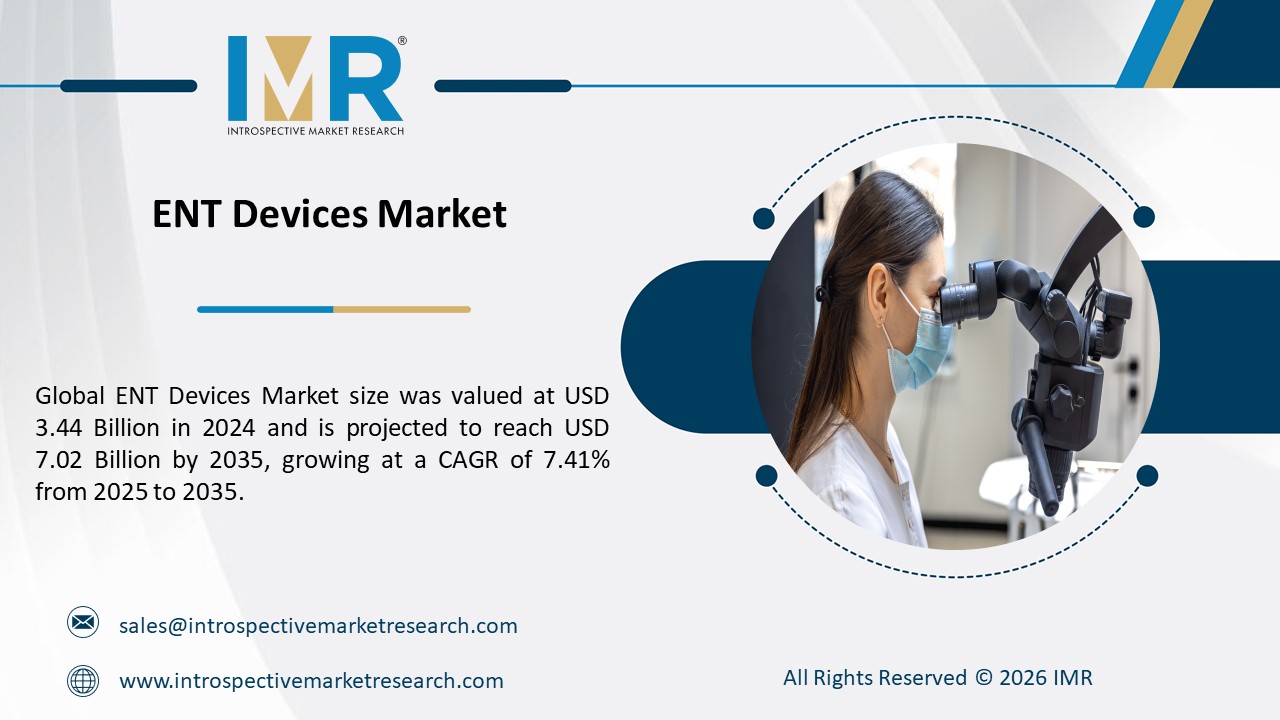
According to a new report published by Introspective Market Research, titled, “ENT Devices Market by Product Type, End User, and Procedure Type,” The Global ENT Devices Market size was valued at USD 3.44 Billion in 2024 and is projected to reach USD 7.02 Billion by 2035, growing at a CAGR of 7.41% from 2025 to 2035.
ENT devices, also known as otolaryngology devices, are medical instruments and systems used for the diagnosis, treatment, and surgical management of conditions related to the ear, nose, and throat. These devices include hearing aids, cochlear implants, endoscopes, powered surgical instruments, and diagnostic imaging tools that enable precise evaluation and minimally invasive interventions. Compared to traditional diagnostic and surgical methods, modern ENT devices offer improved accuracy, reduced procedural time, and enhanced patient comfort.
The increasing adoption of technologically advanced ENT devices has significantly improved outcomes in the treatment of hearing loss, sinusitis, sleep apnea, and head and neck disorders. Innovations such as digital hearing aids, robotic-assisted ENT surgeries, and high-definition visualization systems are transforming clinical practice. These advancements help clinicians deliver more personalized and effective care across a wide range of ENT conditions.
ENT devices are widely used in hospitals, ambulatory surgical centers, and specialty ENT clinics. Major end-user industries include healthcare providers, diagnostic centers, and academic medical institutions. Rising awareness about early diagnosis, coupled with increasing healthcare expenditure globally, continues to support the steady expansion of the ENT devices market.
Market Segmentation
The ENT Devices Market is segmented into Product Type, End User, and Procedure Type.
- By Product Type, the market is categorized into Diagnostic Devices, Surgical Devices, and Hearing Aids & Implants.
- By End User, the market is categorized into Hospitals, Ambulatory Surgical Centers, and ENT Clinics.
- By Procedure Type, the market is categorized into Ear Procedures, Nose Procedures, and Throat Procedures.
Growth Driver
One of the primary growth drivers of the ENT devices market is the rising prevalence of ENT-related disorders worldwide. Conditions such as hearing loss, chronic sinusitis, allergic rhinitis, and sleep apnea are increasing due to aging populations, urbanization, noise pollution, and lifestyle changes. The growing geriatric population is particularly susceptible to hearing impairment and balance disorders, driving demand for advanced hearing aids and implantable devices. Additionally, improved access to healthcare services and increased awareness of early diagnosis are encouraging patients to seek timely ENT treatments, further fueling market growth.
Market Opportunity
A significant market opportunity lies in the rapid advancement and adoption of minimally invasive and digital ENT technologies. Innovations such as AI-enabled diagnostic tools, smart hearing aids with wireless connectivity, and robotic-assisted ENT surgeries are creating new avenues for market expansion. Emerging economies present substantial growth potential due to improving healthcare infrastructure, rising disposable incomes, and increasing investments in medical technology. Furthermore, government initiatives supporting hearing healthcare and ENT screening programs are expected to create long-term opportunities for manufacturers and service providers in the global ENT devices market.
Detailed Segmentation
ENT Devices Market, Segmentation
The ENT Devices Market is segmented on the basis of Product Type, End User, and Procedure Type.
Product Type
The Product Type segment is further classified into Diagnostic Devices, Surgical Devices, and Hearing Aids & Implants. Among these, the Hearing Aids & Implants sub-segment accounted for the highest market share in 2024. This dominance is attributed to the high global prevalence of hearing loss and the increasing adoption of advanced digital and rechargeable hearing aids. Continuous technological advancements, improved sound processing, and growing acceptance of cochlear implants have further strengthened the position of this sub-segment.
End User
The End User segment is further classified into Hospitals, Ambulatory Surgical Centers, and ENT Clinics. Among these, the Hospitals sub-segment accounted for the highest market share in 2024. Hospitals remain the primary centers for complex ENT surgeries and advanced diagnostic procedures due to the availability of specialized infrastructure, skilled professionals, and integrated care facilities. The rising number of ENT-related surgical interventions performed in hospitals continues to support this segment’s leadership.
Some of The Leading/Active Market Players Are-
• Medtronic plc (Ireland)
• Johnson & Johnson (USA)
• Stryker Corporation (USA)
• Olympus Corporation (Japan)
• Cochlear Limited (Australia)
• Sonova Holding AG (Switzerland)
• Demant A/S (Denmark)
• Karl Storz SE & Co. KG (Germany)
• GN Store Nord A/S (Denmark)
• Smith & Nephew plc (UK)
• Natus Medical Incorporated (USA)
• William Demant Holding Group (Denmark)
• Starkey Laboratories, Inc. (USA)
and other active players.
Key Industry Developments
In March 2024, a leading ENT device manufacturer launched a next-generation AI-enabled hearing aid platform designed to improve speech clarity and personalized sound processing.
The new product integrates machine learning algorithms and wireless connectivity, enabling real-time adjustments based on user environments. This development is expected to enhance user experience and drive adoption of premium hearing solutions globally.
In September 2024, a major medical device company expanded its ENT surgical portfolio through a strategic acquisition of a minimally invasive ENT technology firm.
The acquisition strengthened the company’s capabilities in endoscopic and robotic-assisted ENT procedures, supporting its long-term growth strategy and expanding its global footprint in the ENT devices market.
Key Findings of the Study
• Hearing aids & implants dominate the product segment due to rising hearing loss prevalence
• Hospitals remain the leading end-user segment globally
• Technological advancements and aging populations are key growth drivers
• North America and Europe lead the market, while Asia-Pacific shows fastest growth