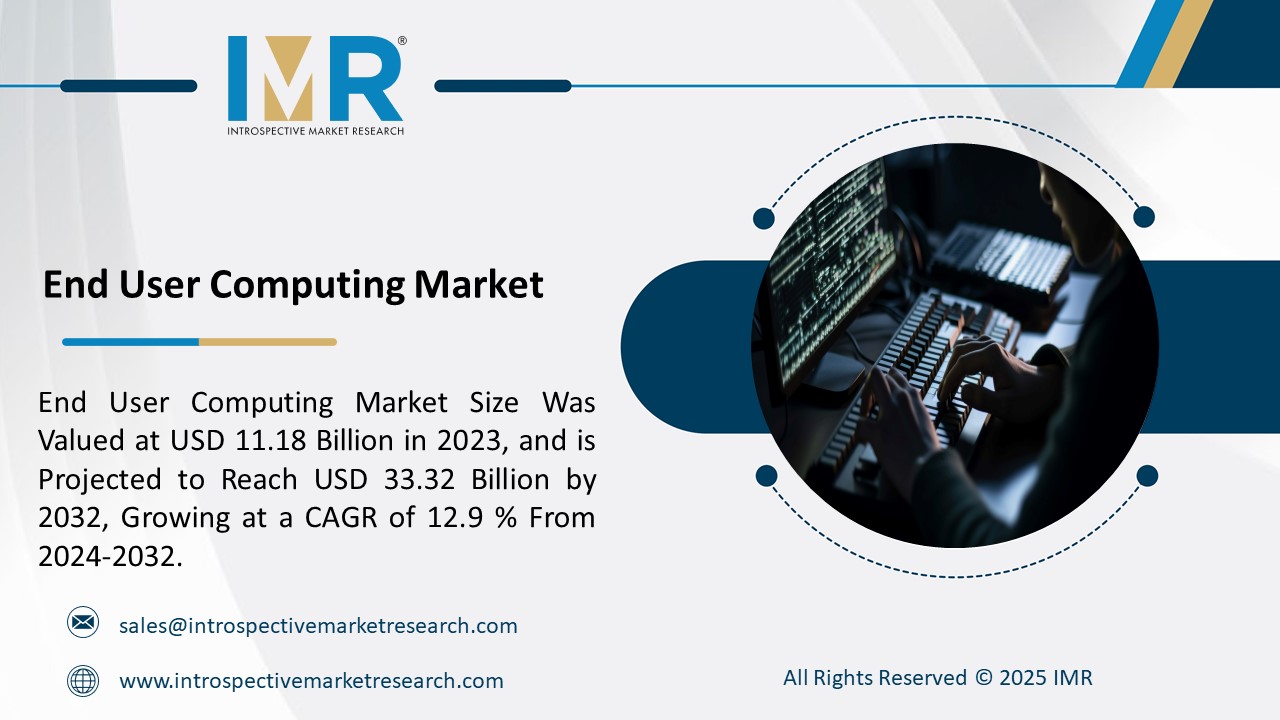
According to a new report published by Introspective Market Research, titled, End User Computing Market by Component, Deployment, and Industry Vertical, The Global End User Computing Market Size Was Valued at USD 11.18 Billion in 2023 and is Projected to Reach USD 33.32 Billion by 2032, Growing at a CAGR of 12.9%. The End User Computing (EUC) Market is witnessing remarkable growth as organizations increasingly prioritize flexible, secure, and scalable digital work environments. End user computing solutions empower businesses to deliver virtual desktops and applications to employees across devices and locations, ensuring seamless access and enhanced productivity. These solutions bridge the gap between IT control and user convenience, enabling a more agile and remote-ready workforce in today’s hybrid business landscape.
With the growing adoption of cloud-based services, virtual desktop infrastructure (VDI), and digital workspace technologies, the EUC market has evolved into a cornerstone of enterprise IT modernization strategies. Businesses are leveraging these solutions to centralize IT management, improve data security, and reduce endpoint complexity all while offering users an uninterrupted experience.
Moreover, industries such as BFSI, healthcare, education, and manufacturing are increasingly adopting EUC to streamline operations, ensure regulatory compliance, and enhance workforce mobility. The shift toward remote and hybrid work models, combined with rising demand for Bring Your Own Device (BYOD) policies, continues to strengthen the market’s expansion globally.
A key growth driver for the End User Computing Market is the rising adoption of remote and hybrid work environments. The global workforce transformation—accelerated by digitalization and the post-pandemic work culture—has prompted enterprises to adopt EUC solutions for enhanced flexibility and centralized IT control. These systems enable secure data access, application delivery, and endpoint management, regardless of device or location. Organizations are increasingly turning to EUC to ensure consistent user experiences, safeguard corporate information, and improve overall operational efficiency, thereby fueling market growth across sectors and geographies.
A significant market opportunity lies in the integration of artificial intelligence (AI) and automation within end user computing solutions. AI-driven analytics can optimize performance, predict maintenance needs, and enhance user experience through intelligent resource allocation. Furthermore, the increasing focus on cybersecurity and zero-trust architectures presents a lucrative opportunity for EUC vendors to develop next-generation platforms with advanced threat detection and response capabilities. As organizations move toward fully digital workspaces and edge computing models, the demand for AI-enabled, cloud-native EUC platforms is expected to surge, creating new growth avenues for technology providers.
End User Computing Market, Segmentation
The End User Computing Market is segmented on the basis of Component, Deployment, and Industry Vertical.
Component
-
The Component segment is further classified into Solutions and Services. Among these, the Solutions segment accounted for the highest market share in 2023. EUC solutions, such as virtual desktop infrastructure (VDI), application virtualization, and digital workspace management tools, are extensively deployed to enhance remote access and IT efficiency. These tools empower enterprises to deliver consistent performance, maintain compliance, and optimize resource utilization. The growing demand for secure and scalable digital workspaces continues to drive this segment’s dominance.
Deployment
-
The Deployment segment is further classified into On-Premises and Cloud. Among these, the Cloud sub-segment held the largest market share in 2023. Cloud-based EUC solutions offer enhanced scalability, flexibility, and cost-efficiency, allowing organizations to manage users and devices without extensive infrastructure investments. The increasing shift toward Software-as-a-Service (SaaS) models and virtual cloud desktops is expected to reinforce this trend, especially among SMEs and enterprises focused on digital transformation.
Some of The Leading/Active Market Players Are-
- Citrix Systems, Inc. (United States)
- VMware, Inc. (United States)
- Microsoft Corporation (United States)
- IBM Corporation (United States)
- Tech Mahindra Ltd. (India)
- Fujitsu Limited (Japan)
- IGEL Technology GmbH (Germany)
- NComputing Co., Ltd. (South Korea)
- Syntegra IT Consulting (United Kingdom)
- Dell Technologies Inc. (United States)
- Amazon Web Services, Inc. (United States)
- Red Hat, Inc. (United States)
- Parallels International GmbH (Switzerland)
- Evolve IP, LLC (United States)
- and other active players.
Key Industry Developments
- In April 2024, VMware, Inc. launched its new EUC management suite integrated with AI capabilities for predictive endpoint monitoring and intelligent workspace automation.
- The update enhances user productivity while simplifying IT operations across hybrid and multi-cloud environments.
- In June 2024, Citrix Systems, Inc. announced a strategic partnership with Google Cloud to expand its cloud-hosted virtual desktop solutions globally.
- This collaboration aims to help enterprises accelerate digital workspace adoption and improve secure access to business applications worldwide.
Key Findings of the Study
- The Solutions segment dominated the market in 2023.
- Cloud-based deployment led the global market share.
- North America remains the leading region for EUC adoption.
- Rising hybrid work culture and remote access needs are major growth drivers.
- Integration of AI and automation marks a key future trend.