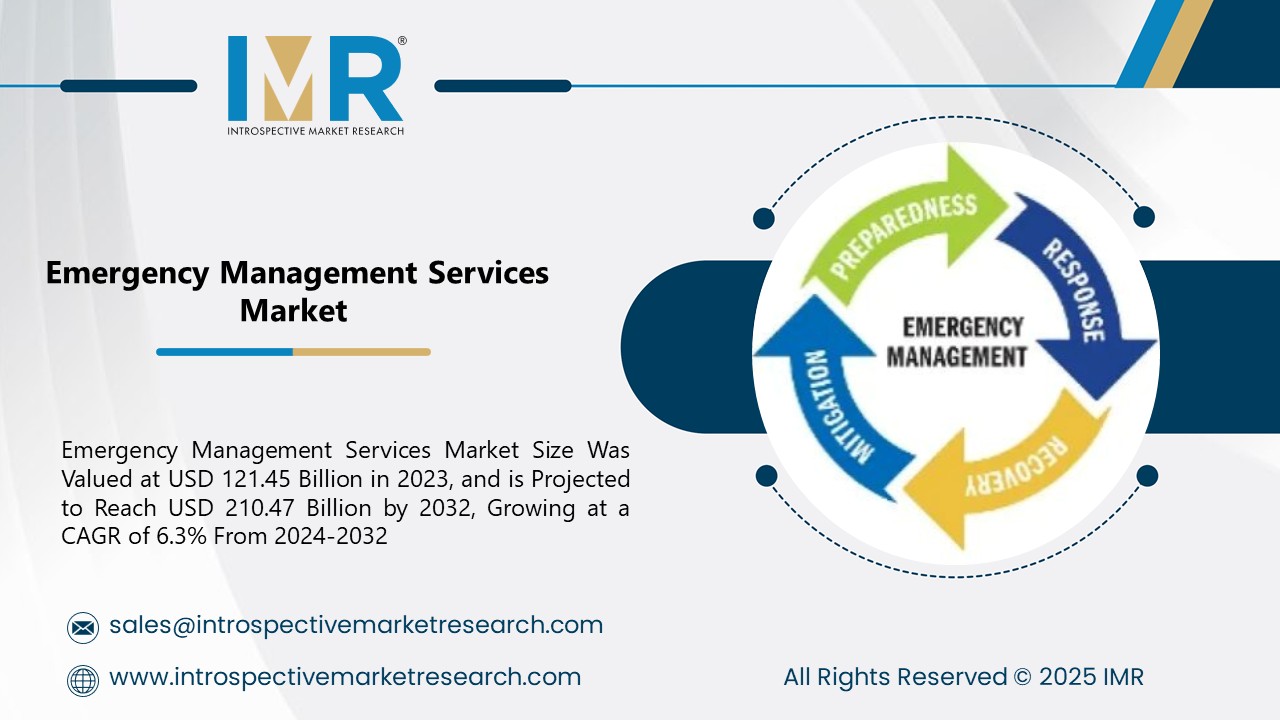
According to a new report published by Introspective Market Research, titled, Emergency Management Services Market by Component (Solutions, Services), by Emergency Type (Natural, Man-made), by End-User (Government & Public Safety, Healthcare & Medical, Energy & Utilities, Transportation, BFSI), The Global Emergency Management Services Market Size Was Valued at USD 121.45 Billion in 2023 and is Projected to Reach USD 210.47 Billion by 2032, Growing at a CAGR of 6.3%. The Emergency Management Services Market encompasses a comprehensive suite of solutions and services designed to mitigate, prepare for, respond to, and recover from various types of emergencies and disasters. These services integrate advanced technologies such as communication systems, emergency notification platforms, incident management software, and early warning systems. They offer critical advantages over traditional, reactive approaches by enabling proactive planning, real-time coordination, and efficient resource deployment, significantly reducing potential harm and economic losses.
These indispensable services are utilized across a wide spectrum of end-users and industries globally. Government and public safety agencies rely on them for coordinating responses to natural calamities like floods, earthquakes, and wildfires, as well as man-made emergencies such as terror attacks or industrial accidents. Healthcare and medical sectors employ these services for mass casualty incidents and public health crises. Additionally, energy & utilities, transportation, and BFSI industries leverage emergency management to safeguard critical infrastructure, ensure business continuity, and protect assets and personnel during unforeseen events.
The Emergency Management Services Market is segmented into Component, Emergency Type, and End-User. By Component, the market is categorized into Solutions and Services. By Emergency Type, the market is categorized into Natural and Man-made. By End-User, the market is categorized into Government & Public Safety, Healthcare & Medical, Energy & Utilities, Transportation, and BFSI.
A key growth driver for the emergency management services market is the increasing frequency and intensity of natural disasters globally, coupled with a rise in complex man-made crises. Climate change contributes to more extreme weather events, while geopolitical instabilities and technological risks fuel other forms of emergencies. This heightened threat landscape compels governments, organizations, and communities to invest more heavily in robust emergency preparedness and response systems. The continuous need to protect lives, infrastructure, and economic stability in the face of diverse hazards is a primary catalyst for market expansion.
A significant market opportunity lies in the integration of Artificial intelligence (AI), machine learning (ML), and IoT (Internet of Things) into emergency management solutions. These technologies can provide predictive analytics for disaster forecasting, enhance real-time situational awareness through sensor networks, and optimize resource allocation during critical incidents. AI-powered systems can analyze vast amounts of data to identify emerging threats and recommend optimal response strategies, while IoT sensors can monitor environmental conditions or infrastructure integrity. This technological convergence offers the potential for more intelligent, proactive, and efficient emergency management.
Emergency Management Services Market, Segmentation
The Emergency Management Services Market is segmented on the basis of Component, Emergency Type, and End-User.
Component
The Component segment is further classified into Solutions and Services. Among these, the Solutions sub-segment accounted for the highest market share in 2023. Emergency management solutions encompass a broad range of software platforms, communication tools, and analytical systems that form the backbone of modern emergency preparedness and response. These include incident management software, GIS mapping tools, early warning systems, and mass notification platforms. Organizations invest heavily in these tangible solutions to build resilient infrastructure and robust operational capabilities for managing crises effectively, driving this segment's dominance.
Emergency Type
The Emergency Type segment is further classified into Natural and Man-made. Among these, the Natural sub-segment accounted for the highest market share in 2023. The escalating frequency and severity of natural disasters, such as hurricanes, floods, earthquakes, and wildfires, globally create an immense and consistent demand for emergency management services tailored to these events. Governments and communities are heavily investing in preparedness, early warning systems, and post-disaster recovery efforts to mitigate the devastating impacts of these environmental phenomena, making this the largest and most urgent category for emergency response.
Some of The Leading/Active Market Players Are-
- Motorola Solutions (US)
- Siemens AG (Germany)
- Honeywell International Inc. (US)
- IBM Corporation (US)
- Thales Group (France)
- Esri (Environmental Systems Research Institute) (US)
- Vaisala Oyj (Finland)
- NEC Corporation (Japan)
- Everbridge, Inc. (US)
- Hexagon AB (Sweden)
- Accenture (Ireland)
- Wiley Global LLC (US)
- Collins Aerospace (US)
- Johnson Controls International plc (Ireland)
- Nokia Corporation (Finland)
Key Industry Developments
- In January 2024, Everbridge, a global leader in critical event management, announced new integrations with its platform to enhance multi-agency coordination during large-scale emergencies. These updates enable seamless communication and data sharing between various public safety organizations, improving incident response times and resource allocation. The development aims to create a more unified and effective approach to managing complex crises, from natural disasters to public health events.
- In October 2023, Motorola Solutions acquired Rave Mobile Safety, a leading provider of mass notification and incident management solutions for public safety. This acquisition significantly strengthens Motorola's portfolio in emergency communications and critical event management, allowing them to offer a more comprehensive suite of tools to government agencies, educational institutions, and enterprises. The move highlights the strategic importance of robust notification systems in modern emergency preparedness.
Key Findings of the Study
- Solutions component leads the market, foundational for emergency infrastructure.
- Natural emergencies drive the largest demand due to increasing global events.
- Market growth is fueled by rising frequency and intensity of global disasters.
- AI, ML, and IoT integration offer significant opportunities for advanced services.
- The market is set to expand robustly, reaching over USD 210 billion by 2032.