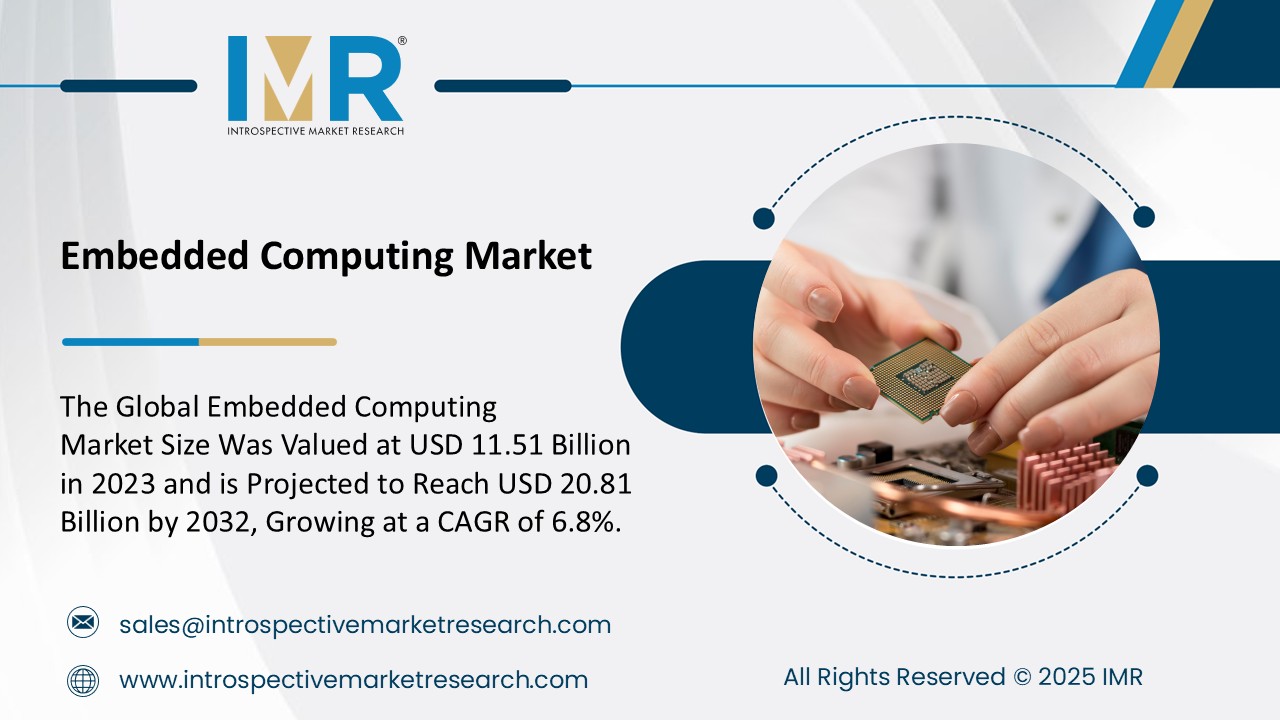
According to a new report published by Introspective Market Research, titled, Embedded Computing Market by Component, Application, and Industry Vertical, The Global Embedded Computing Market Size Was Valued at USD 11.51 Billion in 2023 and is Projected to Reach USD 20.81 Billion by 2032, Growing at a CAGR of 6.8%. The Embedded Computing Market is expanding rapidly as demand accelerates for smart devices, industrial automation, and the Internet of Things (IoT). Embedded computing systems are integral to a wide range of applications, from automotive and healthcare to aerospace, consumer electronics, and robotics. They offer high reliability, real-time performance, and energy efficiency, surpassing conventional computing platforms in specialized tasks where size, power, and cost constraints are critical.
Recent innovations in edge computing, hardware design, and embedded software have enabled the deployment of lightweight, high-performance systems across new use cases such as autonomous vehicles, smart factories, wearables, and telemedicine devices. The sector benefits from the proliferation of artificial intelligence (AI), which allows for advanced machine learning and predictive analytics at the device level, as well as growing emphasis on cybersecurity for embedded solutions.
The Embedded Computing Market is segmented into Component, Application, and Industry Vertical.
- By Component, the market is categorized into (Hardware, Software).
- By Application, the market is categorized into (Automotive, Healthcare, Industrial Automation, Consumer Electronics, Aerospace & Defense, Others).
- By Industry Vertical, the market is categorized into (Manufacturing, Healthcare, Transportation, Communication, Energy, Others).
A primary growth driver is the increasing adoption of embedded systems in IoT devices and smart consumer electronics, propelled by the need for enhanced connectivity, seamless communication, and optimal device performance. Industries are prioritizing reliable, low-power solutions to bring real-time data intelligence and automation into everyday applications—from personal wearables to complex industrial controls. The integration of embedded systems allows manufacturers to launch feature-rich, high-efficiency products and stay competitive in dynamic markets.
Key opportunity exists in the expansion of edge AI, energy-efficient designs, and security-driven embedded platforms. Vertical industries such as healthcare, automotive, and smart manufacturing can leverage the latest advancements in embedded hardware and software to unlock new levels of automation, predictive analytics, and process reliability. Regional growth—particularly in Asia-Pacific—positions manufacturers to scale global operations in response to rising demand for intelligent devices, autonomous systems, and next-generation connectivity.
Embedded Computing Market, Segmentation
The Embedded Computing Market is segmented on the basis of Component, Application, and Industry Vertical.
Component
The Component segment is further classified into Hardware and Software. Among these, the Hardware sub-segment accounted for the highest market share in 2024. Hardware, including processors, microcontrollers, circuits, and modules, forms the backbone for running complex embedded software. Ongoing innovation in hardware design leads to smaller, faster, and more energy-efficient systems, meeting demands across automotive, industrial, and consumer applications.
Application
The Application segment is further classified into Automotive, Healthcare, Industrial Automation, Consumer Electronics, Aerospace & Defense, and Others. Among these, Automotive accounted for the highest market share in 2024. Embedded computing enables advanced driver-assistance systems (ADAS), infotainment, navigation, and vehicle safety solutions, making it essential for modern automotive innovation and regulatory compliance worldwide.
Some of the Leading/Active Market Players Are
- NVIDIA Corporation (USA)
- Intel Corporation (USA)
- Qualcomm Technologies, Inc. (USA)
- IBM Corporation (USA)
- Microsoft Corporation (USA)
- Apple Inc. (USA)
- Advanced Micro Devices, Inc. (AMD) (USA)
- Texas Instruments Incorporated (USA)
- Analog Devices, Inc. (USA)
- Samsung Electronics Co., Ltd. (South Korea)
- Huawei Technologies Co., Ltd. (China)
- MediaTek Inc. (Taiwan)
- Renesas Electronics Corporation (Japan)
- Arm Holdings (UK)
- NXP Semiconductors N.V. (Netherlands)
- STMicroelectronics N.V. (Switzerland)
- Other active players.
Key Industry Developments
In September 2025, Advantech launched the UBX-020RC, a compact edge embedded system integrated with Google Mobile Services. Its robust, high-performance hardware targets industrial IoT applications, supporting advanced connectivity, security, and remote device management for manufacturers deploying smart production lines and automated logistics. This marks a notable step in industrial-grade embedded platform evolution.
In April 2025, New Eagle unveiled a high-performance compute platform for autonomous vehicles, equipped with John Deere’s Vision Processing Unit. The solution supports real-time image analysis and multi-camera input, setting new standards for embedded AI performance in automotive and agricultural machinery markets. The launch is expected to accelerate innovation in edge AI and machine vision for next-generation vehicles.
Key Findings of the Study
- Hardware and automotive segments hold dominant market shares.
- North America leads, driven by technology adoption and industry innovation.
- IoT device integration and edge AI drive global embedded computing demand.
- Asia-Pacific region primed for fastest industry growth.
- Ongoing advances in energy-efficient, secure embedded systems shape market trends.