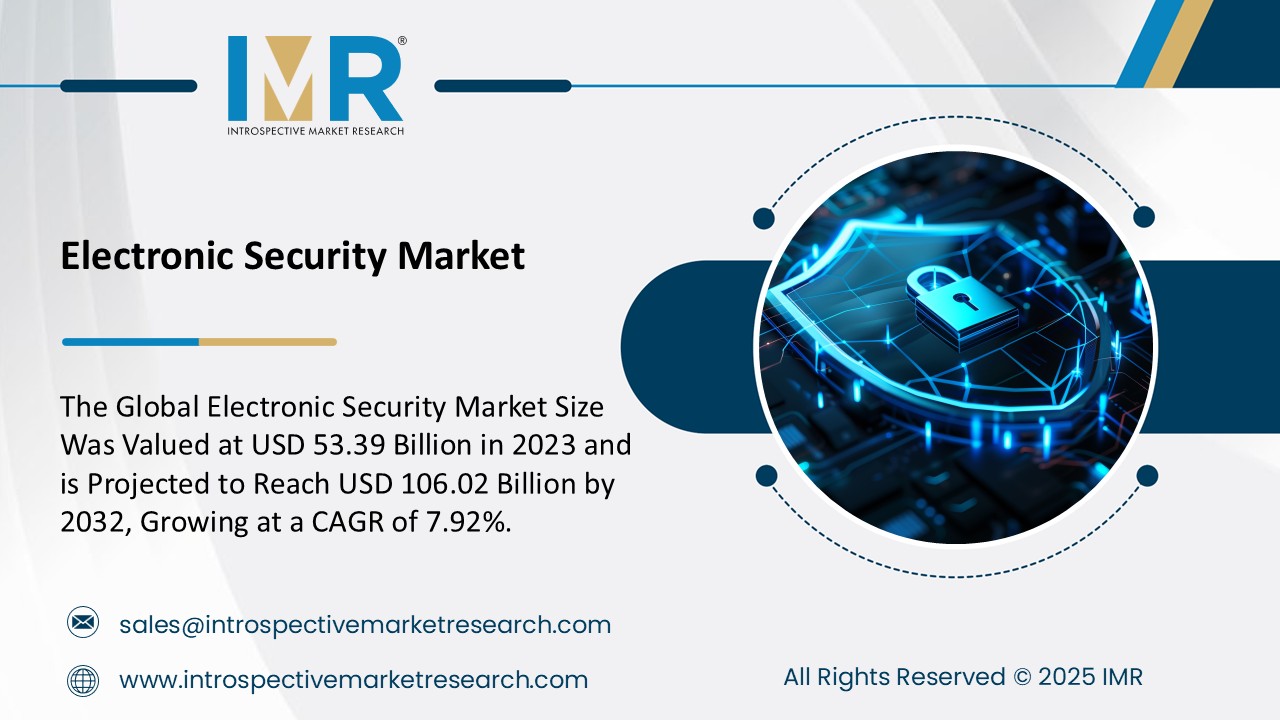
According to a new report published by Introspective Market Research, titled, Electronic Security Market by Component, Deployment Mode, and End Use, the Global Electronic Security Market Size Was Valued at USD 53.39 Billion in 2023 and is Projected to Reach USD 106.02 Billion by 2032, Growing at a CAGR of 7.92%.? The electronic security market comprises technologically advanced solutions designed to safeguard assets, infrastructure, and individuals through surveillance, access control, and intrusion detection systems. Compared to traditional security measures, electronic methods (such as smart CCTV, biometric access systems, and alarm management) deliver enhanced automation, rapid incident response, and deeper integration with IT and smart building platforms. The rising incidences of security breaches, coupled with the integration of AI and IoT, are driving market expansion globally.
Major industries where electronic security finds extensive adoption include banking and financial services, transportation, utilities, retail, government, and residential complexes. Their advantages—real-time monitoring, remote access, and ease of scalability—make these solutions prime choices for critical infrastructure, smart city projects, and large commercial establishments.
The Electronic Security Market is segmented into Component, Deployment Mode, and End Use. By Component, the market is categorized into Solution (Surveillance, Access Control, Intrusion Detection, etc.) and Service (Managed Security, Maintenance, etc.). By Deployment Mode, it is categorized into On-premises and Cloud-based. By End Use, it is segmented into Commercial, Residential, Government, Industrial, and others.
Widespread adoption of cloud-based security systems is fueling market growth, enabling centralized real-time monitoring, remote access, and seamless integration across locations. These solutions reduce the need for costly local infrastructure and offer flexible scalability, making them highly attractive for organizations seeking streamlined and efficient security management, especially in rapidly digitizing sectors.
Emerging smart city initiatives and broad infrastructure development in Asia-Pacific present significant opportunities for electronic security vendors. Governments and private organizations are increasing investments in intelligent surveillance, data-driven access control, and security integration for transport, utilities, and urban centers, opening new avenues for growth with advanced, interconnected systems.
Electronic Security Market, Segmentation
The Electronic Security Market is segmented on the basis of Component, Deployment Mode, and End Use.
Component
The Component segment is further classified into Solution and Service. Among these, the Solution sub-segment accounted for the highest market share in 2023. Electronic security solutions—primarily surveillance cameras, access control, and intrusion detection—are central to both public and private sector safety strategies, reflecting their critical role in real-time incident detection, response, and investigation. Growing demand for integrated end-to-end platforms strengthens this segment’s lead.
Deployment Mode
The Deployment Mode segment is further classified into On-premises and Cloud-based. Among these, the On-premises sub-segment accounted for the highest market share in 2023. Despite surging cloud adoption, on-premises solutions dominate due to tighter data control, regulatory compliance, and preference in high-security environments such as defense and government infrastructure. However, the cloud-based segment is projected to expand at a faster rate through 2032 as organizations seek flexibility and cost efficiencies.
Some of The Leading/Active Market Players Are-
- ADT Inc. (United States)
- Johnson Controls International plc (Ireland)
- Honeywell International Inc. (United States)
- Robert Bosch GmbH (Germany)
- Siemens AG (Germany)
- Hangzhou Hikvision Digital Technology Co., Ltd. (China)
- ASSA ABLOY AB (Sweden)
- Axis Communications AB (Sweden)
- Zhejiang Dahua Technology Co., Ltd. (China)
- Genetec Inc. (Canada)
- Avigilon Corporation (Canada)
- Aiphone Co., Ltd. (Japan)
- Teledyne FLIR LLC (United States)
- NAPCO Security Technologies (United States)
- MOBOTIX AG (Germany)
- Other active players.
Key Industry Developments
In March 2025, ADT Inc. launched an AI-powered surveillance system integrating real-time threat prediction for commercial facilities. This next-generation platform combines advanced analytics and IoT sensors to optimize incident response, aiming to set a new benchmark in proactive safety management.
The system leverages intelligent pattern recognition and cloud connectivity to automate safety protocols, enabling seamless collaboration between security staff and law enforcement. ADT’s innovation is expected to accelerate adoption in retail, logistics, and public infrastructure applications.
In July 2024, Honeywell introduced a unified building security suite offering integrated access control, video surveillance, and fire detection for smart cities. The platform uses wireless protocols and predictive analytics for real-time urban protection.
This solution improves operational efficiency and scalability for municipal and private sector clients, providing a robust framework for urban security, especially in high-density environments and critical infrastructure protection.
Key Findings of the Study
- Solutions segment led market share in 2023
- Asia-Pacific dominates regional demand; North America fastest-growing region
- Cloud-based systems and AI integration are key growth drivers
- Smart city development and rapid urbanization propel market expansion
- Market CAGR projected at 7.92% from 2024 to 2032