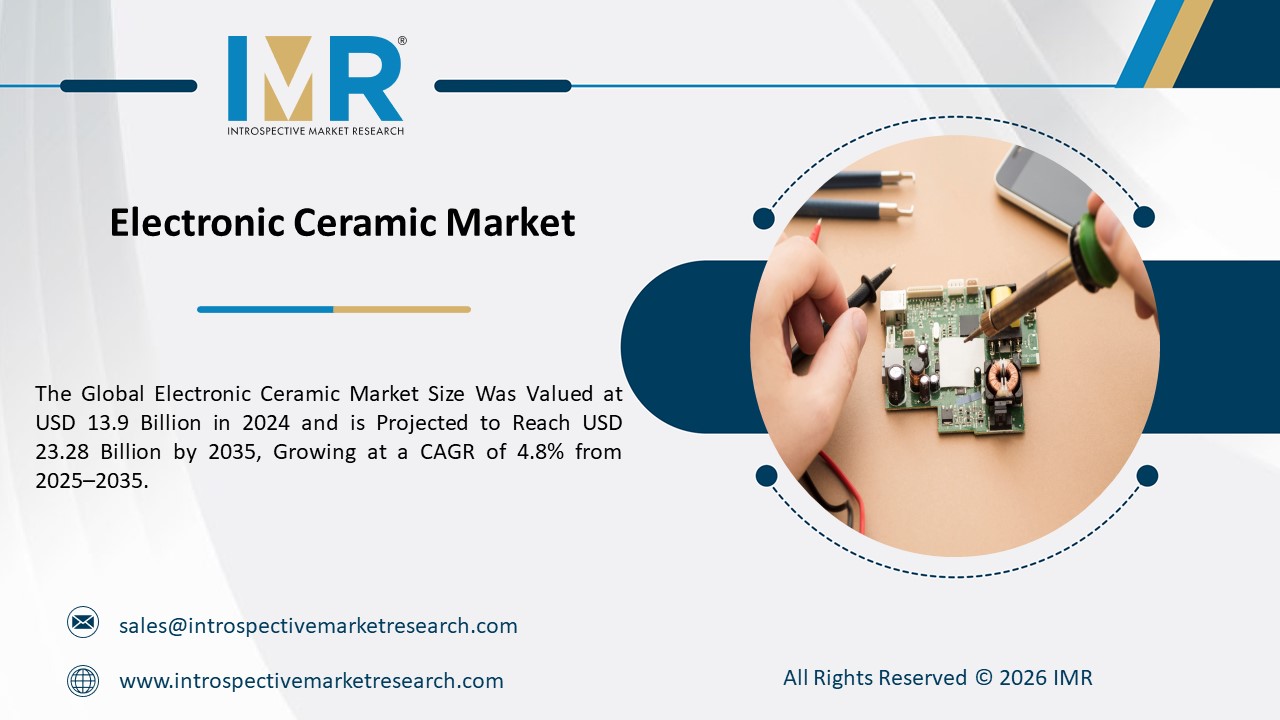
“According to a new report published by Introspective Market Research, titled, Electronic Ceramic Market by Material Type, Application, and End-Use Industry, The Global Electronic Ceramic Market Size Was Valued at USD 13.9 Billion in 2024 and is Projected to Reach USD 23.28 Billion by 2035, Growing at a CAGR of 4.8% from 2025–2035.”
The electronic ceramic market plays a critical role in modern electronics by providing materials with superior electrical, thermal, and mechanical properties. Electronic ceramics are inorganic, non-metallic materials widely used in components such as capacitors, resistors, sensors, actuators, and substrates. Compared to traditional materials, electronic ceramics offer high dielectric strength, excellent insulation, thermal stability, and resistance to harsh environmental conditions, making them indispensable in advanced electronic systems.
These materials are extensively utilized across industries such as consumer electronics, automotive, telecommunications, healthcare, and industrial manufacturing. The rapid adoption of electric vehicles, expansion of 5G infrastructure, and increasing demand for miniaturized, high-performance electronic components are significantly driving market growth. Continuous advancements in material science and manufacturing technologies further enhance the performance and reliability of electronic ceramics.
Moreover, the growing focus on energy efficiency, smart devices, and automation is accelerating the use of electronic ceramics in next-generation applications. With increasing investments in electronics production and R&D worldwide, the electronic ceramic market is expected to witness steady growth throughout the forecast period.
Market Segmentation
The Electronic Ceramic Market is segmented into Material Type, Application, and End-Use Industry.
- By Material Type, the market is categorized into Alumina, Titanate, Zirconia, Ferrite, and Others.
- By Application, the market is categorized into Capacitors, Resistors, Inductors, Sensors & Actuators, and Substrates.
- By End-Use Industry, the market is categorized into Consumer Electronics, Automotive, Telecommunications, Healthcare, Industrial, and Others.
Growth Driver
One of the key growth drivers of the electronic ceramic market is the rising demand for advanced electronic components in consumer electronics and automotive applications. The proliferation of smartphones, wearable devices, smart home systems, and electric vehicles has increased the need for compact, reliable, and high-performance electronic components. Electronic ceramics provide superior dielectric properties, thermal resistance, and durability, making them ideal for use in high-frequency and high-voltage applications. Additionally, the shift toward electrification in vehicles and the integration of advanced driver-assistance systems (ADAS) are further boosting the adoption of electronic ceramic components globally.
Market Opportunity
A major market opportunity lies in the expansion of 5G networks and next-generation communication technologies. The deployment of 5G infrastructure requires high-performance ceramic capacitors, substrates, and filters capable of operating at high frequencies with minimal signal loss. Emerging applications such as the Internet of Things (IoT), artificial intelligence, and renewable energy systems also present lucrative growth opportunities. Furthermore, increasing investments in semiconductor manufacturing and electronics production in emerging economies are expected to create new avenues for market expansion during the forecast period.
Detailed Segmentation
Electronic Ceramic Market, Segmentation
The Electronic Ceramic Market is segmented on the basis of Material Type, Application, and End-Use Industry.
Material Type
The Material Type segment is further classified into Alumina, Titanate, and Zirconia. Among these, the Alumina sub-segment accounted for the highest market share in 2024. Alumina-based electronic ceramics are widely used due to their excellent electrical insulation, high thermal conductivity, mechanical strength, and cost-effectiveness. These properties make alumina ceramics suitable for substrates, insulators, and packaging applications in consumer electronics, automotive electronics, and industrial equipment. Their widespread availability and proven performance continue to support their dominance in the market.
Application
The Application segment is further classified into Capacitors, Resistors, and Sensors & Actuators. Among these, the Capacitors sub-segment accounted for the highest market share in 2024. Electronic ceramic capacitors are essential components in nearly all electronic devices, offering high capacitance, reliability, and stability across a wide range of operating conditions. The growing demand for miniaturized and high-capacity capacitors in smartphones, electric vehicles, and telecommunications equipment has significantly contributed to the strong growth of this sub-segment.
Some of The Leading/Active Market Players Are-
-
Kyocera Corporation (Japan)
-
Murata Manufacturing Co., Ltd. (Japan)
-
TDK Corporation (Japan)
-
CoorsTek Inc. (USA)
-
Morgan Advanced Materials (UK)
-
CeramTec GmbH (Germany)
-
NGK Insulators, Ltd. (Japan)
-
Taiyo Yuden Co., Ltd. (Japan)
-
Samsung Electro-Mechanics (South Korea)
-
Toshiba Materials Co., Ltd. (Japan)
-
Maruwa Co., Ltd. (Japan)
-
CTS Corporation (USA)
-
Yokowo Co., Ltd. (Japan)
-
Ferro Corporation (USA)
-
Surmet Corporation (USA)
- and other active players.
Key Industry Developments
In March 2024, a leading electronic ceramic manufacturer announced the expansion of its production facility to meet rising demand from the electric vehicle and semiconductor industries.
This expansion aims to increase manufacturing capacity for high-performance ceramic substrates and capacitors, enabling the company to strengthen its global supply chain and cater to growing demand for advanced electronic components.
In October 2024, a major market player launched a new range of high-frequency ceramic components designed for 5G and IoT applications.
The newly introduced products offer improved signal stability, thermal performance, and miniaturization, supporting next-generation communication technologies and reinforcing the company’s competitive position in the global market.
Key Findings of the Study
-
Alumina dominates the material type segment due to cost-effectiveness and strong performance.
-
Capacitors represent the leading application segment globally.
-
Asia-Pacific holds the largest market share, driven by electronics manufacturing hubs.
-
Growth is fueled by EV adoption, 5G expansion, and consumer electronics demand.