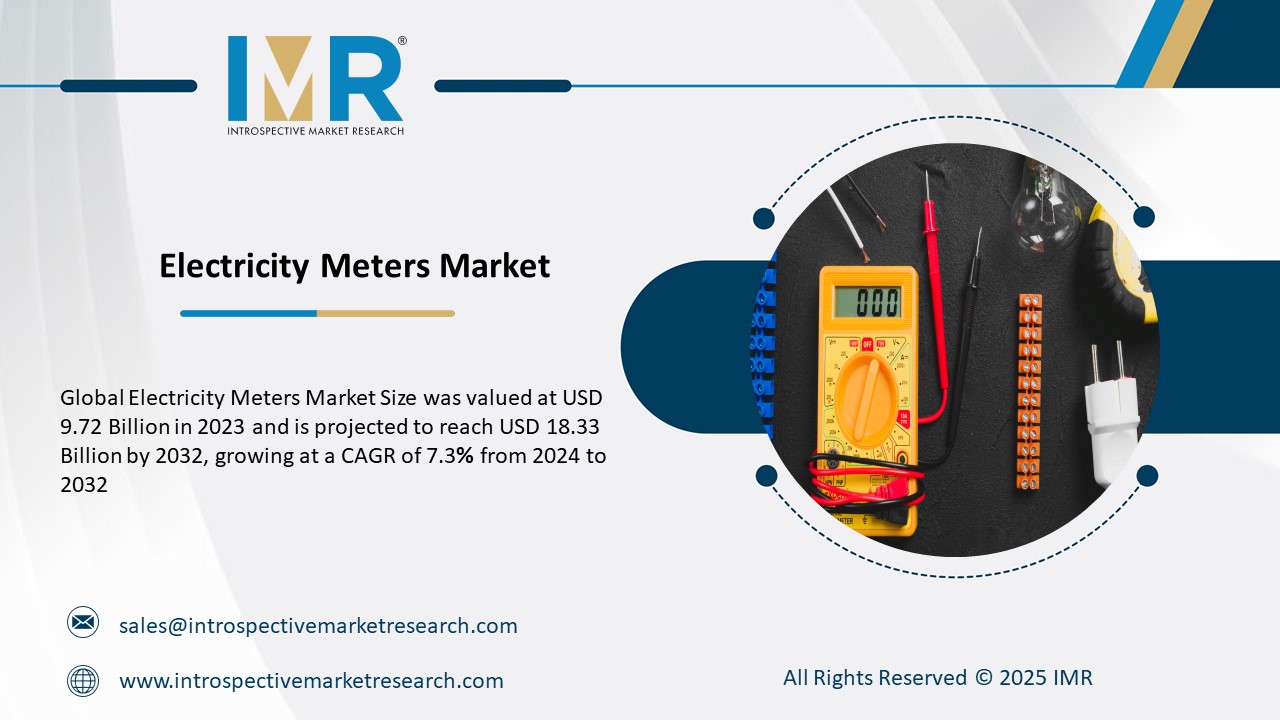
According to a new report published by Introspective Market Research, titled “Electricity Meters Market by Type, Technology, and End-User Industry,” the Global Electricity Meters Market Size was valued at USD 9.72 Billion in 2023 and is projected to reach USD 18.33 Billion by 2032, growing at a CAGR of 7.3% from 2024 to 2032.The Electricity Meters Market is witnessing significant growth, driven by increasing investments in smart grid infrastructure, renewable energy integration, and energy efficiency initiatives worldwide. Electricity meters, including traditional electromechanical meters and advanced smart meters, play a crucial role in monitoring energy consumption, billing, and demand-side management.
The rising adoption of smart meters is transforming the energy ecosystem, enabling real-time data monitoring, remote control, and predictive analytics. Utilities are increasingly deploying advanced metering infrastructure (AMI) to enhance operational efficiency, reduce energy losses, and improve customer service. Furthermore, government initiatives promoting energy conservation and sustainability are creating favorable market conditions globally.
The Electricity Meters Market is segmented by Type, Technology, and End-User Industry.
-
By Type: Single-Phase, Three-Phase
-
By Technology: Electromechanical, Electronic, Smart Meters
-
By End-User Industry: Residential, Commercial, Industrial
A key growth driver for the Electricity Meters Market is the global shift toward smart grid technologies. The integration of smart meters enables utilities to remotely monitor consumption patterns, detect outages, and implement dynamic pricing models. Additionally, rising urbanization, increasing electricity demand, and stringent energy regulations are compelling governments and private utilities to adopt advanced metering solutions, thereby accelerating market growth.
The adoption of IoT-enabled and wireless smart meters offers a significant market opportunity. These advanced meters provide real-time data analytics, predictive maintenance, and automated reporting, which help optimize energy distribution and reduce operational costs. Growing investments in renewable energy, coupled with incentives for energy-efficient infrastructure, are expected to further boost demand for smart electricity meters over the forecast period.
Electricity Meters Market, Segmentation
The Electricity Meters Market is segmented on the basis of Type, Technology, and End-User Industry.
By Type
The Single-Phase segment dominated the market in 2023, accounting for the majority of residential applications due to cost-effectiveness and compatibility with household electrical loads.
By Technology
The Smart Meters segment is projected to grow at the highest CAGR during the forecast period, driven by increasing deployment of AMI systems, government mandates, and rising demand for accurate, real-time energy data.
Regional Insights
Asia-Pacific held the largest share in the global electricity meters market in 2023, led by rapid urbanization, government initiatives for smart grid deployment, and increasing electricity demand in countries such as China, India, and Japan. Europe and North America are expected to witness steady growth due to strong adoption of smart metering technologies and energy efficiency regulations.
Leading Market Players
Prominent companies operating in the Electricity Meters Market include:
- Schneider Electric SE (France)
- Siemens AG (Germany)
- Itron, Inc. (U.S.)
- Landis+Gyr AG (Switzerland)
- ABB Ltd. (Switzerland)
- Honeywell International Inc. (U.S.)
- Elster Group GmbH (Germany)
- Kamstrup A/S (Denmark)
- Wasion Group Holdings Ltd. (China)
- Hexing Electrical Co., Ltd. (China)
- Other active players.
Recent Industry Developments
- In March 2024, Siemens AG launched an advanced smart meter platform with IoT integration, enabling real-time energy monitoring and predictive analytics for utilities.
- In September 2023, Schneider Electric announced a strategic partnership with major Asian utilities to deploy over 5 million smart electricity meters across residential and commercial sectors.
Key Findings of the Study
- Smart Meters are the fastest-growing technology segment.
- Single-Phase meters dominate residential applications.
- Asia-Pacific is the leading regional market, followed by Europe and North America.
- Investments in smart grid infrastructure and IoT-enabled devices are key growth enablers.