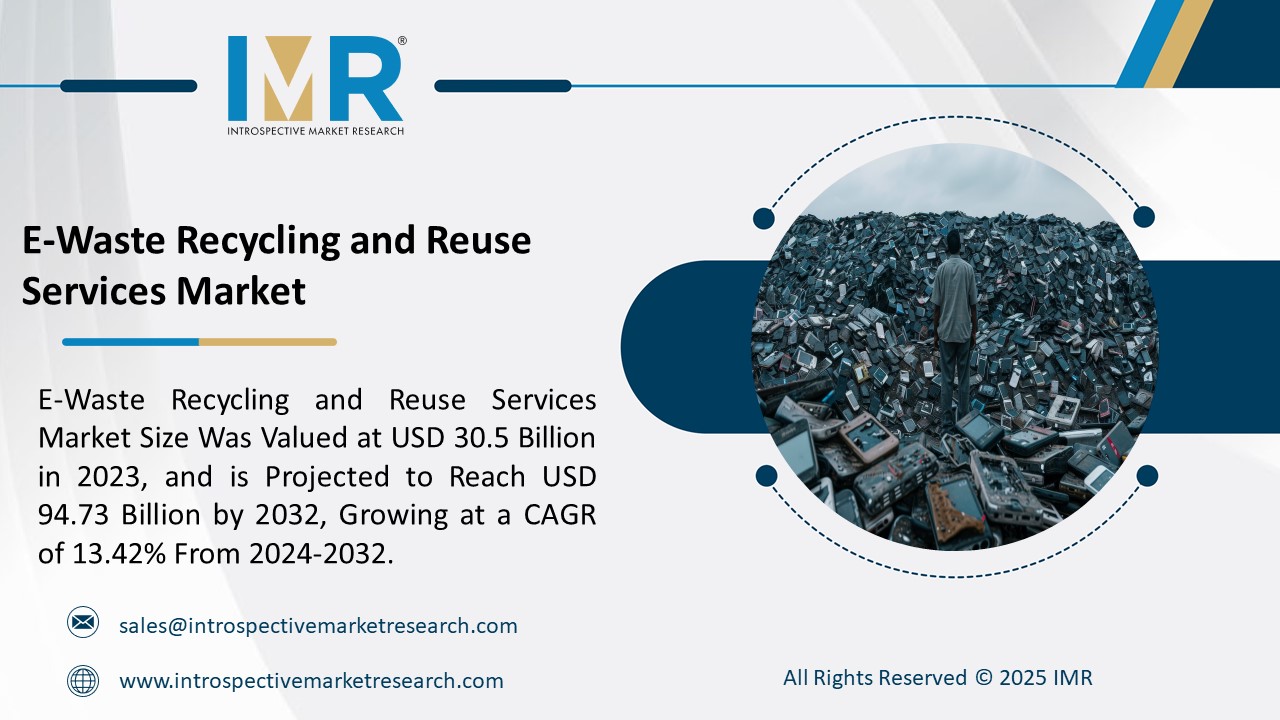
According to a new report published by Introspective Market Research, titled, E-Waste Recycling and Reuse Services Market by Waste Source (Household Appliances, IT & Telecom Equipment, Consumer Electronics, Medical Equipment, Industrial & Commercial Electronics), by Material Recovered (Metals, Plastics, Glass, Others), by Service Type (Recycling, Reuse & Refurbishment, Collection & Transportation, Data Destruction), The Global E-Waste Recycling and Reuse Services Market Size Was Valued at USD 30.5 Billion in 2023 and is Projected to Reach USD 94.73 Billion by 2032, Growing at a CAGR of 13.42% from 2024 to 2032. The E-Waste Recycling and Reuse Services Market is dedicated to the collection, processing, and recovery of valuable materials from discarded electronic and electrical equipment, while also facilitating the repair and reintroduction of functional devices back into circulation. These services address the escalating problem of electronic waste (e-waste) by diverting harmful substances from landfills and conserving finite natural resources. Unlike traditional waste management, e-waste services focus on maximizing resource recovery and minimizing environmental impact. Major users include governments, businesses (IT & telecom, manufacturing, healthcare), and individual consumers, all seeking sustainable solutions for their obsolete electronics.
The rapid obsolescence of electronic devices, coupled with growing environmental awareness and stricter regulatory frameworks, is creating a robust demand for efficient and responsible e-waste management solutions. This market plays a critical role in promoting circular economy principles globally.
The rapid increase in the generation of electronic waste, fueled by accelerated technological obsolescence and consumer demand for new devices, is the primary growth driver for the E-Waste Recycling and Reuse Services Market. As smartphones, laptops, and other electronics have shorter lifespans, vast quantities of e-waste accumulate annually. This growing waste stream necessitates sophisticated recycling and reuse infrastructure to extract valuable materials and prevent hazardous substances from harming the environment, thereby continuously expanding the demand for specialized services.
The increasing focus on circular economy principles and the recovery of critical raw materials present a significant market opportunity. E-waste contains valuable metals like gold, silver, copper, and rare earth elements, which are finite resources. As geopolitical tensions affect supply chains and sustainability goals become paramount, governments and industries are prioritizing the extraction of these materials from e-waste. This shift creates lucrative prospects for advanced recycling technologies and services capable of efficiently recovering high-value resources, reducing reliance on virgin materials, and fostering a more sustainable economy.
E-Waste Recycling and Reuse Services Market, Segmentation
The E-Waste Recycling and Reuse Services Market is segmented on the basis of Waste Source, Material Recovered, and Service Type.
Waste Source
-
The Waste Source segment is further classified into Household Appliances, IT & Telecom Equipment, Consumer Electronics, Medical Equipment, and Industrial & Commercial Electronics. Among these, the IT & Telecom Equipment sub-segment accounted for the highest market share in 2023. This dominance stems from the high volume and rapid refresh cycles of devices such as computers, laptops, servers, smartphones, and network equipment. Businesses and individuals frequently upgrade these items, leading to a substantial and consistent flow of waste that requires specialized handling due to the presence of both valuable materials and potentially hazardous components, driving demand for dedicated recycling and reuse services.
Material Recovered
- The Material Recovered segment is further classified into Metals, Plastics, Glass, and Others. Among these, the Metals sub-segment accounted for the highest market share in 2023. E-waste is a rich source of various metals, including precious metals like gold, silver, and platinum, as well as base metals like copper and aluminum. The high market value of these recovered metals makes their extraction a highly profitable aspect of e-waste recycling. Advances in metallurgical recovery processes allow for efficient separation and purification, incentivizing investment in services that can effectively reclaim these valuable resources, reducing the need for virgin mining and promoting resource circularity.
Some of The Leading/Active Market Players Are-
- Veolia Environnement S.A. (France)
- Suez S.A. (France)
- Remondis SE & Co. KG (Germany)
- Stena Metall Group (Sweden)
- WM (Waste Management) (US)
- E-Waste Systems, Inc. (EWSI) (US)
- Sims Limited (Australia)
- Tes (Singapore)
- Electronic Recyclers International (ERI) (US)
- Umicore (Belgium)
- Enviro-Hub Holdings Ltd (Singapore)
- Aurubis AG (Germany)
- Boliden AB (Sweden)
- Global Electric Electronic Processing (GEEP) (Canada)
- Re-Teck (China)
- other active players.
Key Industry Developments
- In January 2023, Sims Limited announced the expansion of its e-waste recycling capabilities in North America with the opening of a new advanced facility in California. This expansion aimed to address the growing volume of e-waste in the region, particularly from data centers and corporate clients. The facility integrates cutting-edge processing technology to maximize the recovery of valuable materials and ensure environmentally sound management of electronic scrap.
- In September 2022, Umicore, a global materials technology and recycling group, announced a significant investment in expanding its precious metal refining capacity for e-waste. This investment was driven by the increasing demand for critical raw materials from electronic devices and aimed to strengthen Umicore's position as a leader in urban mining. The expansion is expected to enhance the efficiency of extracting gold, silver, and other valuable metals from complex electronic scrap streams.
Key Findings of the Study
- IT & Telecom equipment is the largest waste source segment.
- Metals recovered represent the most valuable material segment.
- Rapid growth in e-waste generation is the primary market driver.
- Circular economy and critical raw material recovery offer significant opportunities.