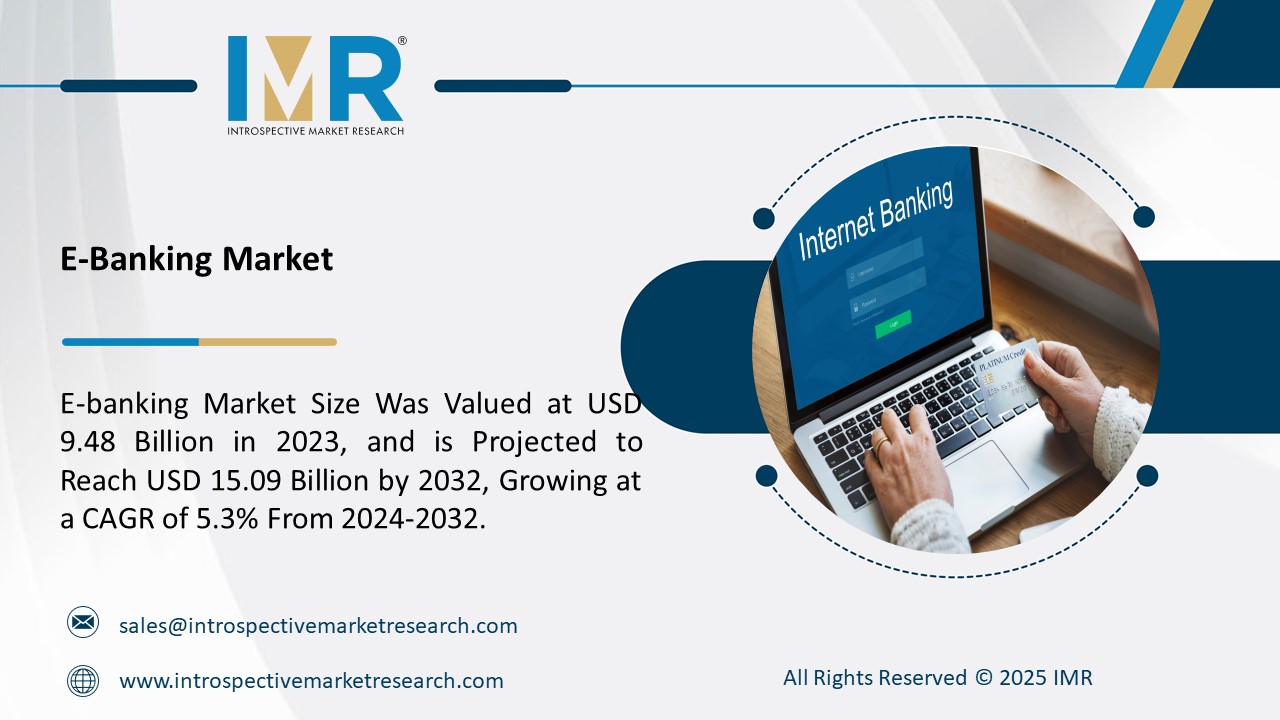
According to a new report published by Introspective Market Research, titled, E-Banking Market by Service Type, Deployment, and End-User, The Global E-Banking Market Size Was Valued at USD 9.48 Billion in 2023 and is Projected to Reach USD 15.09 Billion by 2032, Growing at a CAGR of 5.3%. The global E-Banking market is experiencing steady growth as consumers and businesses increasingly shift toward digital financial services. E-Banking encompasses online banking platforms, mobile banking apps, and electronic payment solutions that provide customers with secure, convenient, and real-time access to their financial accounts. These services reduce the reliance on traditional branch-based banking, lowering operational costs and improving service efficiency.
Compared to conventional banking, E-Banking offers several advantages, including 24/7 access to accounts, instant fund transfers, automated bill payments, and improved transparency. The increasing preference for cashless transactions and digital financial management has driven the adoption of E-Banking across retail, corporate, and SME sectors. The rise of fintech innovations, coupled with regulatory support for digital financial infrastructure, is further expanding the E-Banking ecosystem. Cloud technology, AI-powered chatbots, biometric authentication, and blockchain solutions are transforming traditional banking operations into more secure, efficient, and customer-centric services, fueling market growth globally.
The E-Banking Market is segmented into Service Type, Deployment, and End-User. By Service Type, the market is categorized into (Retail Banking, Corporate Banking, Wealth Management, and Others). By Deployment, the market is categorized into (Cloud-Based, On-Premises, and Hybrid). By End-User, the market is categorized into (Individual Consumers, Small & Medium Enterprises, Large Enterprises, and Government Organizations).
A major growth driver for the E-Banking market is the increasing adoption of smartphones and internet connectivity worldwide. With digital literacy rising and mobile banking apps becoming more user-friendly, consumers now prefer convenient, on-the-go banking solutions. Banks and financial institutions are investing heavily in digital platforms, offering secure, real-time services such as account management, fund transfers, and payments. This shift toward digital-first banking reduces operational costs, enhances customer satisfaction, and encourages adoption of e-wallets, contactless payments, and other online banking services, thus driving significant growth in the global E-Banking market.
The growing integration of advanced technologies such as AI, blockchain, and cybersecurity solutions presents a major opportunity for the E-Banking market. AI enables personalized banking experiences, predictive analytics, and automated customer service, while blockchain ensures secure, transparent, and tamper-proof transactions. Moreover, governments and regulatory authorities worldwide are promoting cashless economies, encouraging financial inclusion, and incentivizing digital payment systems. These factors create an opportunity for banks and fintech companies to expand their digital service offerings, reach underserved populations, and enhance operational efficiency, further accelerating market growth over the forecast period.
E-Banking Market, Segmentation
The E-Banking Market is segmented on the basis of Service Type, Deployment, and End-User.
By Service Type: The Service Type segment is further classified into Retail Banking, Corporate Banking, Wealth Management, and Others. Among these, the Retail Banking sub-segment accounted for the highest market share in 2023. Retail Banking dominates due to the increasing demand for convenient, digital-first solutions for everyday financial transactions. Services such as mobile banking apps, online account management, and digital payments are widely used by individual consumers. The adoption of digital wallets and e-wallet services has further strengthened the position of Retail Banking, providing seamless, secure, and efficient banking experiences for millions of customers globally.
By Deployment: The Deployment segment is further classified into Cloud-Based, On-Premises, and Hybrid. Among these, the Cloud-Based sub-segment accounted for the highest market share in 2023. Cloud-based E-Banking platforms enable financial institutions to reduce IT infrastructure costs while providing scalable, flexible, and secure services. Banks can deploy applications rapidly, ensure real-time updates, and maintain compliance with regulatory standards. The flexibility offered by cloud deployment allows institutions to integrate advanced analytics, AI, and cybersecurity measures, providing an improved digital banking experience for both individual and corporate customers.
Some of The Leading/Active Market Players Are
- JPMorgan Chase & Co. (USA)
- Bank of America (USA)
- Citigroup Inc. (USA)
- HSBC Holdings plc (UK)
- BNP Paribas (France)
- Wells Fargo & Company (USA)
- Deutsche Bank AG (Germany)
- Standard Chartered Bank (UK)
- Barclays plc (UK)
- ICICI Bank Limited (India)
- HDFC Bank Limited (India)
- Banco Santander (Spain)
- Mitsubishi UFJ Financial Group (Japan)
- ING Group (Netherlands)
- Royal Bank of Canada (Canada) and other active players.
Key Industry Developments
-
In March 2024, JPMorgan Chase launched its new AI-powered mobile banking platform for retail customers. The platform integrates real-time financial insights, predictive spending analysis, and automated budgeting tools. It allows users to manage multiple accounts, schedule payments, and receive fraud alerts seamlessly. This initiative strengthens customer engagement and positions the bank as a leader in digital banking innovation.
- In November 2023, HSBC introduced a blockchain-based cross-border payment solution for SMEs. The service enables instant, secure, and low-cost international transactions. SMEs benefit from real-time tracking, reduced transaction fees, and faster settlement cycles. The blockchain solution also enhances transparency, security, and compliance with global financial regulations, creating a competitive edge for HSBC in the digital banking sector.
Key Findings of the Study
- Retail Banking dominates the service type segment.
- Cloud-Based deployment is the preferred choice among financial institutions.
- North America and Europe are leading regions due to high digital adoption and regulatory support.
- Smartphone penetration and online payment adoption are key growth drivers.
- AI, blockchain, and digital transformation present significant future opportunities.