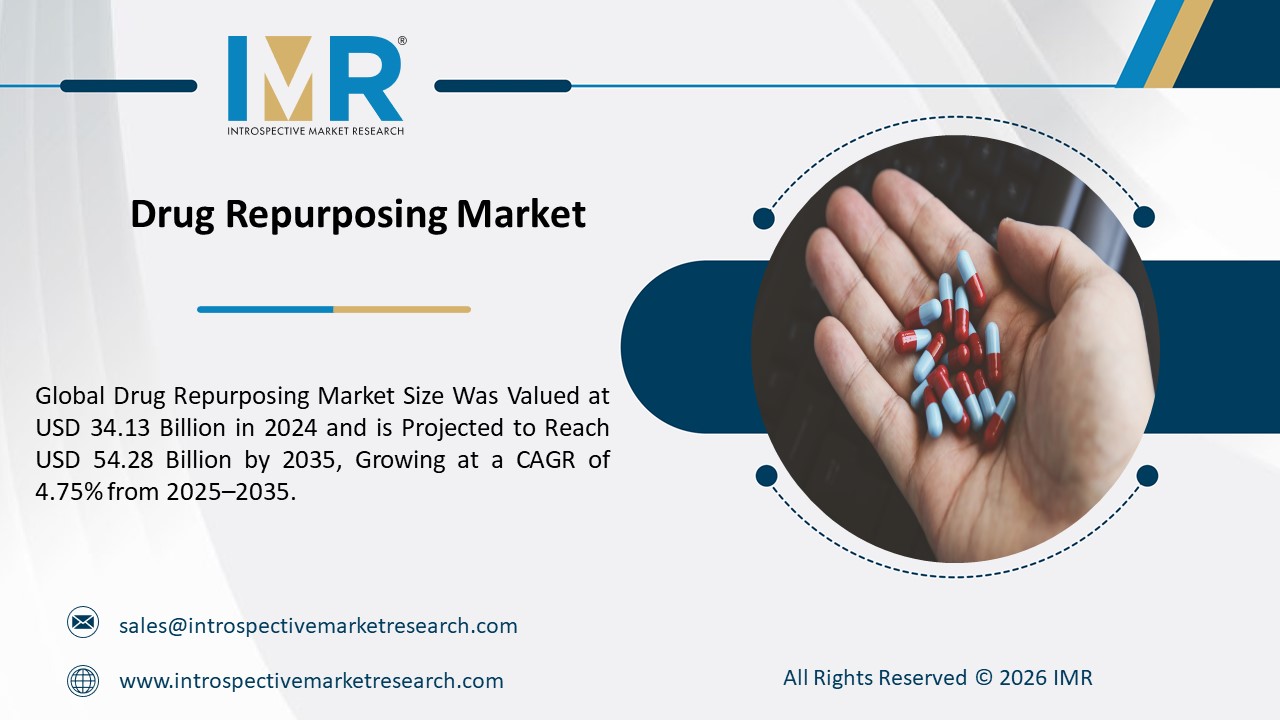
“According to a new report published by Introspective Market Research, titled, Drug Repurposing Market by Therapeutic Area, Drug Type, and End User, The Global Drug Repurposing Market Size Was Valued at USD 34.13 Billion in 2024 and is Projected to Reach USD 54.28 Billion by 2035, Growing at a CAGR of 4.75% from 2025–2035.”
The drug repurposing market, also known as drug repositioning, focuses on identifying new therapeutic uses for existing or previously approved drugs. This approach significantly reduces the time, cost, and risk associated with traditional drug discovery, as repurposed drugs have already undergone extensive safety and toxicity testing. As a result, pharmaceutical and biotechnology companies increasingly adopt drug repurposing strategies to accelerate product development and improve return on investment.
Drug repurposing plays a critical role across major therapeutic areas such as oncology, neurology, infectious diseases, and rare disorders. Advances in computational biology, artificial intelligence, and genomics have further strengthened the market by enabling faster target identification and data-driven validation. Growing unmet medical needs, rising R&D costs, and the urgency to address emerging diseases continue to position drug repurposing as a strategic pillar of modern drug development.
Market Segmentation
The Drug Repurposing Market is segmented into Therapeutic Area, Drug Type, and End User.
- By Therapeutic Area, the market is categorized into Oncology, Neurology, Cardiovascular Diseases, Infectious Diseases, and Others.
- By Drug Type, the market is categorized into Small Molecules and Biologics.
- By End User, the market is categorized into Pharmaceutical Companies, Biotechnology Companies, and Research Institutes & Academic Centers.
Growth Driver
One of the key growth drivers of the drug repurposing market is the escalating cost and extended timelines associated with traditional drug discovery. Developing a novel drug can take over a decade and require multi-billion-dollar investments, with a high probability of clinical failure. Drug repurposing offers a cost-effective alternative by leveraging existing safety and pharmacokinetic data, enabling faster clinical trials and regulatory approvals. This efficiency is particularly attractive for addressing urgent medical needs, rare diseases, and conditions with limited treatment options, thereby driving sustained market growth.
Market Opportunity
The integration of artificial intelligence, machine learning, and big data analytics presents a significant market opportunity for drug repurposing. Advanced computational platforms can analyze vast biomedical datasets, identify novel drug-disease associations, and predict clinical outcomes with greater accuracy. These technologies enhance decision-making and reduce development risks, encouraging collaborations between technology firms, academic institutions, and pharmaceutical companies. Additionally, increasing government and non-profit funding for rare and neglected diseases further expands the scope of drug repurposing initiatives worldwide.
Detailed Segmentation
Drug Repurposing Market, Segmentation
The Drug Repurposing Market is segmented on the basis of Therapeutic Area, Drug Type, and End User.
Therapeutic Area
The Therapeutic Area segment is further classified into Oncology, Neurology, Cardiovascular Diseases, Infectious Diseases, and Others. Among these, the Oncology sub-segment accounted for the highest market share in 2024. The dominance of oncology is attributed to the high prevalence of cancer globally and the urgent need for effective and affordable treatment options. Repurposed drugs enable faster clinical evaluation for new cancer indications, supported by strong research activity and increasing collaborations between academic institutions and pharmaceutical companies.
Drug Type
The Drug Type segment is further classified into Small Molecules and Biologics. Among these, the Small Molecules sub-segment accounted for the highest market share in 2024. Small-molecule drugs are widely favored due to their well-established manufacturing processes, oral bioavailability, and extensive historical clinical data. Their chemical versatility allows researchers to explore multiple therapeutic indications efficiently, making them a preferred choice for repurposing programs across diverse disease areas.
Some of The Leading/Active Market Players Are-
• Pfizer Inc. (U.S.) • Novartis AG (Switzerland) • Johnson & Johnson (U.S.) • GlaxoSmithKline plc (U.K.) • Sanofi S.A. (France) • Eli Lilly and Company (U.S.) • AstraZeneca plc (U.K.) • Bayer AG (Germany) • Roche Holding AG (Switzerland) • AbbVie Inc. (U.S.) • Takeda Pharmaceutical Company Limited (Japan) • Teva Pharmaceutical Industries Ltd. (Israel) • Dr. Reddy’s Laboratories Ltd. (India) • Sun Pharmaceutical Industries Ltd. (India)
and other active players.
Key Industry Developments
In March 2024, a leading pharmaceutical company expanded its drug repurposing pipeline to target rare neurological disorders using AI-driven screening platforms.The initiative focuses on analyzing existing compound libraries to identify new therapeutic indications, reducing early-stage development risks and accelerating clinical validation for unmet neurological conditions.
In September 2024, a global research consortium announced a collaboration to repurpose approved antiviral drugs for emerging infectious diseases.The collaboration aims to improve pandemic preparedness by rapidly advancing repurposed therapies into late-stage clinical trials, supported by shared data and regulatory alignment.
Key Findings of the Study
• Oncology emerged as the dominant therapeutic area segment • Small molecules held the largest share by drug type • North America led the market due to strong R&D infrastructure • Rising drug development costs remain a key growth driver • AI-enabled drug repurposing is a major market trend