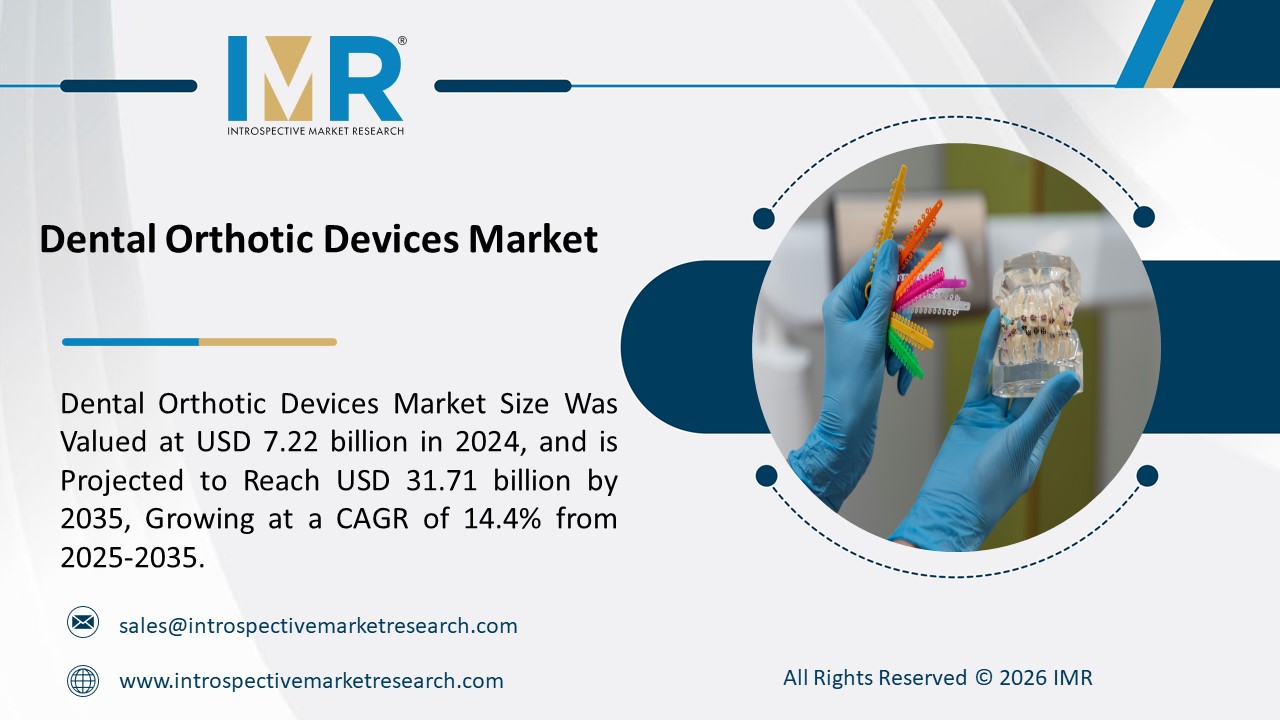
According to a new report published by Introspective Market Research, titled, “Dental Orthotic Devices Market by Product, Application, and End-User,” The Global Dental Orthotic Devices Market Size Was Valued at USD 7.22 Billion in 2024 and is Projected to Reach USD 31.71 Billion by 2035, Growing at a CAGR of 14.4% From 2025–2035.
The Dental Orthotic Devices market comprises specialized oral appliances designed to diagnose, treat, and manage temporomandibular joint (TMJ) disorders, sleep-related breathing disorders like obstructive sleep apnea (OSA), and parafunctional habits such as bruxism (teeth grinding and clenching). Key products include mandibular advancement devices (MADs), night guards/splints, and TMJ orthotics. These devices offer a significant advantage over surgical interventions or pharmacological management by providing a non-invasive, reversible, and often first-line therapeutic approach that can alleviate pain, protect dental structures, and improve airway patency during sleep with minimal side effects.
The paramount growth driver for the dental orthotic devices market is the global epidemic of sleep-disordered breathing, particularly obstructive sleep apnea (OSA), and the mainstream adoption of oral appliance therapy as a primary treatment. With millions of adults worldwide suffering from undiagnosed or untreated OSA a condition linked to hypertension, heart disease, stroke, and daytime fatigue there is immense diagnostic and therapeutic demand. Continuous Positive Airway Pressure (CPAP) machines, while effective, face significant patient compliance issues due to discomfort. Mandibular Advancement Devices (MADs), prescribed by dentists, have emerged as a highly effective, comfortable, and portable alternative for mild to moderate OSA, driving a massive influx of patients into dental practices specializing in sleep medicine and fueling unprecedented market expansion.
A significant market opportunity lies in the integration of digital dentistry, advanced materials, and telehealth for personalized, patient-centric care. The adoption of intraoral scanners and 3D printing allows for the precise digital design and rapid fabrication of fully customized devices, improving fit, comfort, and efficacy. Furthermore, the development of "smart" orthotics embedded with sensors to monitor wear time, jaw position, and treatment efficacy (e.g., apnea-hypopnea index reduction) can provide objective therapy data. Coupled with telehealth platforms for remote patient monitoring and adjustment, these technologies enable a new standard of personalized, data-driven dental sleep medicine, creating high-value offerings and improving long-term patient outcomes and compliance.
Dental Orthotic Devices Market, Segmentation
The Dental Orthotic Devices Market is segmented on the basis of Product, Application, and End-User.
Product
The Product segment is further classified into Mandibular Advancement Devices (MADs), Night Guards/Splints, and TMJ Orthotics. Among these, the Mandibular Advancement Devices (MADs) sub-segment accounted for the highest market share in 2024 and is projected to be the fastest-growing. MADs dominate due to their critical role as the leading dental treatment for Obstructive Sleep Apnea (OSA). By positioning the lower jaw slightly forward, they prevent the collapse of the upper airway during sleep. Their high efficacy for mild-to-moderate OSA, superior patient compliance compared to CPAP, and growing acceptance by sleep physicians and insurance providers have positioned MADs as the flagship product driving the entire dental orthotics market forward.
Application
The Application segment is further classified into Sleep Apnea, Bruxism, and Temporomandibular Joint Disorder (TMD). Among these, the Sleep Apnea application sub-segment accounted for the highest market share in 2024. The sleep apnea segment's leadership is directly linked to the vast and growing addressable patient population and the severe health consequences of untreated OSA. As awareness of sleep apnea's links to systemic health issues increases, more patients are seeking diagnosis and treatment. Oral appliance therapy with MADs has become a standard-of-care option, creating a sustained, large-scale demand that far exceeds the market for devices treating bruxism or TMD alone, though these often co-occur and are treated with combination devices.
Some of The Leading/Active Market Players Are-
• SomnoMed Ltd. (Australia)
• ProSomnus Sleep Technologies (US)
• Oventus Medical (Australia)
• Panthera Dental (Canada)
• DynaFlex (US)
• Myerson LLC (US)
• Glidewell Laboratories (US)
• OravanOSA (Canada)
• Erkodent Erich Kopp GmbH (Germany)
• and other active players.
Key Industry Developments
In February 2025, SomnoMed launched the next generation of its flagship MATRx plus digital sleep therapy platform. The system now integrates at-home sleep test data with digital jaw position scans to virtually simulate and pre-select the optimal mandibular advancement position for an oral appliance before it is even fabricated, aiming to improve first-fit success rates and patient outcomes.
In January 2024, ProSomnus received expanded FDA clearance for its precision oral appliance to treat patients with severe obstructive sleep apnea. This clearance, based on clinical data, positions oral appliance therapy as a viable option for a broader patient population historically limited to CPAP or surgery, significantly expanding the market's addressable patient base and reinforcing the clinical legitimacy of dental devices for sleep disorders.
Key Findings of the Study
• Mandibular Advancement Devices (MADs) and the Sleep Apnea application segment dominate the market.
• North America is the largest regional market, driven by high OSA prevalence and favorable insurance reimbursement.
• The key growth driver is the rising global prevalence of sleep apnea and adoption of oral appliance therapy.
• Major trends include the integration of digital dentistry (3D printing/scanners) and the development of smart, sensor-embedded devices.