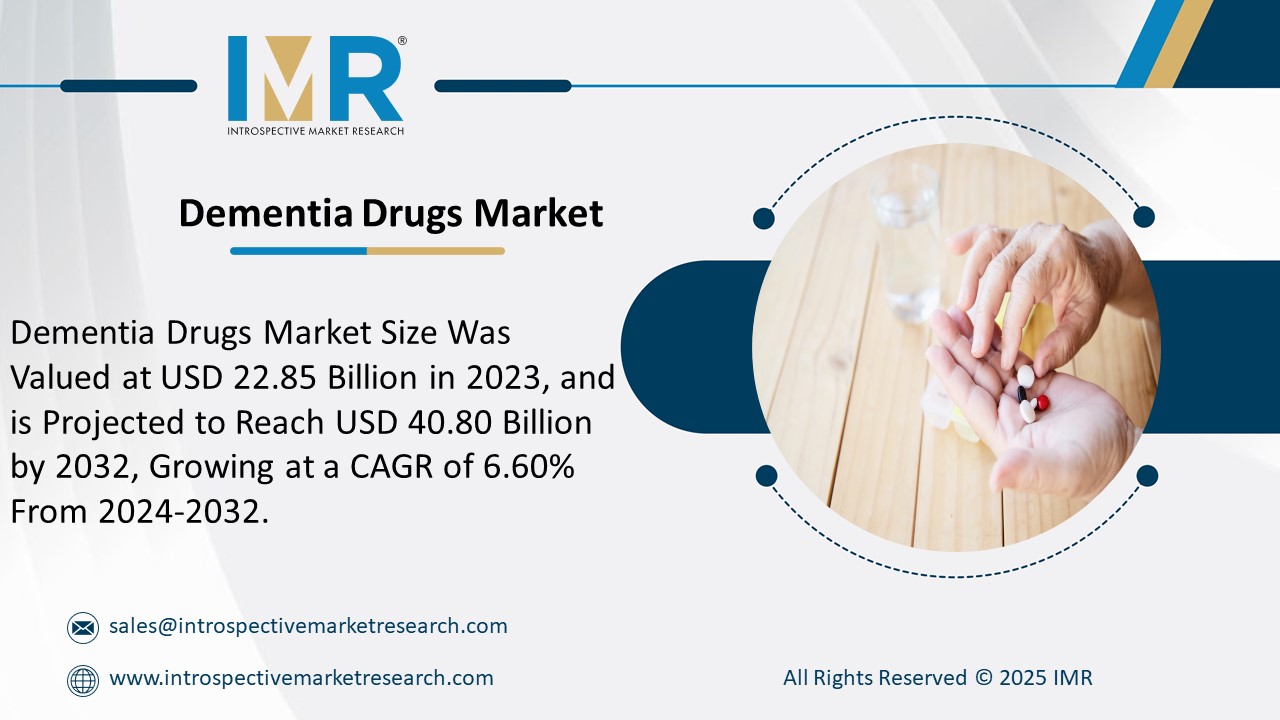
According to a new report published by Introspective Market Research, titled, Dementia Drugs Market by Drug Class, Therapeutic Approach, and Distribution Channel, The Global Dementia Drugs Market Size Was Valued at USD 22.85 Billion in 2023 and is Projected to Reach USD 40.80 Billion by 2032, Growing at a CAGR of 6.60%. The dementia drugs market is witnessing steady growth driven by the increasing prevalence of dementia and related cognitive disorders worldwide. Dementia, encompassing Alzheimer’s disease, vascular dementia, and other neurodegenerative conditions, significantly impairs memory, thinking, and daily functioning. With aging populations and rising life expectancy across major regions, the demand for effective dementia therapies has surged.
Traditionally, acetylcholinesterase inhibitors and NMDA receptor antagonists have dominated treatment approaches, providing symptomatic relief. However, recent innovations in disease-modifying therapies, immunotherapies, and combination drugs are expanding treatment options. Pharmaceutical companies are investing heavily in R&D to develop novel agents targeting the underlying neurodegenerative mechanisms, thereby enhancing patient outcomes.
The market’s growth is further bolstered by increased awareness of cognitive health, improving diagnostic capabilities, and supportive healthcare initiatives. Hospitals, specialty clinics, and online pharmacies are facilitating patient access, contributing to market expansion.
The Dementia Drugs Market is segmented into Drug Class, Therapeutic Approach, and Distribution Channel. By Drug Class, the market is categorized into Acetylcholinesterase Inhibitors, NMDA Receptor Antagonists, Combination Drugs, and Others. By Therapeutic Approach, the market is categorized into Symptomatic Therapy and Disease-Modifying Therapy. By Distribution Channel, the market is categorized into Hospital Pharmacies, Retail Pharmacies, and Online Pharmacies.
A primary growth driver for the dementia drugs market is the rising global geriatric population. Age is a major risk factor for dementia, with the number of elderly individuals increasing rapidly, particularly in North America, Europe, and Asia-Pacific. This demographic trend has led to a corresponding rise in dementia cases, driving demand for effective pharmacological interventions. Coupled with advancements in early diagnosis and awareness programs, pharmaceutical companies are increasingly investing in drug development and treatment accessibility, contributing to sustained market growth over the forecast period.
A key market opportunity lies in disease-modifying therapies (DMTs) for Alzheimer’s and other dementias. Unlike traditional symptomatic treatments, DMTs aim to slow or halt disease progression by targeting underlying neurodegenerative mechanisms, including amyloid beta accumulation and tau protein aggregation. The ongoing development of monoclonal antibodies, immunotherapies, and gene-targeted therapies offers potential breakthroughs. Expanding clinical trials, regulatory support, and reimbursement schemes in developed and emerging markets present lucrative opportunities for pharmaceutical companies to capture a significant share in this evolving therapeutic landscape.
Dementia Drugs Market, Segmentation
The Dementia Drugs Market is segmented on the basis of Drug Class, Therapeutic Approach, and Distribution Channel.
Drug Class
The Drug Class segment is further classified into Acetylcholinesterase Inhibitors, NMDA Receptor Antagonists, Combination Drugs, and Others. Among these, the Acetylcholinesterase Inhibitors sub-segment accounted for the highest market share in 2023. These drugs are widely prescribed for mild-to-moderate Alzheimer’s disease and work by enhancing cholinergic neurotransmission, improving memory and cognitive function. Their established efficacy, proven safety profile, and global availability make them the preferred treatment choice, while ongoing research continues to optimize their therapeutic potential.
Therapeutic Approach
The Therapeutic Approach segment is further classified into Symptomatic Therapy and Disease-Modifying Therapy. Among these, the Symptomatic Therapy sub-segment accounted for the highest market share in 2023. Symptomatic drugs address memory loss, cognitive decline, and behavioral symptoms, providing immediate relief to patients. Despite advancements in disease-modifying therapies, symptomatic treatment remains critical due to its accessibility, well-established clinical guidelines, and significant patient adoption across hospitals, clinics, and pharmacies globally.
Some of The Leading/Active Market Players Are-
- Biogen Inc. (United States)
- Eli Lilly and Company (United States)
- Roche Holding AG (Switzerland)
- Eisai Co., Ltd. (Japan)
- Novartis AG (Switzerland)
- Pfizer Inc. (United States)
- Johnson & Johnson (United States)
- Takeda Pharmaceutical Company Limited (Japan)
- H. Lundbeck A/S (Denmark)
- ACADIA Pharmaceuticals Inc. (United States)
- Mylan N.V. (Netherlands)
- Sun Pharmaceutical Industries Ltd. (India)
- F. Hoffmann-La Roche Ltd. (Switzerland)
- Amgen Inc. (United States)
- AbbVie Inc. (United States)
and other active players.
Key Industry Developments
-
In March 2024, the FDA approved lecanemab, a monoclonal antibody for early Alzheimer’s disease. The approval marked a significant advancement in disease-modifying therapies.
Lecanemab demonstrated reduced amyloid plaque accumulation and slower cognitive decline in clinical trials. This approval encourages further investment in immunotherapy approaches, offering hope to millions affected by early-stage Alzheimer’s globally. - In July 2024, Biogen and Eisai announced a global expansion for aducanumab distribution, targeting mild Alzheimer’s patients. The initiative increased patient access and raised awareness of disease-modifying options.
The collaboration aims to optimize supply chains, educate healthcare providers, and support early intervention programs, reinforcing the market presence of biologics and innovative dementia therapeutics worldwide.
Key Findings of the Study
- Acetylcholinesterase inhibitors dominated the drug class segment in 2023.
- Symptomatic therapies remain the most widely used therapeutic approach.
- North America and Europe lead the dementia drugs market globally.
- Aging population and rising dementia prevalence are key growth drivers.
- Expansion of disease-modifying therapies presents significant market opportunities.