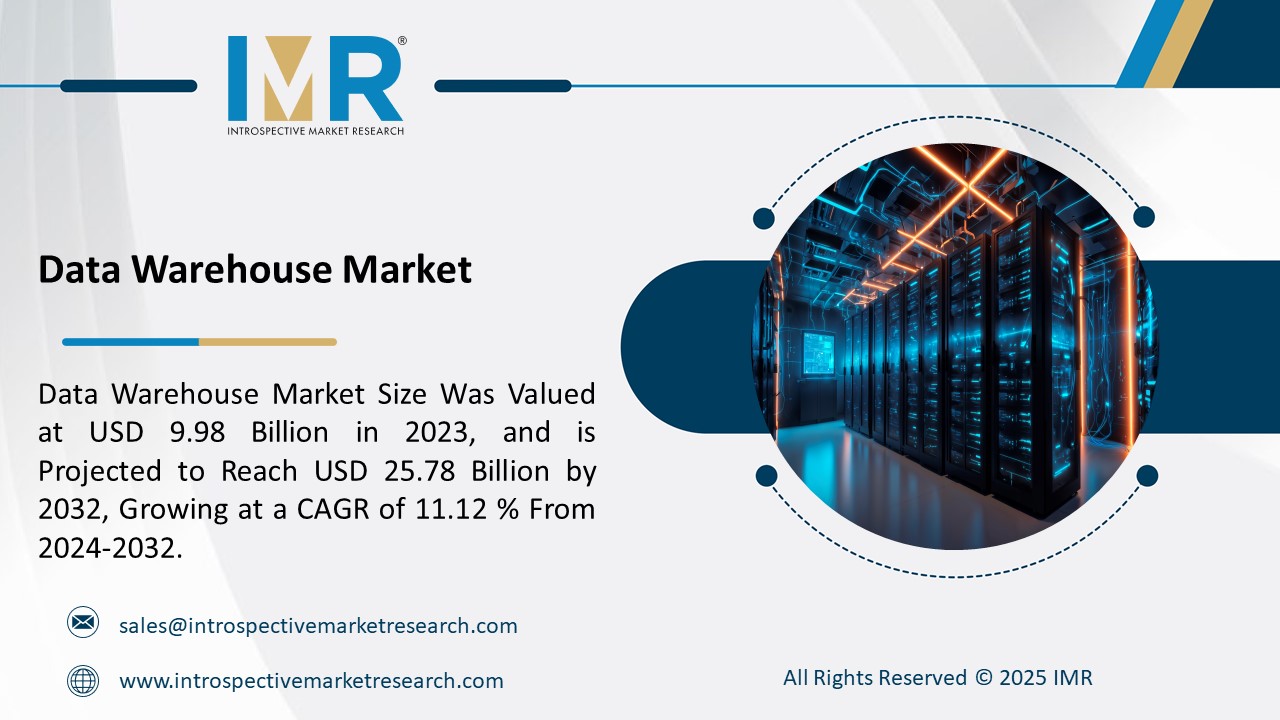
According to a new report published by Introspective Market Research, titled, Data Warehouse Market by Type (Enterprise Data Warehouse (EDW), Operational Data Store (ODS), Data Mart), Deployment (On-premises, Cloud), End-Use Industry (BFSI, Retail & E-commerce, Healthcare, IT & Telecom, Manufacturing, Government, Others), The Global Data Warehouse Market Size Was Valued at USD 9.98 Billion in 2023 and is Projected to Reach USD 25.78 Billion by 2032, Growing at a CAGR of 11.12%. A data warehouse is a centralized repository that stores integrated data from one or more disparate sources. It is designed for analytical reporting and decision-making, rather than for transactional processing. Data warehouses consolidate historical and current data, transforming it into a structured format suitable for business intelligence (BI) tools, data mining, and other analytical applications, providing a unified view of an organization's information.
The Data Warehouse Market is experiencing robust growth as businesses across various industries increasingly recognize the critical need for robust data management and advanced analytics to gain competitive insights. Unlike traditional transactional databases, data warehouses are optimized for complex queries and high-volume data analysis, offering superior performance for strategic decision-making. Their ability to deliver a comprehensive and consistent view of business operations makes them an indispensable tool for driving informed strategies and fostering innovation.
The escalating volume and complexity of business data (big data) generated across all sectors is a primary driver for the data warehouse market. Organizations are inundated with information from various sources like transactional systems, social media, IoT devices, and web interactions. To derive meaningful insights and make data-driven decisions, businesses require robust data warehousing solutions capable of efficiently storing, processing, and analyzing this vast and diverse dataset. The need to transform raw data into actionable intelligence is compelling companies to invest heavily in modern data warehousing infrastructure.
A significant market opportunity lies in the continued migration towards cloud-based data warehousing solutions. Cloud data warehouses offer unparalleled scalability, flexibility, cost-effectiveness (pay-as-you-go models), and reduced infrastructure management overhead compared to traditional on-premises solutions. This shift allows businesses of all sizes, especially SMEs, to access advanced analytical capabilities without substantial upfront investments. Further opportunities arise from integrating data warehouses with advanced analytics, machine learning, and artificial intelligence tools, enabling predictive analytics and real-time insights that were previously unachievable.
Data Warehouse Market, Segmentation
Type
- The Type segment is further classified into Enterprise Data Warehouse (EDW), Operational Data Store (ODS), and Data Mart. Among these, the Enterprise Data Warehouse (EDW) sub-segment accounted for the highest market share in 2023. An EDW serves as a central, integrated repository for all organizational data, providing a holistic view of the business. Its ability to consolidate information from disparate sources across various departments allows for comprehensive analytics, cross-functional reporting, and strategic decision-making at an enterprise level. The demand for a single source of truth for all business intelligence needs underpins the dominance of the EDW segment.
Deployment
- The Deployment segment is further classified into On-premises and Cloud. Among these, the Cloud sub-segment accounted for the highest market share in 2023. Cloud data warehouses offer immense advantages in terms of scalability, cost efficiency, flexibility, and ease of management. Businesses are rapidly adopting cloud solutions to avoid the significant capital expenditure and operational complexities associated with on-premises infrastructure. The ability to quickly provision resources, scale up or down based on demand, and leverage managed services from leading cloud providers makes cloud data warehousing an increasingly attractive and dominant choice for modern enterprises seeking agility and cost optimization.
Some of The Leading/Active Market Players Are-
- Amazon Web Services (AWS) (USA)
- Google LLC (USA)
- Microsoft Corporation (USA)
- Snowflake Inc. (USA)
- Oracle Corporation (USA)
- IBM Corporation (USA)
- Teradata Corporation (USA)
- SAP SE (Germany)
- Cloudera, Inc. (USA)
- Informatica LLC (USA)
- Hewlett Packard Enterprise (HPE) (USA)
- SAS Institute Inc. (USA)
- Yellowbrick Data (USA)
- Actian Corporation (USA)
- Exasol AG (Germany)
- other active players.
Key Industry Developments
-
In May 2023, Snowflake Inc. announced several new product innovations, including enhanced capabilities for its Data Cloud, focusing on improved data governance, machine learning integration, and cross-cloud data sharing. These advancements aim to solidify Snowflake's position as a leading cloud data warehouse provider. The updates enable users to derive deeper insights, collaborate more effectively, and ensure data security across various cloud environments, catering to the evolving demands of data-driven enterprises.
- In February 2023, Google Cloud introduced new features for its BigQuery data warehouse, focusing on serverless data ingestion and real-time analytics for streaming data. This update aims to provide faster and more efficient processing of large datasets. The enhancements enable businesses to perform complex analytical queries on live data streams with minimal operational overhead, empowering them to make immediate business decisions based on the freshest information available, particularly beneficial for industries requiring instant insights.
Key Findings of the Study
- Enterprise Data Warehouse (EDW) is the dominant type for comprehensive analytics.
- Cloud deployment leads the market due to scalability and cost-effectiveness.
- The surge in big data generation is a primary growth driver.
- Integration with AI/ML offers significant market opportunities.
- Demand for real-time analytics and data-driven decision-making is a key trend.