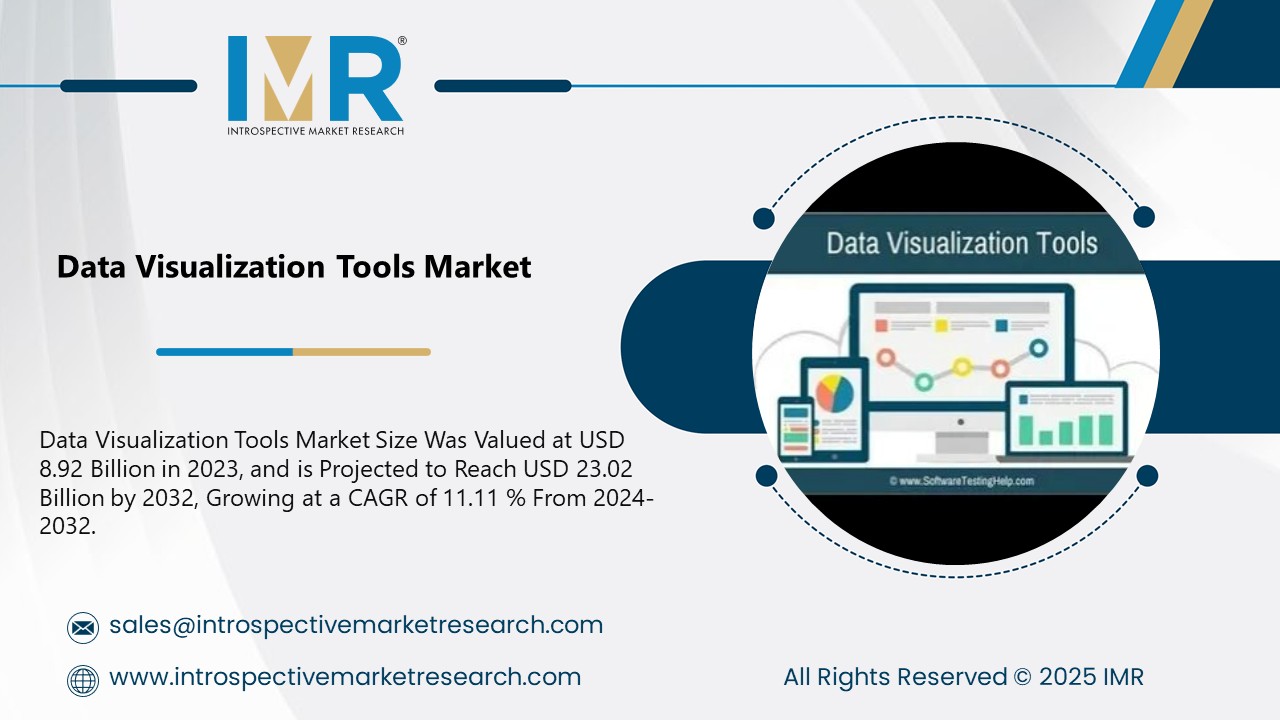
According to a new report published by Introspective Market Research, titled, Data Visualization Tools Market by Component, Deployment, Business Function, and End-User, The Global Data Visualization Tools Market Size Was Valued at USD 8.92 Billion in 2023 and is Projected to Reach USD 23.02 Billion by 2032, Growing at a CAGR of 11.11%. The Data Visualization Tools Market encompasses software solutions that transform complex raw data into understandable and insightful visual representations such as charts, graphs, maps, and dashboards. These tools enable users, from business analysts to executives, to identify patterns, trends, and anomalies more effectively, facilitating informed decision-making and strategic planning across various industries.
These tools offer significant advantages over traditional data analysis methods by democratizing data access and making complex information digestible for non-technical users. They enhance data exploration, improve communication of insights, and accelerate the decision-making process, replacing tedious manual analysis with dynamic, interactive visualizations. Data visualization tools are extensively used in business intelligence, marketing, finance, healthcare, and education, empowering organizations to leverage their data assets more effectively.
One key growth driver for the Data Visualization Tools Market is the exponential growth of big data across virtually all industries. Organizations are collecting vast amounts of data from various sources, including customer interactions, IoT devices, social media, and operational systems. This deluge of data makes traditional analysis methods impractical and inefficient. Data visualization tools provide the essential means to process, interpret, and derive actionable insights from these massive datasets quickly and effectively. The increasing recognition that raw data is only valuable when understood and applied strategically is directly fueling the demand for sophisticated visualization solutions.
A significant market opportunity lies in the integration of Artificial Intelligence (AI) and Machine Learning (ML) capabilities into data visualization tools. This integration can elevate visualization beyond mere representation to intelligent insight generation. AI-powered visualization tools can automatically detect significant patterns, anomalies, and correlations within data, even suggesting the most appropriate visualization types. Furthermore, ML algorithms can personalize dashboards, predict future trends, and offer prescriptive analytics, guiding users towards optimal decisions without requiring extensive manual exploration. This advanced layer of intelligence transforms passive viewing into active, guided analysis, creating a new paradigm for data interaction and unlocking deeper, more immediate value from complex datasets.
Data Visualization Tools Market, Segmentation
The Data Visualization Tools Market is segmented on the basis of Component, Deployment, Business Function, and End-User.
Component
- The Component segment is further classified into Software and Services. Among these, the Software sub-segment accounted for the highest market share in 2023. The software component is fundamental to the data visualization tools market, encompassing the core platforms and applications that enable the creation, manipulation, and display of visual data. This includes various standalone tools, integrated modules within larger BI suites, and cloud-based visualization services. The continuous innovation in software functionalities, such as advanced charting capabilities, interactive dashboards, and seamless data connectivity, drives its dominance. Enterprises invest heavily in sophisticated visualization software to empower their teams with self-service analytics and transform raw data into actionable insights, solidifying the software segment's leading position.
Deployment
- The Deployment segment is further classified into On-Premise and Cloud-Based. Among these, the Cloud-Based sub-segment accounted for the highest market share in 2023. Cloud-based deployment has rapidly gained traction due to its numerous advantages, including scalability, flexibility, reduced infrastructure costs, and accessibility from anywhere. Organizations increasingly prefer cloud solutions for data visualization as they facilitate easier collaboration, offer automatic updates, and can handle fluctuating data volumes without significant upfront investment. The shift towards remote work and the growing adoption of hybrid cloud strategies further accelerate the demand for cloud-based data visualization tools, making it the dominant deployment model.
Some of The Leading/Active Market Players Are-
- Tableau Software (a Salesforce company) (USA)
- Microsoft Corporation (USA)
- Qlik Technologies Inc. (USA)
- SAP SE (Germany)
- SAS Institute Inc. (USA)
- IBM Corporation (USA)
- Oracle Corporation (USA)
- MicroStrategy Incorporated (USA)
- Domo, Inc. (USA)
- Sisense Inc. (USA)
- TIBCO Software Inc. (USA)
- Infor (USA)
- Zoho Corporation (India)
- Looker (a Google company) (USA)
- Information Builders (USA)
- and other active players.
Key Industry Developments
- In October 2023, Tableau (a Salesforce company) released its latest version, featuring enhanced AI-powered insights and natural language processing (NLP) capabilities. This update allows users to ask questions about their data in plain English and receive automated visual insights.This advancement aims to democratize data analysis, making it more accessible to business users without extensive technical skills. By integrating AI and NLP, Tableau seeks to accelerate the discovery of insights and improve decision-making across organizations, strengthening its position as a market leader.
- In September 2023, Microsoft announced significant updates to Power BI, including improved integration with Microsoft Fabric and new data storytelling features. These updates focus on providing a more unified and collaborative experience for data analysis and visualization.The enhancements allow users to create more engaging and interactive data stories, facilitating better communication of insights. By strengthening Power BI's capabilities and its ecosystem integration, Microsoft continues to empower businesses with robust tools for transforming data into actionable intelligence.
Key Findings of the Study
- Software components and cloud-based deployments hold the largest market shares.
- North America leads the market due to early adoption of advanced analytics and a strong tech infrastructure.
- The exponential growth of big data is a primary market driver.
- Key market trends include AI/ML integration and enhanced interactive capabilities.
- Opportunities exist in advanced analytics for real-time and prescriptive insights.