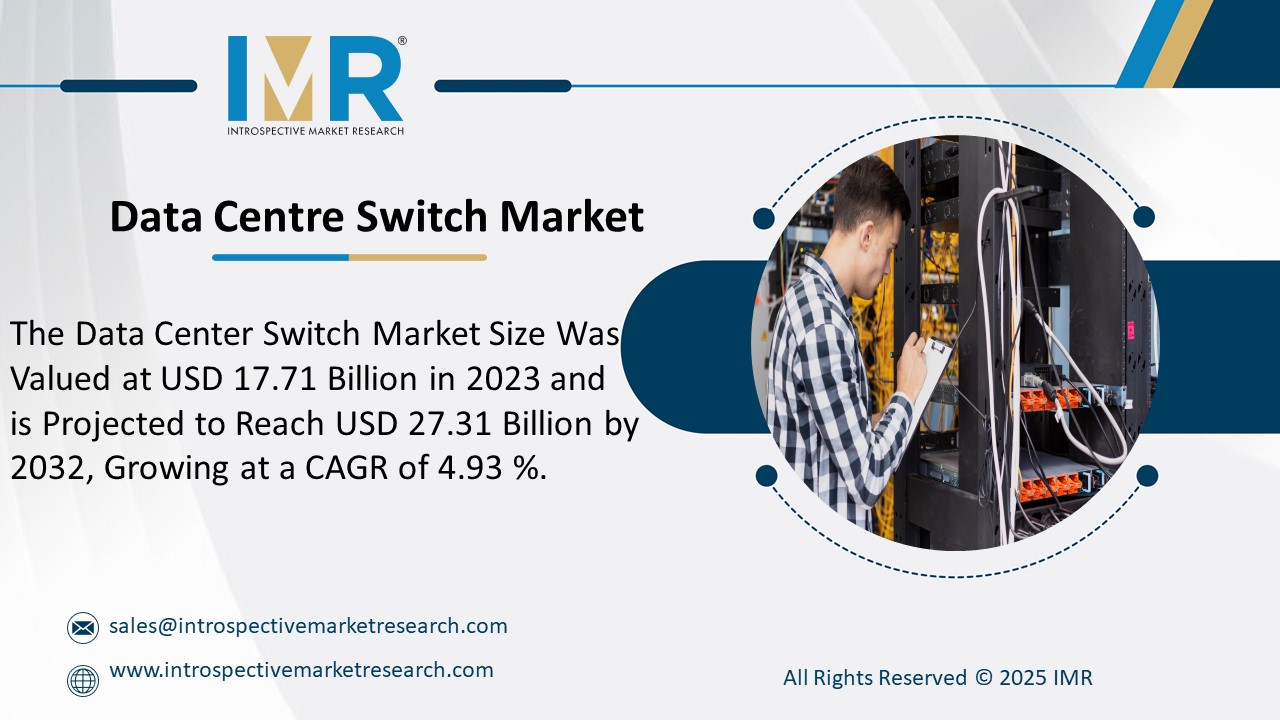
According to a new report published by Introspective Market Research, titled, Data Center Switch Market by Type, End-User, Port Speed, and Region, The Global Data Center Switch Market Size Was Valued at USD 17.71 Billion in 2023 and is Projected to Reach USD 27.31 Billion by 2032, Growing at a CAGR of 4.93 %. The global data center switch market is experiencing steady growth as organizations continue to expand their digital infrastructure to support cloud computing, big data analytics, and the Internet of Things (IoT). Data center switches serve as critical components in managing and directing traffic between servers and end-users within enterprise and cloud data centers. They ensure high-speed connectivity, low latency, and efficient network management—key requirements in modern data-driven operations.
With the rising adoption of hyperscale data centers and the migration toward software-defined networking (SDN), data center switches are evolving rapidly to deliver scalability and flexibility. Enterprises are increasingly investing in high-performance Ethernet switches that can handle heavy workloads while maintaining energy efficiency and security. Furthermore, the integration of artificial intelligence (AI) and automation tools into network management systems is transforming how data centers operate, enhancing reliability and optimizing resource utilization.
The Data Center Switch Market is segmented into Type, End-User, and Port Speed. By Type, the market is categorized into (Core Switches, Distribution Switches, and Access Switches). By End-User, the market is categorized into (Enterprises, Cloud Service Providers, and Telecom Service Providers). By Port Speed, the market is categorized into (10G, 25G, 40G, 100G, and Above 100G).
One of the key growth drivers of the data center switch market is the increasing demand for high-speed connectivity driven by cloud computing and big data applications. As enterprises migrate their workloads to the cloud, the need for faster and more reliable data transfer becomes essential. The adoption of 100G and 400G Ethernet switches is on the rise to meet bandwidth-intensive requirements. Additionally, the growing number of connected devices and the surge in global internet traffic continue to push data center operators toward infrastructure upgrades, fueling consistent market growth.
The market presents strong opportunities in the expansion of edge data centers and the adoption of AI-driven network management. The proliferation of 5G technology and edge computing is prompting telecom operators and enterprises to deploy compact, localized data centers requiring efficient switching solutions. Moreover, AI integration into switching systems enables real-time network optimization, predictive maintenance, and energy savings. Vendors that develop intelligent, scalable switches compatible with hybrid and multi-cloud environments are poised to capture significant growth potential over the forecast period.
Data Center Switch Market, Segmentation
The Data Center Switch Market is segmented on the basis of Type, End-User, and Port Speed.
Type
The Type segment is further classified into Core Switches, Distribution Switches, and Access Switches. Among these, the Core Switches sub-segment accounted for the highest market share in 2023. Core switches are crucial for handling high volumes of traffic between servers and storage systems. Their ability to support advanced routing, higher throughput, and redundancy makes them essential in large-scale and hyperscale data centers, ensuring minimal latency and maximum uptime.
End-User
The End-User segment is further classified into Enterprises, Cloud Service Providers, and Telecom Service Providers. Among these, the Cloud Service Providers sub-segment accounted for the highest market share in 2023. The increasing adoption of cloud computing services by businesses globally has driven hyperscale data center construction. Cloud providers such as AWS, Microsoft Azure, and Google Cloud are expanding their infrastructures, leading to robust demand for high-speed, energy-efficient switches capable of managing dynamic, large-scale workloads.
Some of The Leading/Active Market Players Are-
- Cisco Systems Inc. (USA)
- Arista Networks Inc. (USA)
- Juniper Networks Inc. (USA)
- Huawei Technologies Co. Ltd. (China)
- Hewlett Packard Enterprise (USA)
- Dell Technologies Inc. (USA)
- Extreme Networks Inc. (USA)
- NEC Corporation (Japan)
- Broadcom Inc. (USA)
- Mellanox Technologies Ltd. (Israel)
- Edgecore Networks Corporation (Taiwan)
- Fortinet Inc. (USA)
- D-Link Corporation (Taiwan)
- Avaya Holdings Corp. (USA)
- other active players.
Key Industry Developments
-
In May 2024, Cisco Systems introduced its next-generation Silicon One G200 chip for data center switches, designed to deliver 51.2 Tbps bandwidth per chip.
This launch marks a significant step toward supporting AI and cloud workloads, offering improved energy efficiency and scalability. The innovation aligns with growing global demand for faster, high-capacity networking solutions. - In August 2025, Arista Networks partnered with Microsoft Azure to enhance cloud data center automation and network visibility.
The collaboration aims to integrate Arista’s CloudVision platform with Azure Networking, enabling customers to automate large-scale network configurations, optimize workloads, and ensure higher service reliability across multi-cloud deployments.
Key Findings of the Study
- Core switches dominate the market due to their critical role in managing heavy data center traffic.
- Cloud service providers remain the leading end-users, driven by global hyperscale expansion.
- Asia-Pacific and North America are major growth regions for data center infrastructure.
- Increasing 100G and 400G Ethernet adoption supports faster data transfer and scalability.
- AI-driven automation and edge data center deployments are key emerging trends.