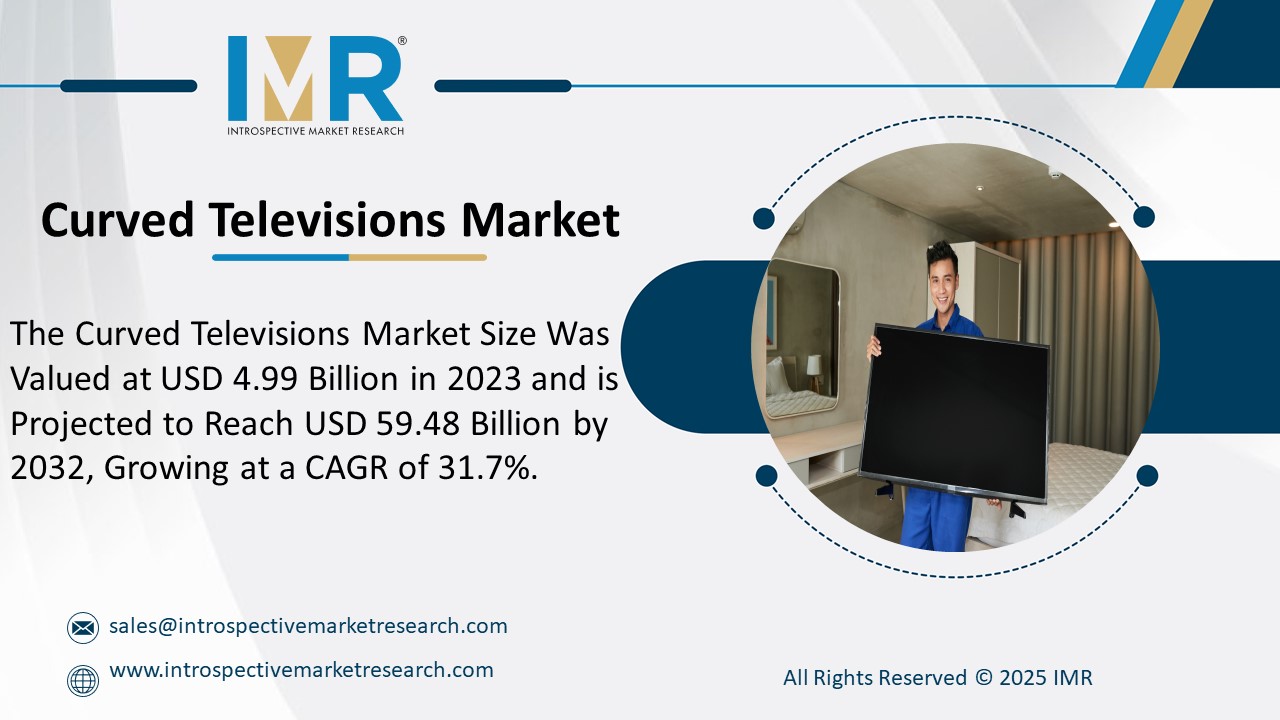
According to a new report published by Introspective Market Research, titled, Curved Televisions Market by Display Technology, Screen Size, End-Use, and Region, The Global Curved Televisions Market Size Was Valued at USD 4.99 Billion in 2023 and is Projected to Reach USD 59.48 Billion by 2032, Growing at a CAGR of 31.7%. The Global Curved Televisions Market is evolving rapidly, driven by consumer demand for more immersive and visually striking home entertainment experiences. Curved TVs feature inward bending screens designed to wrap around the viewer’s field of view, offering enhanced depth perception and reduced distortion compared to flat screens. Advances in OLED, QLED, and flexible display technologies are enabling curved displays with higher resolutions, thinner form factors, and better durability.
As consumers increasingly prioritize home cinema setups, gaming, and visual immersion, curved televisions are being adopted across residential and commercial segments. They find use in high-end living rooms, premium gaming zones, luxury hospitality suites, and showcase installations. Unique viewing angles, aesthetic appeal, and enhanced visual immersion distinguish curved TVs from traditional flat models and make them an attractive option for tech-savvy buyers.
The rising adoption of large-screen formats, 4K/8K content, and smart platform integration further drives growth in curved televisions. Manufacturers are pushing innovations in bendable panels, motion optimization, and enhanced brightness to overcome past limitations. As display costs decline and consumer strike a balance between novelty and usability, curved televisions continue their resurgence in premium segments.
The Curved Televisions Market is segmented into Display Technology, Screen Size, and End-Use. By Display Technology, the market is categorized into (OLED, QLED, LED/LCD). By Screen Size, the market is categorized into (Below 55-inch, 55-65 inch, Above 65 inch). By End-Use, the market is categorized into (Residential, Commercial, Hospitality & Entertainment).
One key growth driver for the Curved Televisions Market is the surging demand for immersive viewing experiences in the era of high-definition content and gaming. As consumers increasingly adopt 4K and 8K video streaming, content creation and media platforms are producing visuals that benefit from curved display geometry. Curved screens enhance perceived depth, widen the perceived field of view, and reduce edge distortion, thereby creating a cinematic experience right in the living room. Manufacturers adopting bendable OLED and QLED technologies further bolster this driver by enabling durable, high-performance curved panels that attract premium buyers.
A significant opportunity lies in the growth of premium, large-screen curved televisions for high-end residential and commercial installations. As display fabrication costs decrease and flexible panel technologies mature, manufacturers can scale production and offer curved TVs in larger sizes (above 65 inches) with advanced features. Luxury real estate, boutique hotels, luxury yachts, and premium experiential venues represent untapped verticals. By integrating smart connectivity, AR/VR support, and modular curvature (adjustable bend), brands can differentiate and command higher margins. This trend offers a pathway to drive adoption beyond niche tech enthusiasts into aspirational mainstream segments.
Curved Televisions Market, Segmentation
The Curved Televisions Market is segmented on the basis of Display Technology, Screen Size, and End-Use.
Display Technology
The Display Technology segment is further classified into OLED, QLED, and LED/LCD. Among these, the OLED sub-segment accounted for the highest market share in 2023. OLED curved panels offer deeper contrast, wider viewing angles, faster refresh response, and flexibility, making them ideal for immersive curved displays. Their self-emissive pixels and thinner structure support more elegant, seamless curved designs favored in premium segments.
Screen Size
The Screen Size segment is further classified into Below 55-inch, 55-65 inch, and Above 65 inch. Among these, the Above 65 inch sub-segment accounted for the highest market share in 2023. Larger curved TVs provide a more dramatic immersive effect, filling more of the viewer’s peripheral vision. As manufacturing costs of large curved panels decline and consumer appetite for big screens grows, this sub-segment leads in value share.
Some of The Leading/Active Market Players Are-
- Samsung Electronics (South Korea)
- LG Electronics (South Korea)
- Sony Corporation (Japan)
- TCL Corporation (China)
- Hisense Co., Ltd. (China)
- Panasonic Corporation (Japan)
- Philips (Netherlands)
- Sharp Corporation (Japan)
- Skyworth (China)
- Vizio, Inc. (USA)
- other active players.
Key Industry Developments
-
In August 2024, Samsung launched its next-generation curved OLED TV lineup featuring adjustable bend radius and ultra slim panels.
Samsung’s new curved OLED models incorporate bendable substrates that allow adjustable curvature settings, enabling users to fine-tune the screen shape. These models also enhance brightness, HDR performance, and integrate AI upscaling. Samsung’s move bolsters its premium TV portfolio and reignites interest in the curved category, positioning itself as a frontrunner in flexible display technology. - In March 2025, LG Electronics announced a strategic alliance with display materials firms to scale production of flexible OLED panels for curved TV adoption.
LG formed partnerships with polymer film and encapsulation material providers to optimize reliability and yield of curved OLED displays. The alliance focuses on improving durability, reducing defects, and streamlining manufacturing. This effort aims to reduce costs and accelerate curved TV growth, enabling multiple OEMs to adopt curved panels rather than depending on a single supplier ecosystem.
Key Findings of the Study
- OLED dominates display technology due to superior visual performance and flexibility.
- Above 65-inch screen size leads segment value share thanks to immersive appeal.
- Surge in gaming, 4K/8K content, and display technology innovation drives growth.
- Premium and commercial installations present major expansion opportunities.
- Leading players are pushing flexible panels and strategic alliances to scale curved TV adoption.