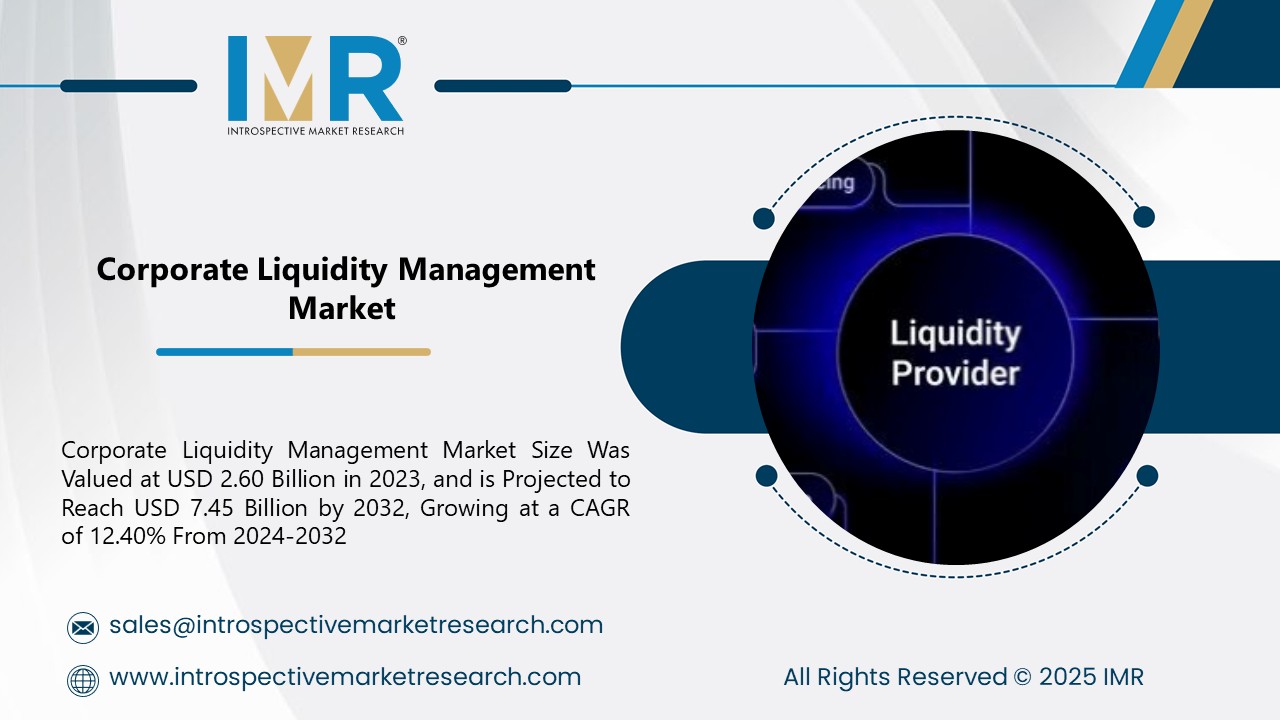
According to a new report published by Introspective Market Research, titled, Corporate Liquidity Management Market by Component (Software, Services), by Deployment Type (On-Premise, Cloud-Based), by Organization Size (Small and Medium-Sized Enterprises, Large Enterprises), and by End-User (BFSI, Retail and E-Commerce, Healthcare, IT and Telecom, Manufacturing, Others), The Global Corporate Liquidity Management Market Size Was Valued at USD 2.60 Billion in 2023 and is Projected to Reach USD 7.45 Billion by 2032, Growing at a CAGR of 12.40%. The Corporate Liquidity Management Market is experiencing robust growth as businesses increasingly recognize the critical importance of optimizing their cash flow and working capital. This market encompasses a range of solutions and services designed to help organizations effectively monitor, control, and forecast their liquidity positions, ensuring financial stability and operational efficiency. These advanced tools offer a significant advantage over traditional manual methods, providing real-time visibility into cash across various accounts and entities, automating reconciliation processes, and facilitating sophisticated forecasting.
The primary objective of corporate liquidity management is to prevent cash shortages and surpluses, optimize investment of excess funds, and mitigate financial risks. Its main uses span across major industries, including banking, financial services, and insurance (BFSI), where precise cash positioning is paramount; retail and e-commerce, which handle high volumes of daily transactions; and manufacturing, where managing supply chain finances is crucial. The adoption of these solutions enables companies to make informed financial decisions, improve profitability, and maintain compliance with regulatory requirements.
The Corporate Liquidity Management Market is segmented into Component, Deployment Type, Organization Size, and End-User. By Component, the market is categorized into Software and Services. By Deployment Type, the market is categorized into On-Premise and Cloud-Based. By Organization Size, the market is categorized into Small and Medium-Sized Enterprises and Large Enterprises. By End-User, the market is categorized into BFSI, Retail and E-Commerce, Healthcare, IT and Telecom, Manufacturing, and Others.
key growth driver for the Corporate Liquidity Management Market is the escalating complexity of global financial operations and the increasing volatility in economic conditions. As businesses expand internationally and engage in cross-border transactions, managing diverse currencies, regulatory environments, and payment systems becomes a significant challenge. This complexity necessitates sophisticated liquidity management solutions that can provide a consolidated view of cash positions, automate reconciliation, and offer advanced forecasting capabilities. The need to mitigate risks associated with currency fluctuations, interest rate changes, and unexpected economic downturns further propels the demand for robust liquidity management platforms, enabling companies to maintain financial resilience and operational agility amidst an unpredictable global landscape.
A significant market opportunity for the Corporate Liquidity Management Market lies in the growing adoption of cloud-based solutions, particularly among Small and Medium-Sized Enterprises (SMEs). Cloud-based platforms offer cost-effectiveness, scalability, and easier deployment compared to traditional on-premise systems, making them highly attractive for businesses with limited IT infrastructure and budgets. As SMEs increasingly recognize the benefits of sophisticated liquidity management, such as improved cash flow visibility and reduced operational costs, the demand for accessible cloud solutions will surge. This trend presents a substantial opportunity for solution providers to develop and market tailored, user-friendly cloud-native platforms that cater specifically to the unique financial management needs and resource constraints of the SME segment, expanding the overall market reach.
Corporate Liquidity Management Market, Segmentation
The Corporate Liquidity Management Market is segmented on the basis of Component, Deployment Type, Organization Size, and End-User.
Component
- The Component segment is further classified into Software and Services. Among these, the Software sub-segment accounted for the highest market share in 2023. The software component of corporate liquidity management includes a wide array of specialized applications designed to automate and optimize various aspects of cash management. These solutions offer functionalities such as cash positioning, forecasting, reconciliation, in-house banking, and risk management. With advanced analytics and reporting capabilities, liquidity management software provides treasurers and financial managers with real-time insights into their company's cash flows across multiple bank accounts, entities, and geographies. The continuous innovation in these software platforms, including the integration of AI and machine learning for predictive analytics, drives their dominant market share as businesses prioritize efficiency and data-driven decision-making in financial operations.
Deployment Type
- The Deployment Type segment is further classified into On-Premise and Cloud-Based. Among these, the Cloud-Based sub-segment accounted for the highest market share in 2023. Cloud-based liquidity management solutions have gained significant traction due to their inherent advantages, including lower upfront costs, reduced IT infrastructure requirements, and enhanced scalability. These solutions offer businesses the flexibility to access their financial data and management tools from anywhere, at any time, promoting greater operational agility. Cloud deployment also facilitates faster implementation and updates, ensuring that companies always have access to the latest features and security protocols. The increasing trend towards digital transformation and the growing acceptance of Software-as-a-Service (SaaS) models across various industries have firmly established cloud-based solutions as the preferred choice for modern corporate liquidity management, driving their leading market share.
Some of The Leading/Active Market Players Are-
- SAP SE (Germany)
- Oracle Corporation (US)
- Fiserv, Inc. (US)
- Kyriba (US)
- FIS (US)
- Broadridge Financial Solutions, Inc. (US)
- CGI Inc. (Canada)
- Intellect Design Arena Ltd. (India)
- GTreasury (US)
- HighRadius (US)
- Infor (US)
- Coupa Software Inc. (US)
- Cashfac (UK)
- TreasuryXpress (US)
- Finastra (UK)
Key Industry Developments
- In October 2023, Kyriba announced a strategic partnership with J.P. Morgan to enhance real-time payments and liquidity management for corporate clients. This collaboration integrates J.P. Morgan's advanced payment capabilities with Kyriba's leading treasury management platform.
This partnership aims to provide corporate treasurers with greater visibility and control over their cash flows, enabling faster and more efficient execution of payments. The integration is expected to streamline financial operations, reduce manual effort, and improve decision-making through real-time data access and advanced analytics. - In September 2023, FIS launched its new next-generation liquidity management solution, "Quantum," designed to offer enhanced automation and predictive analytics for corporate treasuries. This innovative platform incorporates artificial intelligence and machine learning technologies.
Quantum focuses on providing real-time cash visibility, accurate forecasting, and sophisticated risk management tools. The solution is tailored to help businesses navigate complex financial landscapes by automating routine tasks, improving forecasting accuracy, and enabling proactive liquidity optimization, thereby increasing operational efficiency and strategic financial planning.
Key Findings of the Study
- The software segment holds the dominant share, driven by demand for automation and advanced analytics.
- Cloud-based solutions are rapidly gaining traction due to scalability and cost-effectiveness.
- North America remains the leading region, benefiting from technological advancements and a strong financial sector.
- Key growth drivers include increasing financial complexity and the need for real-time cash visibility.
- The market is trending towards AI/ML integration for predictive liquidity forecasting.