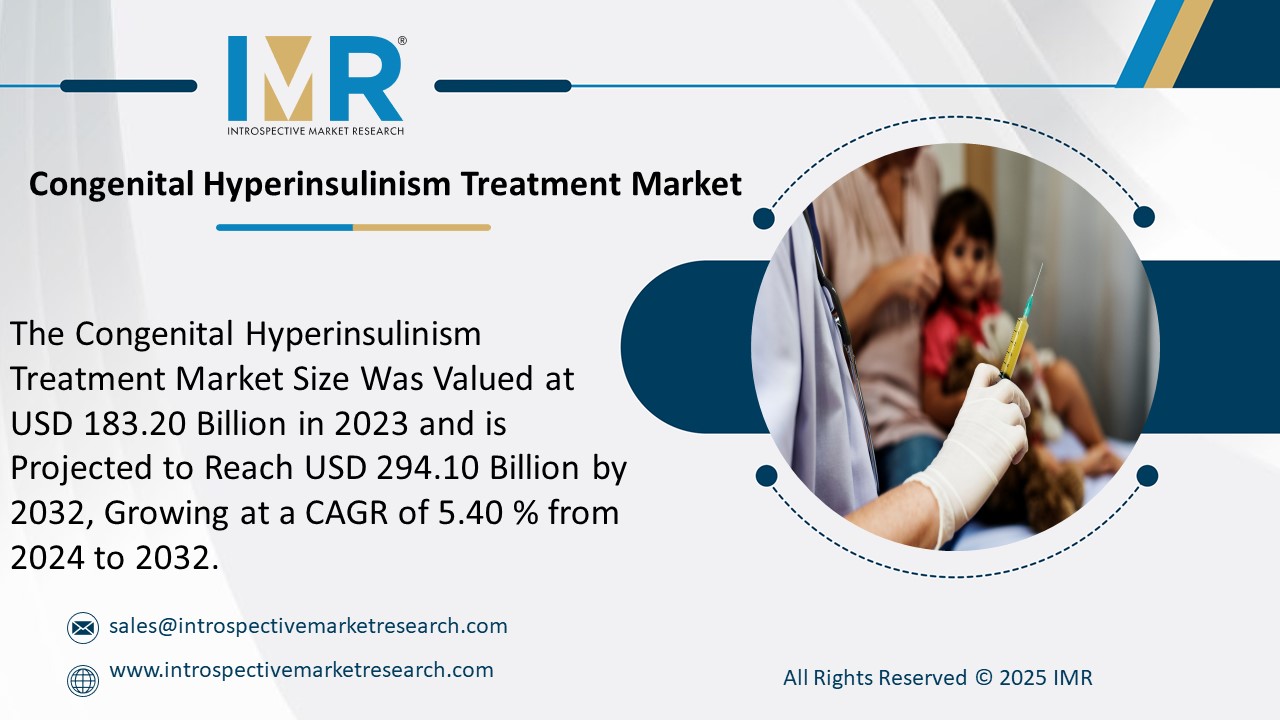
According to a new report published by Introspective Market Research, titled, Congenital Hyperinsulinism Treatment Market by Treatment Type, Drug Type, End-User, and Region, The Global Congenital Hyperinsulinism Treatment Market Size Was Valued at USD 183.20 Billion in 2023 and is Projected to Reach USD 294.10 Billion by 2032, Growing at a CAGR of 5.40 % from 2024 to 2032. Congenital hyperinsulinism (CHI) is a rare genetic disorder characterized by inappropriate and excessive insulin secretion by pancreatic β-cells, leading to persistent hypoglycemia. Management of CHI often involves a combination of medical therapies, surgical interventions, genetic testing, and continuous monitoring of blood glucose levels. Compared to conventional hypoglycemia treatments, CHI therapies must be precise, sustained, and tailored to the patient’s genotype and disease severity.
Advances in molecular diagnostics, imaging, and genetic profiling have improved early detection of CHI, enabling more targeted interventions. The treatment repertoire includes pharmacological agents such as diazoxide, octreotide, nifedipine, and investigational agents targeting novel pathways. In refractory cases, partial or full pancreatectomy remains a surgical option, albeit with long-term risks. The complexity of CHI management underscores the need for integrated diagnostics and therapeutic strategies.
Demand for CHI treatments is rising as awareness grows, and as more patients receive genetic diagnoses. Pharmaceutical companies are investing in next-generation therapies, including receptor modulators, gene therapy, and novel peptide analogues. As therapeutic options expand, clinicians and caregivers increasingly favor precision approaches over broad systemic therapy.
The Congenital Hyperinsulinism Treatment Market is segmented into Treatment Type, Drug Type, and End-User. By Treatment Type, the market is categorized into (Medical Management, Surgical Intervention, Gene Therapy). By Drug Type, the market is categorized into (Diazoxide, Octreotide, Nifedipine, Glucagon, Others). By End-User, the market is categorized into (Hospitals & Specialty Clinics, Diagnostic & Research Centers, Ambulatory Care, Others).
One key growth driver in the CHI treatment market is the rising adoption of precision diagnostics and genetic testing. As next-generation sequencing and molecular assays become more accessible, more patients with CHI are diagnosed early and stratified by genotype. This enables clinicians to choose targeted therapies and avoid broad interventions. Moreover, regulatory support for rare disease diagnostics and reimbursement incentives encourage adoption. As diagnosis rates increase, the addressable patient base for CHI therapies expands, fueling demand for new treatments tailored to specific genetic subtypes.
A major opportunity lies in developing gene therapy and receptor-modulating biologics for CHI. Because CHI is often a monogenic disorder, it is a suitable candidate for gene editing, viral vector delivery, or RNA therapies to correct the underlying genetic defect. Biologics that modulate somatostatin or potassium channels specifically in pancreatic β-cells may enable highly selective control of insulin secretion. Success in these novel therapies would open premium pricing, improve long-term outcomes, and reduce reliance on lifelong pharmacotherapy or invasive surgeries.
Congenital Hyperinsulinism Treatment Market, Segmentation
The Congenital Hyperinsulinism Treatment Market is segmented on the basis of Treatment Type, Drug Type, and End-User.
Medical Management
The Medical Management segment is further classified into (Diazoxide, Octreotide, Nifedipine, Glucagon, Others). Among these, the Diazoxide sub-segment accounted for the highest market share in 2023. Diazoxide is the first-line therapy for many CHI patients, effectively inhibiting insulin release and stabilizing glucose in a majority of cases. Its longstanding clinical usage, broad availability, and inclusion in treatment guidelines make it the backbone of CHI medical therapy. Despite limitations, it remains dominant given its well-characterized safety profile and efficacy in diverse patient groups.
Surgical Intervention
The Surgical Intervention segment is further classified into (Partial Pancreatectomy, Near-total Pancreatectomy, Islet Cell Transplantation). Among these, the Partial Pancreatectomy sub-segment accounted for the highest market share in 2023. Partial pancreatectomy is favored when focal lesions are localized, allowing selective removal while preserving pancreatic function. This approach strikes a balance between disease control and minimizing surgical risk, making it the most commonly adopted surgical option. Advances in imaging and intraoperative localization support its continued preference in treatable cases.
Some of The Leading/Active Market Players Are-
- Zealand Pharma A/S (Denmark)
- Crinetics Pharmaceuticals, Inc. (USA)
- Novartis AG (Switzerland)
- Pfizer Inc. (USA)
- Eli Lilly and Company (USA)
- Takeda Pharmaceutical Company (Japan)
- Merck & Co., Inc. (USA)
- Sanofi S.A. (France)
- Novo Nordisk A/S (Denmark)
- Xeris Pharmaceuticals, Inc. (USA)
- other active players.
Key Industry Developments
-
In October 2024, U.S. FDA declined to approve Zealand Pharma’s dasiglucagon for treating congenital hyperinsulinism in infants.
Zealand Pharma’s submission was met with a “complete response letter” citing issues related to third-party manufacturing facility reinspection timing, rather than safety or efficacy. The FDA plans separate decisions for short-term and extended use, and has requested additional data for dosing beyond three weeks. Zealand intends to collaborate with regulators and manufacturers to address deficiencies. - In June 2024, Amylyx Pharmaceuticals acquired rights to Eiger BioPharmaceuticals’ investigational drug avexitide for low-blood-sugar management, including CHI applications.
Amylyx purchased the rights to avexitide—a GLP-1 antagonist molecule tested for countering hypoglycemia—for USD 35.1 million, signaling a strategic entry into metabolic and rare disorder therapeutics. The move may bolster CHI pipeline diversity and accelerate development of non-conventional approaches to regulating insulin.
Key Findings of the Study
- Diazoxide leads medical therapy due to longstanding use and guideline backing
- Partial pancreatectomy is the dominant surgical choice in focal CHI
- Gene therapy and receptor-modulating biologics represent prime future growth avenues
- Precision diagnostics and genetic stratification drive market expansion
- Regulatory decisions (e.g. dasiglucagon rejection) underscore development risks