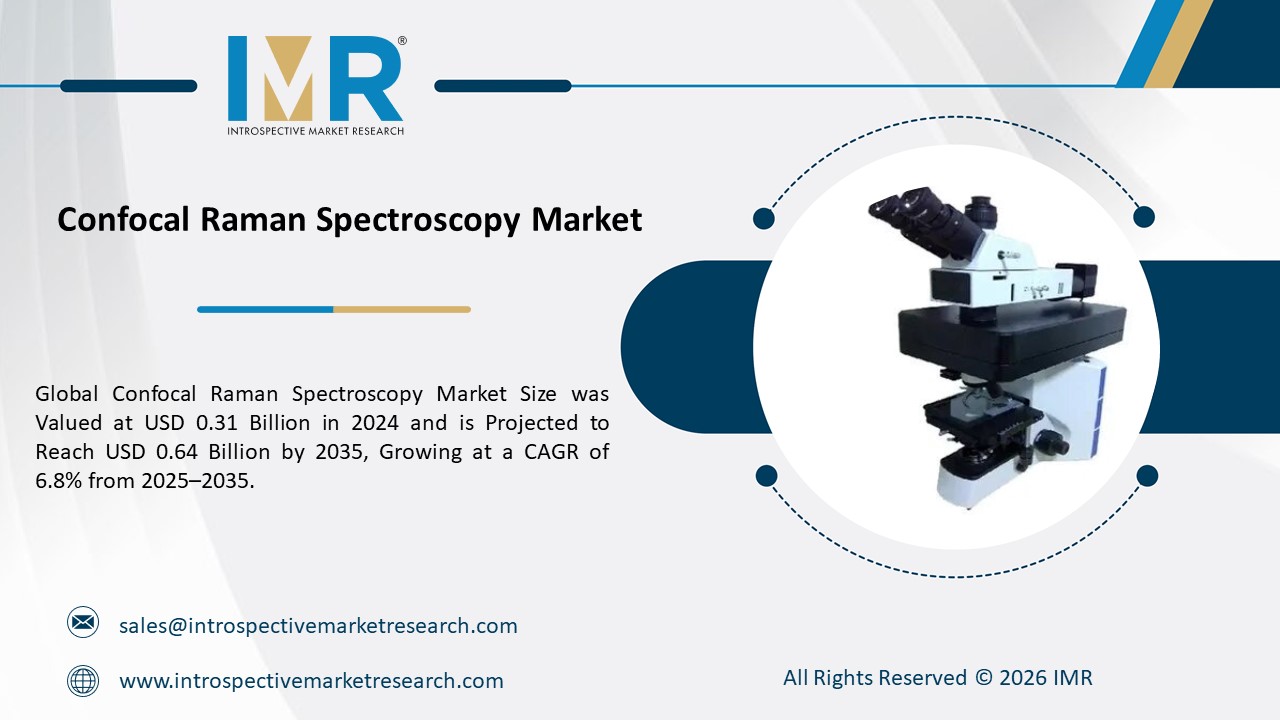
“According to a new report published by Introspective Market Research, titled, Confocal Raman Spectroscopy Market by Product Type, Application, and End User, The Global Confocal Raman Spectroscopy Market Size was Valued at USD 0.31 Billion in 2024 and is Projected to Reach USD 0.64 Billion by 2035, Growing at a CAGR of 6.8% from 2025–2035.”
The confocal Raman spectroscopy market comprises advanced analytical instruments used for non-destructive chemical and structural characterization of materials at microscopic levels. By combining Raman spectroscopy with confocal microscopy, this technology enables high spatial resolution, depth profiling, and precise molecular identification, making it superior to many conventional spectroscopic techniques.
Confocal Raman spectroscopy is widely used across pharmaceuticals, materials science, semiconductors, life sciences, and chemical research. Its key advantages include minimal sample preparation, label-free analysis, and the ability to analyze solids, liquids, and gases. Growing demand for precise material characterization, quality control, and research accuracy is supporting market expansion globally.
Market Segmentation
The Confocal Raman Spectroscopy Market is segmented into Product Type, Application, and End User.
- By Product Type, the market is categorized into Standalone Raman Spectrometers, Portable Raman Spectrometers, and Integrated Raman Systems.
- By Application, the market is categorized into Pharmaceutical Analysis, Material Science, Life Sciences, Semiconductor Analysis, and Others.
- By End User, the market is categorized into Research Institutes, Pharmaceutical & Biotechnology Companies, Industrial Manufacturing, and Academic Institutions.
Growth Driver
The primary growth driver of the confocal Raman spectroscopy market is the increasing demand for advanced, non-destructive analytical techniques in pharmaceuticals and material sciences. Pharmaceutical companies rely heavily on confocal Raman spectroscopy for drug formulation analysis, polymorphism studies, and quality assurance due to its high precision and reliability. Additionally, expanding R&D activities, stricter regulatory standards, and the need for accurate molecular characterization are further accelerating adoption across multiple industries.
Market Opportunity
A major market opportunity lies in the growing adoption of confocal Raman spectroscopy in emerging economies and semiconductor manufacturing. Rapid industrialization, increasing research funding, and expansion of electronics and nanotechnology industries are creating new demand avenues. Moreover, technological advancements such as AI-integrated spectral analysis and miniaturized systems are expected to enhance usability and broaden application scope, opening new growth opportunities over the forecast period.
Detailed Segmentation
Confocal Raman Spectroscopy Market, Segmentation
The Confocal Raman Spectroscopy Market is segmented on the basis of Product Type, Application, and End User.
Product Type
The Product Type segment is further classified into Standalone Raman Spectrometers, Portable Raman Spectrometers, and Integrated Raman Systems. Among these, the Standalone Raman Spectrometers sub-segment accounted for the highest market share in 2024. This dominance is attributed to their high analytical accuracy, advanced imaging capabilities, and widespread use in research laboratories and industrial settings. These systems are preferred for complex material analysis and pharmaceutical research, driving sustained demand globally.
Application
The Application segment is further classified into Pharmaceutical Analysis, Material Science, Life Sciences, Semiconductor Analysis, and Others. Among these, the Pharmaceutical Analysis sub-segment accounted for the highest market share in 2024. The extensive use of confocal Raman spectroscopy for drug development, quality control, and regulatory compliance has fueled its adoption. Increasing pharmaceutical R&D investments continue to strengthen this segment’s market position.
Some of The Leading/Active Market Players Are-
• Horiba Ltd. (Japan)
• Renishaw plc (UK)
• Bruker Corporation (USA)
• Thermo Fisher Scientific Inc. (USA)
• WITec GmbH (Germany)
• Oxford Instruments plc (UK)
• Kaiser Optical Systems Inc. (USA)
• Malvern Panalytical Ltd. (UK)
• Metrohm AG (Switzerland)
• B&W Tek Inc. (USA)
• Rigaku Corporation (Japan)
• JASCO Corporation (Japan)
• Anton Paar GmbH (Austria)
• Smiths Detection Group Ltd. (UK)
and other active players.
Key Industry Developments
In March 2024, a leading spectroscopy manufacturer launched an AI-enabled confocal Raman system designed for faster spectral interpretation.
This development enhances analytical efficiency by automating data processing, reducing analysis time, and improving accuracy for pharmaceutical and materials research applications.
In September 2024, a major player expanded its Raman spectroscopy production facility in Europe.
The expansion aims to meet growing demand from semiconductor and life science industries, strengthening the company’s global supply capabilities and market presence.
Key Findings of the Study
• Standalone systems dominate the product type segment
• Pharmaceutical analysis is the leading application area
• North America holds the largest market share
• Growing R&D investment is a key growth driver
• Technological advancements are shaping market trends