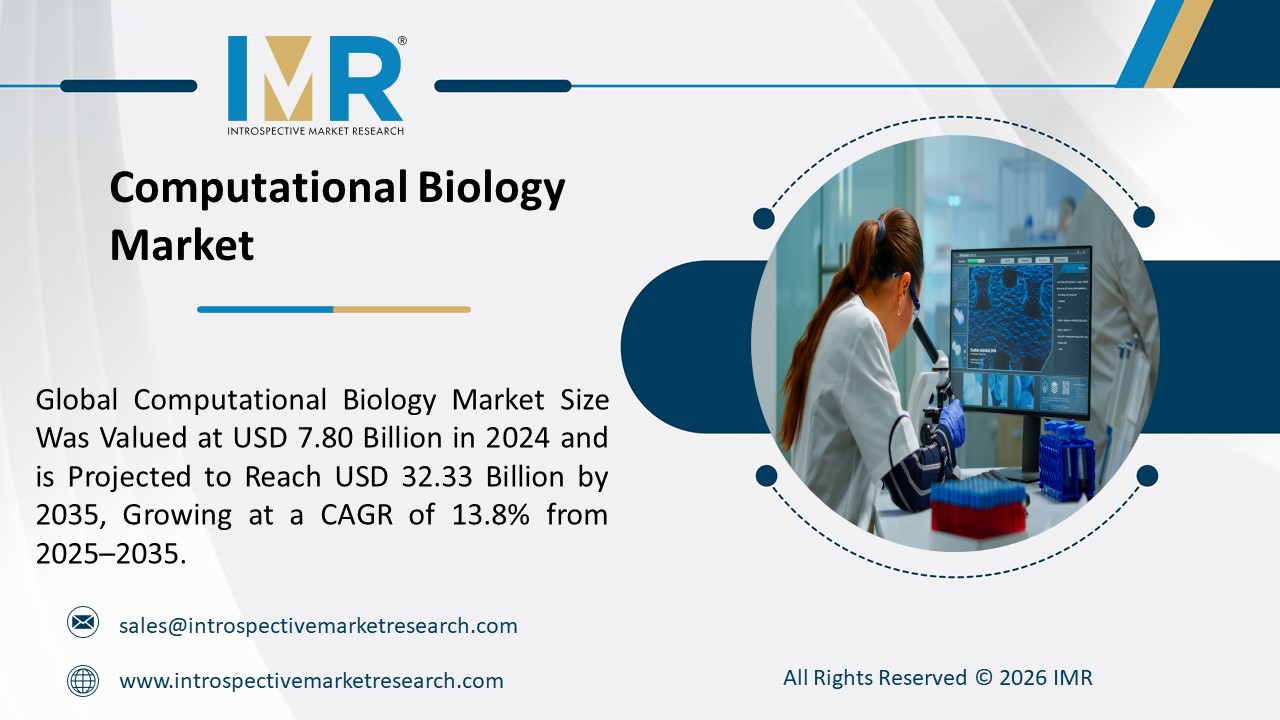
“According to a new report published by Introspective Market Research, titled, Computational Biology Market by Tools, Application, and End User, The Global Computational Biology Market Size Was Valued at USD 7.80 Billion in 2024 and is Projected to Reach USD 32.33 Billion by 2035, Growing at a CAGR of 13.8% from 2025–2035.”
Computational biology is an interdisciplinary field that combines biology, computer science, mathematics, and statistics to analyze and interpret complex biological data. It plays a critical role in understanding genetic sequences, protein structures, disease mechanisms, and cellular processes by leveraging advanced algorithms, artificial intelligence (AI), and high-performance computing. Compared to traditional experimental methods, computational biology offers faster analysis, cost efficiency, and the ability to process large-scale datasets with high accuracy.
The market is witnessing strong growth due to the rising adoption of genomics, proteomics, and systems biology across pharmaceutical, biotechnology, and academic research sectors. Computational tools enable accelerated drug discovery, biomarker identification, and personalized medicine development, reducing time-to-market and R&D costs for life science companies.
Furthermore, increasing availability of biological big data, advancements in cloud computing, and growing investments in precision medicine are driving the integration of computational biology into clinical research and healthcare decision-making. These factors collectively position computational biology as a cornerstone technology in modern life sciences and biomedical research.
Market Segmentation
The Computational Biology Market is segmented into Tools, Application, and End User.
- By Tools, the market is categorized into (Databases, Software Platforms, and Services).
- By Application, the market is categorized into (Drug Discovery & Development, Genomics, Proteomics, Clinical Trials, and Others).
- By End User, the market is categorized into (Pharmaceutical & Biotechnology Companies, Academic & Research Institutes, Healthcare Organizations, and Others).
Growth Driver
One of the key growth drivers of the computational biology market is the rapid expansion of genomics and multi-omics research. The declining cost of genome sequencing and the growing adoption of next-generation sequencing (NGS) technologies have led to an exponential increase in biological data generation. Computational biology tools are essential for managing, analyzing, and interpreting these complex datasets, enabling researchers to uncover disease-associated genes, molecular pathways, and therapeutic targets. This growing reliance on data-driven biological insights continues to fuel demand for advanced computational platforms across research and clinical applications.
Market Opportunity
A major market opportunity lies in the integration of artificial intelligence and machine learning in drug discovery and precision medicine. AI-powered computational biology solutions enable predictive modeling, virtual screening, and simulation of biological processes, significantly improving success rates in drug development. As pharmaceutical companies increasingly adopt AI-driven R&D strategies, the demand for advanced computational biology tools is expected to surge. Additionally, growing government funding, public-private collaborations, and rising interest in personalized healthcare further create lucrative growth opportunities for market participants.
Detailed Segmentation
Computational Biology Market, Segmentation
The Computational Biology Market is segmented on the basis of Tools, Application, and End User.
Tools
The Tools segment is further classified into Databases, Software Platforms, and Services. Among these, the Software Platforms sub-segment accounted for the highest market share in 2024. Software platforms are widely adopted due to their ability to integrate multiple datasets, perform complex simulations, and support AI-based analytics. Their extensive use in drug discovery, genomics analysis, and protein modeling, along with continuous upgrades and cloud-based deployment models, has strengthened their dominance in the market.
Application
The Application segment is further classified into Drug Discovery & Development, Genomics, Proteomics, Clinical Trials, and Others. Among these, the Drug Discovery & Development sub-segment accounted for the highest market share in 2024. Computational biology significantly reduces drug development timelines by enabling target identification, molecular docking, and predictive toxicity analysis. The increasing focus on reducing R&D costs and improving clinical success rates has driven strong adoption of computational tools in pharmaceutical pipelines.
Some of The Leading/Active Market Players Are–
• Thermo Fisher Scientific Inc. (USA)
• IBM Corporation (USA)
• Illumina, Inc. (USA)
• Dassault Systèmes SE (France)
• Accelrys (BIOVIA) (USA)
• Schrödinger, Inc. (USA)
• DNAnexus, Inc. (USA)
• Certara, Inc. (USA)
• PerkinElmer Inc. (USA)
• Genedata AG (Switzerland)
• Agilent Technologies, Inc. (USA)
• Seven Bridges Genomics (USA)
• Insilico Medicine (Hong Kong)
• Partek Incorporated (USA)
• SOPHiA GENETICS (Switzerland)
and other active players.
Key Industry Developments
In March 2024, leading biotech firms expanded partnerships with AI-based computational biology providers to enhance drug discovery pipelines.
These collaborations aim to leverage machine learning models for faster target identification, improved molecular simulations, and reduced drug development costs, accelerating the transition from research to clinical trials.
In October 2024, several academic research institutes adopted cloud-based computational biology platforms to support large-scale genomics projects.
The shift toward cloud infrastructure enables scalable data processing, cross-institutional collaboration, and improved accessibility for researchers, further boosting market adoption.
Key Findings of the Study
• Software platforms dominate the market due to broad application across life sciences
• Drug discovery & development remains the leading application segment
• North America holds the largest market share, driven by advanced R&D infrastructure
• Asia-Pacific is expected to witness the fastest growth over the forecast period
• AI integration and genomics expansion are key market trends