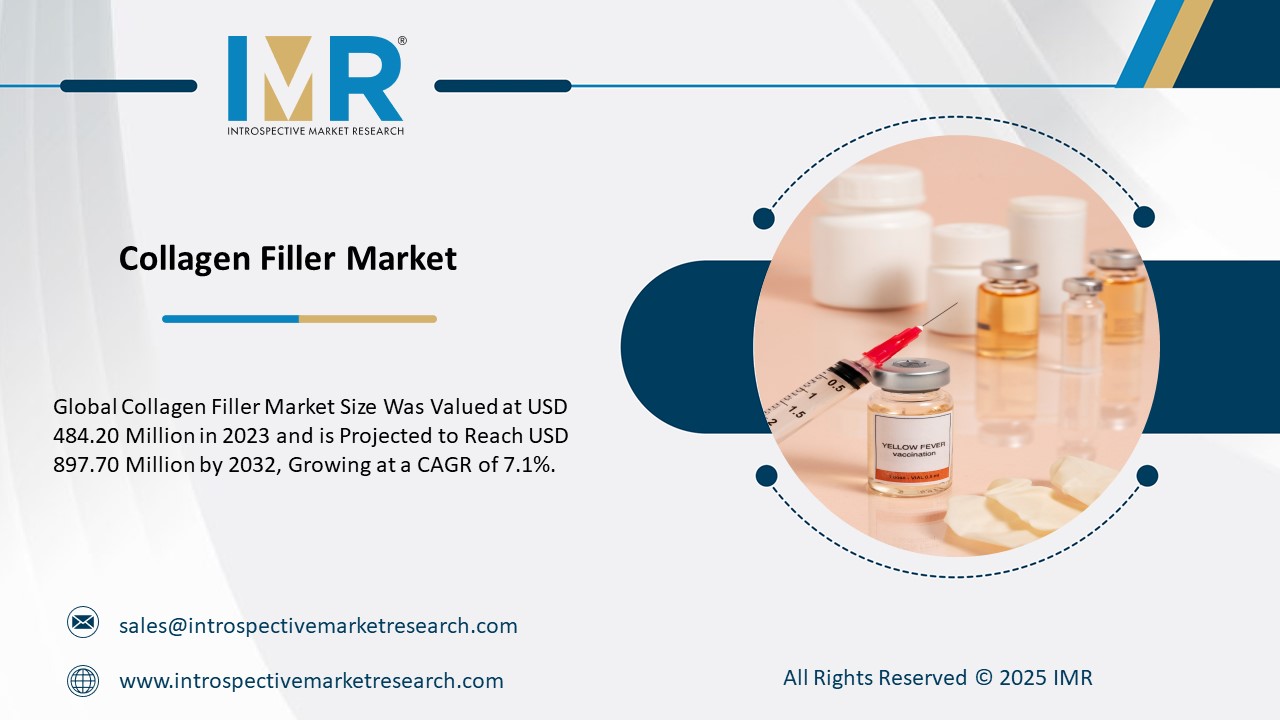
According to a new report published by Introspective Market Research, titled, Collagen Filler Market by Product Type, Application, and End User, The Global Collagen Filler Market Size Was Valued at USD 484.20 Million in 2023 and is Projected to Reach USD 897.70 Million by 2032, Growing at a CAGR of 7.1%.The Collagen Filler Market stands as a key segment within the broader aesthetic medicine landscape, deeply driven by the rising demand for minimally invasive cosmetic procedures worldwide. Collagen fillers, derived from bovine, porcine, or human sources, offer superior biocompatibility and natural results compared to synthetic alternatives, making them a preferred choice for both patients and practitioners. Their primary advantages include immediate volumizing effects, enhanced skin texture, and reduced downtime, which have propelled their adoption in facial aesthetic treatments, scar corrections, and lip augmentations.
The industry’s expansion is underpinned by technological advances in filler purification and cross-linking, which minimize allergic reactions and prolong efficacy. Collagen fillers are increasingly used in medical spas, dermatology clinics, and plastic surgery centers. Their versatile roles range from anti-aging facial wrinkles treatment to targeted medical indications such as lipoatrophy and reconstructive surgery, fostering widespread acceptance across geographies and age demographics.
The Collagen Filler Market is segmented into Product Type, Application, and End User.
-
By Product Type: Bovine-based, Porcine-based, Human-based, Others.
-
By Application: Facial Wrinkle Correction, Lip Augmentation, Scar Treatment, Reconstructive Procedures, Others.
-
By End User: Hospitals, Dermatology Clinics, Ambulatory Surgical Centers, Cosmetic Surgery Centers, Others.
A primary growth driver for the collagen filler market is the escalating demand for non-surgical facial rejuvenation and anti-aging solutions among the aging but appearance-conscious population. This demand is further fueled by rising disposable income, greater social acceptance of cosmetic enhancements, and the surge in medical tourism targeting cost-effective yet high-quality aesthetic treatments. Ongoing innovations in collagen extraction and crosslinking technologies have enhanced product longevity and safety, expanding market reach even in traditionally conservative regions.
Significant market opportunity lies in broadening indications and expanding product lines tailored for different ethnicities, skin types, and specific cosmetic goals. With the increasing trend toward personalized beauty and the rise of hybrid filler technologies (blending collagen with HA or other materials), companies are well-placed to attract new patient groups. Reinforcement of regulatory approvals and the rise of premium products for niche applications (like acne scar correction or facial contouring) further unlock lucrative growth avenues for both established manufacturers and emerging players.
Collagen Filler Market, Segmentation
The Collagen Filler Market is segmented on the basis of Product Type, Application, and End User.
Product Type
The Product Type segment is further classified into Bovine-based, Porcine-based, Human-based, and Others. Among these, the Bovine-based segment accounted for the highest market share in 2023. Bovine collagen offers ready availability, extensive clinical documentation, and competitive pricing, sustaining its preference among practitioners for soft tissue augmentation. Despite the rise of human-derived and hybrid fillers, robust safety records and positive patient outcomes reinforce bovine collagen’s leadership, particularly in emerging markets and cost-sensitive settings.
Application
The Application segment is classified into Facial Wrinkle Correction, Lip Augmentation, Scar Treatment, Reconstructive Procedures, and Others. Among these, Facial Wrinkle Correction held the largest share in 2023, thanks to the popularity of minimally invasive anti-aging procedures. This segment is propelled by the widespread need for natural-looking wrinkle reduction, short treatment times, and the rising prevalence of age-related skin concerns among millennials and Gen Xers globally.
Some of The Leading/Active Market Players Are
- Allergan (AbbVie Inc.) (US)
- Galderma S.A. (Switzerland)
- Merz Pharma GmbH & Co. KGaA (Germany)
- Sinclair Pharma (UK)
- Suneva Medical Inc. (US)
- Syneron Medical Ltd. (Israel)
- Humedix (South Korea)
- Zheijiang Jingjia Medical Technology Co., Ltd. (China)
- Collagen Solutions (UK)
- BioPlus Co., Ltd. (South Korea)
- Laboratoires Vivacy (France)
- Beijing Roxwood Medical Tech Co., Ltd. (China)
- Prollenium Medical Technologies (Canada)
- TEOXANE Laboratories (Switzerland)
- Sunmax Biotechnology Co., Ltd. (Taiwan)
- Other active players.
Key Industry Developments
- In May 2024, Galderma secured FDA clearance for its next-generation bovine-collagen-based filler, targeting long-lasting results in facial wrinkle and lip augmentation applications.This launch is expected to accelerate adoption among US practitioners, owing to the product’s improved safety profile and extended durability that appeals to both new and repeat patients in the aesthetic sector.
- In February 2025, Merz Pharma announced a strategic collaboration with leading bioengineering startups to co-develop hybrid collagen-based fillers combining biopolymer and HA technologies.The venture aims to address growing consumer demand for multi-action injectables tailored to a wider variety of aesthetic and reconstructive indications, improving patient access and boosting Merz’s innovation credentials.
Key Findings of the Study
- Bovine-based fillers and facial wrinkle correction are the market’s leading segments.
- North America and Europe drive demand, supported by strong adoption rates and favorable regulatory frameworks.
- Rising medical tourism and innovation in hybrid fillers fuel global market growth.
- Non-surgical, minimally invasive procedures remain a dominant trend influencing product development.