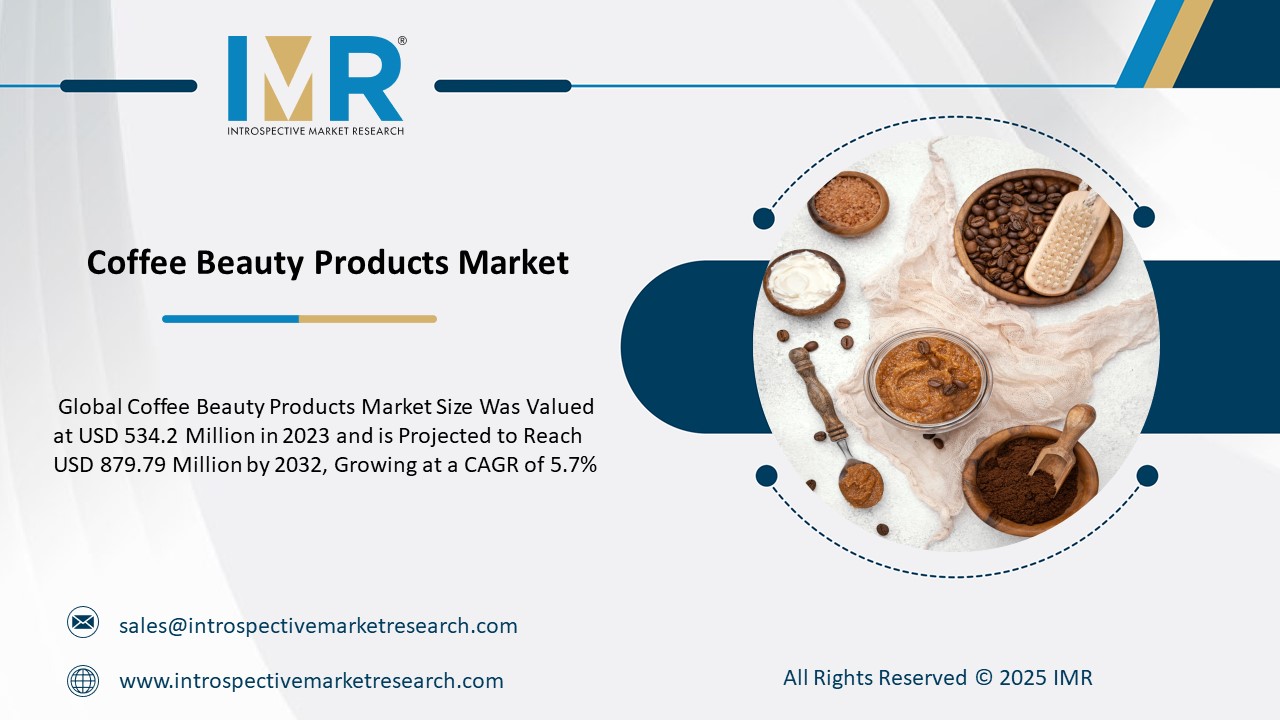
According to a new report published by Introspective Market Research, titled, Coffee Beauty Products Market by Product Type, Price Range, and Distribution Channel, The Global Coffee Beauty Products Market Size Was Valued at USD 534.2 Million in 2023 and is Projected to Reach USD 879.79 Million by 2032, Growing at a CAGR of 5.7%.The Coffee Beauty Products Market represents a dynamic segment in the global personal care industry, driven by rising consumer preference for natural, antioxidant-rich cosmetic solutions. Coffee beauty products are widely recognized for their exfoliating, anti-inflammatory, and revitalizing properties, granting them advantages over conventional alternatives laden with synthetic chemicals. Key forms include scrubs, creams, masks, lotions, shampoos, and serums, each harnessing coffee's unique ability to combat free radicals, stimulate circulation, improve skin tone, and promote a radiant appearance.
With the clean beauty trend accelerating worldwide, brands are formulating products that align with eco-conscious values and ethical sourcing. Coffee, often derived as a by-product, underscores sustainability in beauty routines. Enhanced by endorsements from social media influencers and easy availability across digital and offline channels, coffee beauty products have gained extensive acceptance among diverse consumer groups, particularly those seeking holistic, plant-based skincare and haircare solutions.
The Coffee Beauty Products Market is segmented into Product Type, Price Range, and Distribution Channel.
-
By Product Type: Skincare Products, Haircare Products, Body Care Products, Color Cosmetics, Perfumes & Fragrances.
-
By Price Range: Luxury, Affordable, Drug Store.
-
By Distribution Channel: Online, Supermarkets/Hypermarkets, Specialty Stores, Convenience Stores.
A key growth driver propelling this market is surging global demand for clean-label, caffeine-based skincare, as educated consumers prioritize natural ingredients and transparency. Coffee-based beauty products are popular for their antioxidant potency, skin-brightening qualities, and perceived safety compared to chemical counterparts. Influencer campaigns and the ability to target multiple skincare concerns, from anti-aging to acne reduction, have amplified their visibility and appeal across both mature and emerging markets.
Significant opportunity lies in the expansion of innovative product portfolios and digital retailing. As brands increasingly leverage spent coffee grounds and ethical sourcing, the scope for vegan and cruelty-free certification grows, resonating with sustainability-focused consumers. E-commerce platforms enable rapid, international distribution and targeted marketing, fostering global accessibility. New formulations, e.g., coffee-based serums and scalp treatments, further invite customers seeking specialized benefits, supporting category growth.
Coffee Beauty Products Market, Segmentation
The Coffee Beauty Products Market is segmented on the basis of Product Type, Price Range, and Distribution Channel.
Product Type
The Product Type segment is further classified into Skincare Products, Haircare Products, Body Care Products, Color Cosmetics, and Perfumes & Fragrances. Among these, the Skincare Products sub-segment accounted for the highest market share in 2023. Owing to widespread recognition of coffee's efficacy as an exfoliant and antioxidant, coffee-infused serums, creams, and masks have become bestsellers. This sub-segment is supported by high adoption in both mass and luxury beauty sectors, driven by consumers’ desire for visible, holistic results through botanically derived actives.
Price Range
The Price Range segment is classified into Luxury, Affordable, and Drug Store. Among these, the Affordable sub-segment held the largest market share in 2023. Accessibility of affordable coffee beauty products through mass-market retailers and online platforms has democratized natural skincare, attracting both first-time buyers and repeat users, and boosting brand penetration in developing and developed markets alike.
Some of The Leading/Active Market Players Are
- L’Oréal S.A. (France)
- Avon Products, Inc. (UK)
- Estee Lauder Inc. (US)
- The Procter & Gamble Company (US)
- Unilever Plc (UK)
- Bean Body (Australia)
- BioCare Ltd. (India)
- The Body Shop (UK)
- Java Skin Care (US)
- OGX Beauty (US)
- Pep Technologies Pvt Ltd (mCaffeine) (India)
- Frank Body (Australia)
- Caudalie (France)
- Henkel AG & Co. KGaA (Germany)
- The Nature’s Bounty Co. (US)
- Other active players.
Key Industry Developments
- In September 2024, Frank Body launched a new line of “Coffee Scrub Shots,” single-use sachets targeting the travel and on-the-go beauty market.The launch marks a shift toward personalized, convenient beauty products using signature coffee ingredients, expanding Frank Body’s reach in global personal care and supporting sustainability through waste-minimized packaging.
- In January 2025, L’Oréal announced a partnership with eco-friendly coffee suppliers to develop traceable, fair-trade, coffee-infused skincare ranges.The collaboration aims to reinforce L’Oréal’s leadership in sustainable innovation and appeal to ethically minded consumers seeking transparency and responsible sourcing in their beauty choices.
Key Findings of the Study
- Skincare products are the dominant segment, with online retail leading distribution.
- North America remains the leading region, followed by Europe and Asia-Pacific.
- Demand for natural, plant-based beauty formulas and influencer-driven marketing are key growth drivers.
- Sustainability, upcycling, and ethical sourcing are major market trends shaping new product launches.