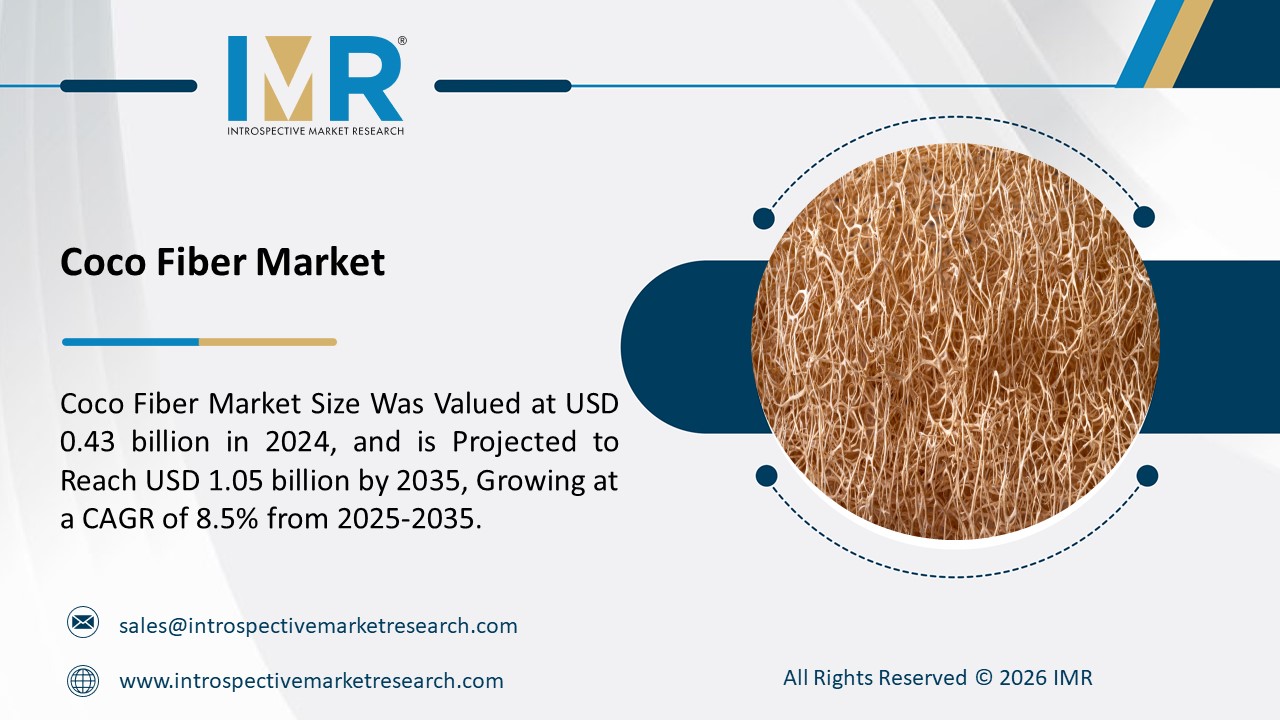
According to a new report published by Introspective Market Research, titled, “Coco Fiber Market by Product, Application, and End-User,” The Global Coco Fiber Market Size Was Valued at USD 0.43 Billion in 2024 and is Projected to Reach USD 1.05 Billion by 2035, Growing at a CAGR of 8.5% From 2025–2035.
The Coco Fiber (also known as coir) market consists of versatile natural fibers extracted from the husk of coconuts, a renewable byproduct of the coconut industry. It is processed into various forms such as bristle fiber, mattress fiber, and decorticated fiber, and further manufactured into products like grow bags, mats, brushes, and erosion control blankets. Its key advantage over synthetic alternatives (like peat moss or plastic geotextiles) and other natural fibers is its exceptional durability, water retention, biodegradability, and resistance to fungal and bacterial degradation. As a 100% renewable, peat-free, and often waste-derived material, it aligns perfectly with the global sustainability movement.
The primary growth driver for the coco fiber market is the rapid global expansion of controlled-environment agriculture (CEA), hydroponics, and organic farming, coupled with the urgent need for sustainable alternatives to peat moss. The horticulture industry is increasingly adopting soilless growing media to improve yield, control pests, and conserve water. Coco peat/coir pith, made from the fine particles of the fiber, is an ideal substrate due to its excellent air-to-water ratio, root-friendly nature, and sustainability. Concurrently, growing environmental awareness has led to bans and restrictions on peat extraction in many regions due to its high carbon footprint and habitat destruction. This regulatory and consumer-driven shift away from peat has positioned coco fiber as the leading renewable, high-performance substitute, creating massive and sustained demand from commercial growers and hobbyists alike.
A significant market opportunity lies in the innovation and development of value-added, processed coco fiber products for high-performance applications and the expansion into new industrial sectors. Beyond basic fiber and peat, opportunities exist in creating engineered blends of coco fiber with other bio-materials (like biochar) for specialized horticultural mixes or enhanced filtration media. Furthermore, developing technically specified fibers with consistent properties for use in biocomposite materials (for automotive panels or packaging) and advanced non-woven geotextiles with improved strength and longevity for civil engineering projects represents a high-growth avenue. Companies that invest in processing technology to produce consistent, high-quality fiber and innovate in product development can move up the value chain and tap into more lucrative industrial markets.
Coco Fiber Market, Segmentation
The Coco Fiber Market is segmented on the basis of Product, Application, and End-User.
Application
The Application segment is further classified into Horticulture & Agriculture, Geotextiles & Erosion Control, Bedding & Upholstery, and Others. Among these, the Horticulture & Agriculture sub-segment accounted for the highest market share in 2024. This dominance is absolute, as coco peat/coir pith has become a cornerstone of modern horticulture. It is used as a primary component in potting mixes, seedling trays, and hydroponic systems for growing vegetables, fruits, flowers, and ornamental plants globally. The segment benefits from the scalability of commercial agriculture and gardening trends, making it the largest and fastest-growing outlet for processed coco fiber, directly driving market expansion.
Product
The Product segment is further classified into Bristle Fiber, Mattress Fiber, and Decorticated Fiber. Among these, the Decorticated Fiber sub-segment accounted for the highest market share in 2024. Decorticated fiber, which is the raw fiber mechanically separated from the coconut husk, serves as the fundamental feedstock for nearly all downstream products. It is the primary material processed into coco peat (by grinding), bristle fiber (by combing), and mattress fiber. Its position as the essential, versatile raw material that feeds into multiple high-growth applications ensures its status as the volume leader in the product category.
Some of The Leading/Active Market Players Are-
• FibreDust LLC (US)
• Coco Technologies Corporation (Philippines)
• SMS Exporters (India)
• Allwin Coir (India)
• Classic Coir (India)
• Benlion Coir Industry (Sri Lanka)
• Heng Huat Resources Group Sdn Bhd (Malaysia)
• Sai Cocopeat Export Private Ltd. (India)
• Dutch Plantin (The Netherlands)
• and other active players.
Key Industry Developments
In March 2024, a leading European coco peat processor announced a partnership with a major greenhouse vegetable producer to develop a closed-loop, nutrient-recirculating growing system based entirely on customized coco fiber substrates. The aim is to maximize water and fertilizer efficiency while producing a completely biodegradable growing medium, enhancing sustainability in high-value crop production.
In January 2024, several major North American landscaping product distributors expanded their portfolios to include erosion control blankets and landscaping mulch made from woven and bonded coco fiber. This move caters to the growing demand from municipalities and construction firms for environmentally friendly, effective soil stabilization solutions that naturally biodegrade over time.
Key Findings of the Study
• The Horticulture & Agriculture application and Decorticated Fiber product segment are the market leaders.
• The Asia-Pacific region is the largest producer and consumer, led by India, Sri Lanka, and Indonesia.
• The key growth driver is the booming horticulture sector and the shift away from peat moss.
• Major trends include innovation in value-added horticultural blends and expansion into geotextile and industrial applications.