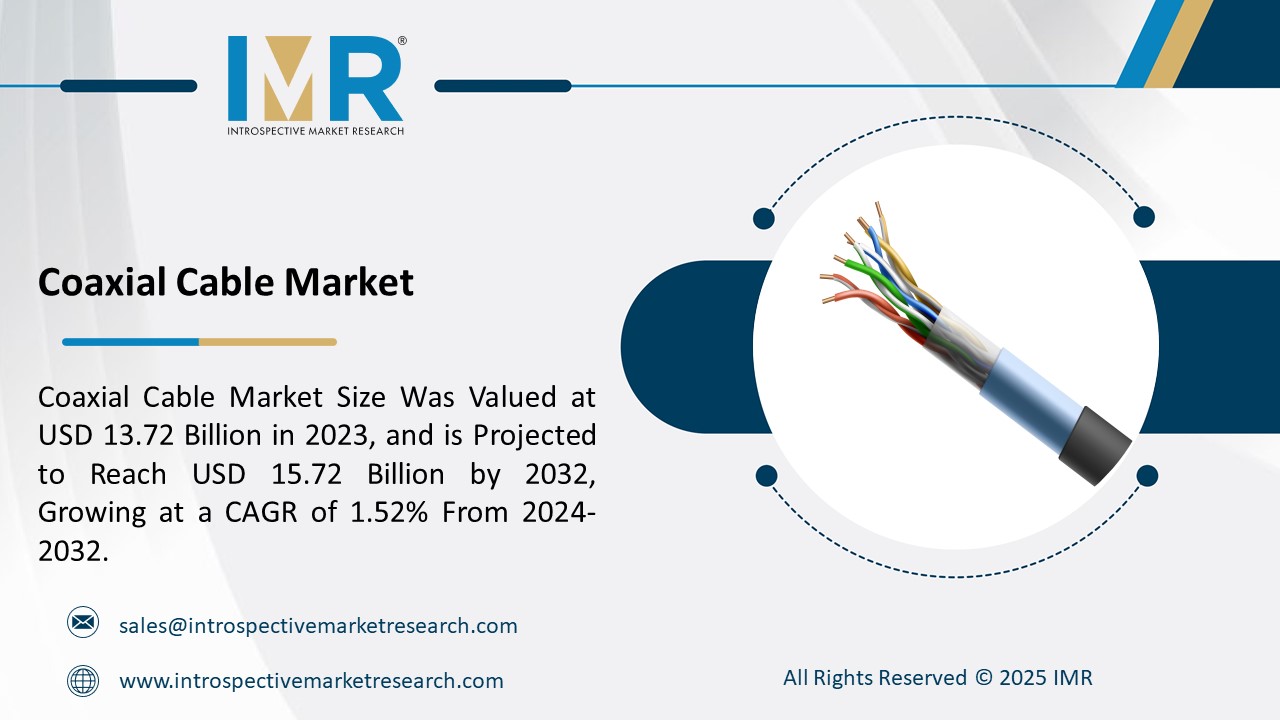
According to a new report published by Introspective Market Research, titled, Coaxial Cable Market by Type (RG Type, RF Type), by Application (Internet Data Transfer, Video Distribution, Radio Frequency Transfer, Other), by End-User (Cable Television, Internet Services, Telecommunications, Military & Aerospace, Industrial, Other), The Global Coaxial Cable Market Size Was Valued at USD 13.72 Billion in 2023 and is Projected to Reach USD 15.72 Billion by 2032, Growing at a CAGR of 1.52%. The coaxial cable market continues to demonstrate steady growth, driven by its enduring relevance in various communication and broadcasting applications despite the rise of newer technologies. Coaxial cables are a type of electrical cable consisting of an inner conductor surrounded by a concentric insulating layer, then surrounded by a conducting shield, and finally an outer insulating jacket. This distinctive design effectively minimizes signal interference and noise, making them ideal for transmitting high-frequency signals over significant distances with minimal loss.
These cables offer reliable and robust connectivity solutions, particularly crucial for applications requiring high bandwidth and signal integrity. Their advantages over simpler alternatives include superior shielding from electromagnetic interference, greater bandwidth capacity compared to twisted-pair cables for certain uses, and established infrastructure for deployment. Coaxial cables remain a fundamental component in industries ranging from cable television and internet services to telecommunications and military communications.
A key growth driver for the coaxial cable market is the continued expansion and upgrading of cable television (CATV) infrastructure, particularly in developing regions. While fiber optics is gaining ground, coaxial cables remain the backbone for "last mile" connectivity in many existing CATV networks due to their cost-effectiveness and established deployment. As demand for high-definition content and broadband internet services grows, cable operators continue to invest in improving their hybrid fiber-coaxial (HFC) networks, requiring resilient coaxial cables to deliver reliable services to subscribers.
A significant market opportunity lies in the expanding demand for robust and interference-resistant communication infrastructure in industrial and military applications. In harsh environments, where electromagnetic interference is prevalent, coaxial cables provide critical shielding and reliability for data transmission, sensor networks, and control systems. The need for secure and stable communication in defense systems, aerospace, and advanced manufacturing facilities, coupled with the proven performance of coaxial technology in such conditions, presents a niche yet high-value growth avenue for market players.
Coaxial Cable Market, Segmentation
The Coaxial Cable Market is segmented on the basis of Type, Application, and End-User.
Type
- The Type segment is further classified into RG Type and RF Type. Among these, the RG Type sub-segment accounted for the highest market share in 2023. RG (Radio Guide) type coaxial cables are widely used in a multitude of applications, including cable television, satellite systems, and various commercial and residential video installations. Their widespread adoption is attributed to standardized specifications, cost-effectiveness, and reliable performance across different frequency ranges. The long-standing presence of RG cables in established infrastructure and their continued use for both analog and digital signal transmission contribute significantly to their dominant market position.
Application
- The Application segment is further classified into Internet Data Transfer, Video Distribution, Radio Frequency Transfer, and Other. Among these, the Video Distribution sub-segment accounted for the highest market share in 2023. Coaxial cables have historically been, and continue to be, the primary medium for video signal transmission, particularly in cable television (CATV) networks. Their ability to carry multiple video channels with minimal signal degradation over long distances makes them indispensable for broadcasting and distributing television signals to millions of homes. Despite the rise of streaming, the existing and continuously upgraded CATV infrastructure relies heavily on coaxial cables for efficient video delivery.
Some of The Leading/Active Market Players Are-
- CommScope, Inc. (USA)
- Belden Inc. (USA)
- TE Connectivity Ltd. (Switzerland)
- Amphenol Corporation (USA)
- Nexans S.A. (France)
- Prysmian Group (Italy)
- Times Microwave Systems (USA)
- TFC (TeleCable Company) (USA)
- Corning Incorporated (USA)
- Hitachi Metals, Ltd. (Japan)
- General Cable Technologies Corporation (USA) (now part of Prysmian Group)
- Alpha Wire (USA)
- Lapp Group (Germany)
- Southwire Company, LLC (USA)
- Radiall (France)
- other active players.
Key Industry Developments
- In July 2023, CommScope, Inc. announced innovations in its coaxial cable portfolio designed to support higher bandwidth requirements for next-generation DOCSIS 4.0 networks, enabling faster internet speeds for cable operators. This development is crucial for maintaining the competitive edge of HFC networks against fiber-to-the-home solutions. CommScope's advancements help existing cable infrastructure to support multi-gigabit speeds, demonstrating the ongoing evolution and relevance of coaxial technology in broadband delivery.
- In October 2022, Belden Inc. introduced a new line of ruggedized coaxial cables specifically engineered for demanding industrial environments, offering enhanced resistance to chemicals, extreme temperatures, and mechanical stress. This product expansion aimed to capitalize on the growing industrial automation and IoT sectors where robust and reliable connectivity is paramount. Belden’s new cables provide critical data transmission integrity in harsh operational settings, ensuring consistent performance for industrial applications.
Key Findings of the Study
- RG Type coaxial cables hold the largest market share due to their widespread use in CATV and residential applications.
- Video Distribution remains the dominant application segment for coaxial cables.
- The continued upgrading of cable television infrastructure is a primary growth driver.
- Growing demand from industrial and military sectors for robust communication offers key opportunities.