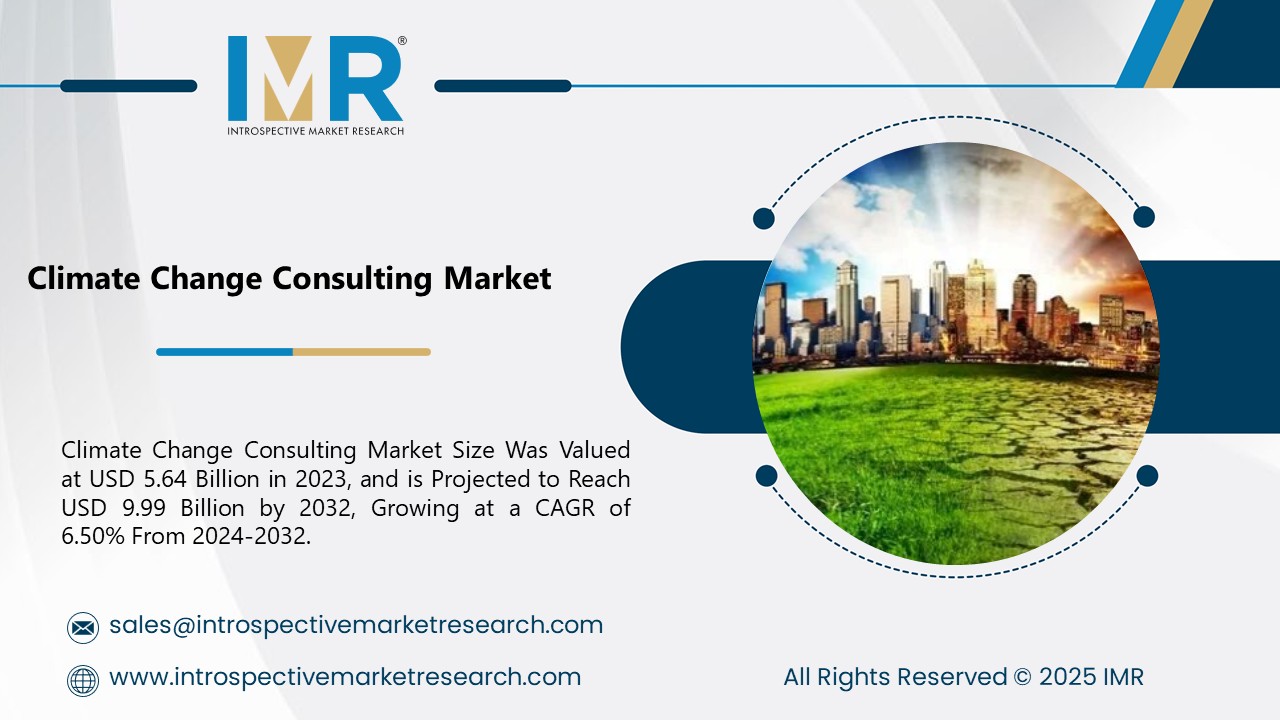
According to a new report published by Introspective Market Research, titled, Climate Change Consulting Market by Service Type, Industry Vertical, and Organization Size, The Global Climate Change Consulting Market Size Was Valued at USD 5.64 Billion in 2023 and is Projected to Reach USD 9.99 Billion by 2032, Growing at a CAGR of 6.50%. The climate change consulting market is experiencing robust growth as organizations globally grapple with the multifaceted impacts of a changing climate and the imperative to transition to a sustainable economy. Climate change consulting services provide expert guidance to businesses, governments, and non-profits in understanding, measuring, and mitigating their environmental footprint, adapting to climate risks, and seizing opportunities presented by the green transition. These services span a broad spectrum, from carbon footprint analysis and regulatory compliance to climate risk assessment, renewable energy integration strategies, and developing comprehensive sustainability roadmaps.
Consultants in this market leverage deep scientific understanding, policy expertise, and strategic business acumen to help clients navigate complex environmental regulations, improve resource efficiency, and enhance their brand reputation. By offering tailored solutions, they enable clients to not only meet their environmental responsibilities but also to gain a competitive edge by fostering resilience, innovation, and long-term value creation in an increasingly carbon-constrained world. The market's growth underscores the critical role of specialized expertise in addressing one of humanity's most pressing challenges.
The Climate Change Consulting Market is segmented into Service Type, Industry Vertical, and Organization Size. By Service Type, the market is categorized into (Strategy & Policy Development, Risk Management, Carbon Footprint Management, Adaptation & Resilience, Technology & Innovation, and Others). By Industry Vertical, the market is categorized into (Energy & Utilities, Manufacturing, BFSI, Government & Public Sector, Agriculture, and Others). By Organization Size, the market is categorized into (Large Enterprises, and Small & Medium-sized Enterprises (SMEs)).
A key growth driver for the climate change consulting market is the escalating global regulatory pressure and the enforcement of stricter environmental policies aimed at reducing greenhouse gas emissions and promoting sustainability. Governments worldwide are implementing ambitious targets and carbon pricing mechanisms, compelling businesses to assess and reduce their environmental impact. This regulatory landscape necessitates specialized expertise to ensure compliance, identify emission reduction opportunities, and develop robust climate strategies, thereby driving the demand for professional climate change consulting services across all industry verticals seeking to avoid penalties and enhance their environmental performance.
A significant market opportunity lies in the growing corporate focus on Environmental, Social, and Governance (ESG) criteria and the increasing investor demand for sustainable business practices. Companies are recognizing that strong ESG performance is not only ethically imperative but also crucial for attracting capital, mitigating risks, and enhancing brand value. Climate change consultants are uniquely positioned to assist organizations in developing credible ESG strategies, reporting on climate-related financial disclosures (e.g., TCFD), and integrating climate considerations into their core business models, thereby enabling them to meet investor expectations and unlock new financing opportunities.
Climate Change Consulting Market, Segmentation
The Climate Change Consulting Market is segmented on the basis of Service Type, Industry Vertical, and Organization Size.
Service Type
- The Service Type segment is further classified into Strategy & Policy Development, Risk Management, Carbon Footprint Management, Adaptation & Resilience, Technology & Innovation, and Others. Among these, the Strategy & Policy Development sub-segment accounted for the highest market share in 2023. This segment involves advising clients on formulating comprehensive climate strategies, setting ambitious sustainability goals, and developing internal and external policies to achieve them. It includes guiding organizations through complex regulatory frameworks, helping them align with international agreements like the Paris Agreement, and developing roadmaps for decarbonization and sustainable growth. The foundational nature of strategic planning in climate action makes this a dominant service area.
Industry Vertical
- The Industry Vertical segment is further classified into Energy & Utilities, Manufacturing, BFSI, Government & Public Sector, Agriculture, and Others. Among these, the Energy & Utilities sub-segment accounted for the highest market share in 2023. The Energy & Utilities sector faces immense pressure to decarbonize operations, transition to renewable energy sources, and adapt to climate-induced disruptions. Climate change consultants provide critical expertise in developing renewable energy strategies, optimizing energy efficiency, assessing climate risks to infrastructure, and navigating the complex regulatory environment. The inherent carbon intensity of this sector and the imperative for transformative change drive a high demand for specialized consulting services to ensure a sustainable and resilient energy future.
Some of The Leading/Active Market Players Are-
- ERM Group (UK)
- Deloitte Touche Tohmatsu Limited (UK)
- PricewaterhouseCoopers (PwC) (UK)
- KPMG International (Netherlands)
- Accenture plc (Ireland)
- McKinsey & Company (USA)
- Boston Consulting Group (BCG) (USA)
- WSP Global Inc. (Canada)
- AECOM (USA)
- Ramboll Group (Denmark)
- Ricardo Plc (UK)
- Schneider Electric SE (France)
- Tetra Tech, Inc. (USA)
- Jacobs Engineering Group Inc. (USA)
- Sustainalytics (Netherlands)
Key Industry Developments
- In February 2023, a major global consulting firm announced a strategic partnership with a leading climate analytics platform to enhance its climate risk assessment services.
This collaboration aims to integrate cutting-edge climate models and data analytics into the firm's consulting offerings, providing clients with more granular and forward-looking insights into physical and transitional climate risks. The enhanced capabilities will enable businesses to make more informed decisions regarding asset management, supply chain resilience, and investment strategies in the face of escalating climate uncertainties. - In October 2022, a specialized climate consulting agency launched a new service specifically designed to help small and medium-sized enterprises (SMEs) develop and report on their net-zero pathways.
Recognizing the unique challenges faced by SMEs in climate action, this service offers streamlined tools and expert guidance to calculate carbon footprints, set ambitious reduction targets, and communicate progress effectively. The initiative aims to democratize access to climate expertise, enabling a broader range of businesses to contribute to global decarbonization efforts and enhance their sustainability credentials.
Key Findings of the Study
- Strategy & Policy Development and Energy & Utilities segments dominate the market.
- Europe and North America are leading regions due to strong regulatory frameworks.
- Increasing regulatory pressures and corporate ESG focus are key growth drivers.
Growing demand for climate risk assessment and adaptation strategies presents a major market trend.