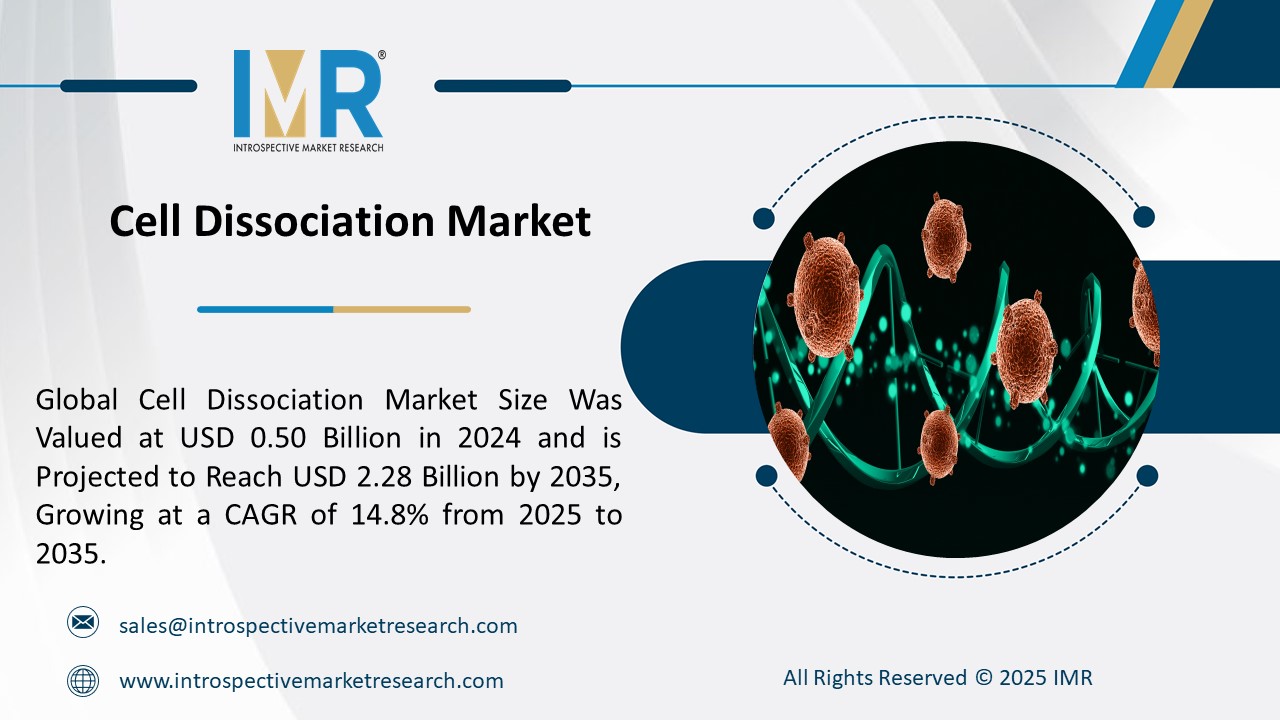
According to a new report published by Introspective Market Research, titled, Cell Dissociation Market by Product Type, Application, and End User, The Global Cell Dissociation Market Size Was Valued at USD 0.50 Billion in 2024 and is Projected to Reach USD 2.28 Billion by 2035, Growing at a CAGR of 14.8% from 2025 to 2035.
The cell dissociation market plays a critical role in modern life science research and biopharmaceutical development by enabling the separation of cells from tissues or cell aggregates into single-cell suspensions. Cell dissociation products, including enzymatic and non-enzymatic reagents, are widely used in cell culture workflows, stem cell research, immunology, and regenerative medicine. These solutions offer higher efficiency, reproducibility, and cell viability compared to traditional mechanical dissociation techniques.
Advancements in cell-based research, coupled with the rapid expansion of cell and gene therapy pipelines, have significantly increased the demand for reliable and scalable cell dissociation technologies. The ability to preserve cellular integrity and functionality during dissociation has become increasingly important for downstream applications such as flow cytometry, single-cell analysis, and therapeutic manufacturing.
Furthermore, growing investments in biotechnology research, rising adoption of 3D cell cultures, and expanding use of primary cells in drug discovery are accelerating market growth. As research laboratories and biopharmaceutical companies prioritize standardized and automation-compatible workflows, the cell dissociation market is expected to witness sustained expansion throughout the forecast period.
Market Segmentation
The Cell Dissociation Market is segmented into Product Type, Application, and End User.
- By Product Type, the market is categorized into Enzymatic Dissociation Reagents, Non-Enzymatic Dissociation Reagents, and Mechanical Dissociation Systems.
- By Application, the market is categorized into Stem Cell Research, Cancer Research, Drug Discovery & Development, and Other Applications.
- By End User, the market is categorized into Biopharmaceutical & Biotechnology Companies, Academic & Research Institutes, and Contract Research Organizations (CROs).
Growth Driver
The primary growth driver of the cell dissociation market is the rapid expansion of cell-based research and regenerative medicine. Increasing research activities in stem cells, immunotherapy, and personalized medicine require efficient dissociation methods to maintain high cell viability and functionality. Additionally, the growing adoption of single-cell analysis techniques in oncology and genomics has significantly boosted the demand for advanced cell dissociation reagents. Rising funding for life science research and continuous innovation in reagent formulations further support market growth.
Market Opportunity
A key market opportunity lies in the rising commercialization of cell and gene therapies worldwide. As biopharmaceutical companies scale up manufacturing of advanced therapies, there is an increasing need for standardized, GMP-compliant cell dissociation solutions. Emerging markets in Asia-Pacific and Latin America also present lucrative growth opportunities due to expanding research infrastructure and increasing government support for biotechnology. Moreover, the integration of automated and closed-system cell processing technologies is expected to create new avenues for market players.
Detailed Segmentation
Cell Dissociation Market, Segmentation
The Cell Dissociation Market is segmented on the basis of Product Type, Application, and End User.
Product Type
The Product Type segment is further classified into Enzymatic Dissociation Reagents, Non-Enzymatic Dissociation Reagents, and Mechanical Dissociation Systems. Among these, the Enzymatic Dissociation Reagents sub-segment accounted for the highest market share in 2024. Enzymatic reagents such as trypsin, collagenase, and dispase are widely preferred due to their high efficiency, consistency, and suitability for a broad range of cell types. Their extensive use in routine cell culture and therapeutic research continues to drive dominance.
Application
The Application segment is further classified into Stem Cell Research, Cancer Research, Drug Discovery & Development, and Other Applications. Among these, the Stem Cell Research sub-segment held the largest market share in 2024. The growing focus on regenerative medicine and tissue engineering has significantly increased the use of cell dissociation solutions in stem cell isolation and expansion. Reliable dissociation methods are essential to maintain pluripotency and cell viability, driving sustained demand in this segment.
Some of The Leading/Active Market Players Are-
-
Thermo Fisher Scientific (USA)
-
Merck KGaA (Germany)
-
STEMCELL Technologies (Canada)
-
Miltenyi Biotec (Germany)
-
BD Biosciences (USA)
-
Lonza Group (Switzerland)
-
PromoCell GmbH (Germany)
-
Takara Bio Inc. (Japan)
-
Bio-Techne Corporation (USA)
-
HiMedia Laboratories (India)
-
Corning Incorporated (USA)
-
Sartorius AG (Germany)
-
PAN-Biotech (Germany)
-
Irvine Scientific (USA)
-
and other active players.
Key Industry Developments
In March 2024, a leading life science company expanded its portfolio of GMP-grade cell dissociation reagents to support commercial cell therapy manufacturing.
This development focuses on improving scalability, regulatory compliance, and reproducibility in advanced therapy workflows, addressing critical challenges faced by biopharmaceutical manufacturers.
In October 2023, a biotechnology firm launched an animal-origin-free enzymatic dissociation solution designed for sensitive stem cell applications.
The product aims to enhance cell viability and reduce contamination risks, supporting the growing demand for safer and more standardized research reagents.
Key Findings of the Study
-
Enzymatic dissociation reagents dominated the product type segment
-
Stem cell research emerged as the leading application area
-
North America held the largest regional market share
-
Growth driven by cell therapy expansion and single-cell research
-
Increasing adoption of GMP-compliant solutions globally