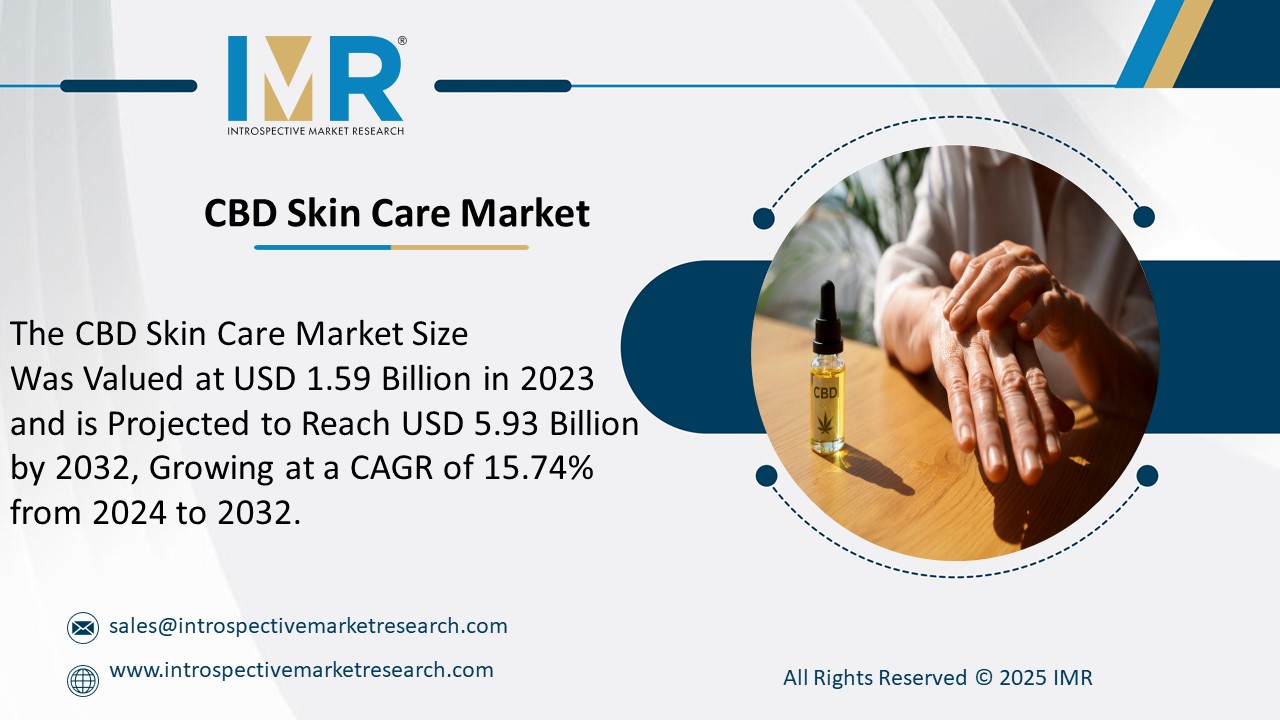
According to a new report published by Introspective Market Research, titled, CBD Skin Care Market by Product Type, Distribution Channel, and Region, The Global CBD Skin Care Market Size Was Valued at USD 1.59 Billion in 2023 and is Projected to Reach USD 5.93 Billion by 2032, Growing at a CAGR of 15.74% from 2024 to 2032. The CBD skin care market encompasses topical beauty and personal care products infused with cannabidiol (CBD), a non-psychoactive compound derived from hemp. CBD is increasingly valued for its anti-inflammatory, antioxidant, and soothing properties. These benefits position CBD-based formulations as attractive alternatives to conventional skincare ingredients for conditions like acne, eczema, and sensitive skin.
CBD-infused creams, oils, serums, masks, and balms are being developed to deliver these therapeutic effects, while traditional skincare products have often relied on synthetic actives and harsh chemicals. Unlike many synthetic ingredients, CBD is marketed as more “natural” and aligning with wellness trends. As consumer awareness of holistic skincare grows, CBD skin care products are gaining traction across facial care, body care, and specialty segments.
Rising demand is fueled by trends toward clean beauty, natural ingredients, and holistic wellness. In several markets, relaxed hemp regulations and consumer willingness to try novel ingredients support growth. E-commerce platforms and social media marketing also help new CBD skincare brands reach niche audiences faster and more directly.
The CBD Skin Care Market is segmented into Product Type, Distribution Channel, and Region. By Product Type, the market is categorized into (Creams & Lotions, Oils & Serums, Masks & Balms, Cleansers & Toners). By Distribution Channel, the market is categorized into (Online / E-Commerce, Specialty Beauty Stores, Pharmacies / Drugstores, Supermarkets / Hypermarkets). By Region, the market is categorized into (North America, Europe, Asia-Pacific, Latin America, Middle East & Africa).
One key growth driver in the CBD skin care market is rising consumer preference for clean, natural, and wellness-oriented beauty formulations. Many consumers are seeking products with botanical or plant-derived actives over synthetic chemicals, especially for sensitive or inflamed skin. CBD, with its positioning as a “natural” antioxidant and anti-inflammatory ingredient, aligns well with that demand trend. Furthermore, the influence of social media, beauty influencers, and wellness communities is accelerating awareness and adoption of CBD skin care among millennials and Gen Z consumers, fueling faster market growth.
A significant market opportunity lies in premiumization and differentiation through advanced formulations and delivery systems. Brands that develop high-potency CBD with improved bioavailability—such as nanoemulsions, liposomal carriers, or transdermal enhancements—can command premium pricing. Moreover, combining CBD with synergistic actives (e.g. niacinamide, peptides, ceramides) for multifunctional benefits (anti-aging, brightening, soothing) opens pathways to mainstream skincare segments. Targeting niche sub-markets such as post-procedure skincare, dermatology channels, and men’s grooming also offers growth potential for differentiated CBD skin care products.
CBD Skin Care Market, Segmentation
The CBD Skin Care Market is segmented on the basis of Product Type, Distribution Channel, and Region.
Product Type
The Product Type segment is further classified into Creams & Lotions, Oils & Serums, Masks & Balms, and Cleansers & Toners. Among these, the Creams & Lotions sub-segment accounted for the highest market share in 2023. Creams and lotions offer convenient, familiar formats for consumers, aid in moisturization, and are often the first entry point for CBD consumption in skincare routines. They allow easier incorporation of CBD into daily regimens and enjoy better consumer acceptance compared to more niche formats.
Distribution Channel
The Distribution Channel segment is further classified into Online / E-Commerce, Specialty Beauty Stores, Pharmacies / Drugstores, and Supermarkets / Hypermarkets. Among these, the Online / E-Commerce sub-segment accounted for the highest share in 2023. Online channels offer direct-to-consumer access, broad product selection, lower overheads, and global reach. Many CBD skincare brands rely on digital marketing to reach consumers in regions with restrictive retail regulations, making e-commerce the dominant distribution route.
Some of The Leading/Active Market Players Are-
- Lord Jones (USA)
- Cannuka LLC (USA)
- Elixinol Global (Australia / USA)
- Kiehl’s / L’Oréal (France / USA)
- Endoca (Netherlands)
- HempMeds (USA)
- CBD For Life (USA)
- Populum (USA)
- Vertly (USA)
- Herbivore Botanicals (USA)
- other active players.
Key Industry Developments
-
In June 2024, Elixinol launched a high-potency CBD facial serum featuring nanoemulsion technology.
Elixinol’s new serum uses nanoemulsion delivery to enhance skin absorption and stability of CBD. The formula combines CBD with hyaluronic acid and botanical antioxidants to address hydration, calmness, and barrier repair. The innovation positions Elixinol in the premium skincare niche and aims to attract dermatology-influenced consumers seeking science-based CBD solutions. - In March 2025, Kiehl’s (L’Oréal) expanded its “CBD-infused skincare” pilot in select European markets.
Kiehl’s launched a limited-edition line integrating CBD into its signature moisturizers and masks, targeting environmentally-conscious and wellness-oriented customers. The pilot includes marketing campaigns highlighting CBD’s soothing properties and clean-label positioning. This move by a major legacy brand signals growing confidence in CBD’s viability within regulated beauty portfolios and may accelerate adoption among mainstream skincare consumers.
Key Findings of the Study
- Creams & Lotions lead by product type thanks to familiarity and ease of use.
- Online / E-Commerce dominates distribution due to accessibility and regulatory flexibility.
- North America and Europe lead regional shares, supported by regulatory acceptance and consumer awareness.
- Growth is driven by clean beauty trends, digital marketing, and CBD’s anti-inflammatory appeal.
- Innovation in delivery systems and brand expansion into mainstream skincare mark key future trends.