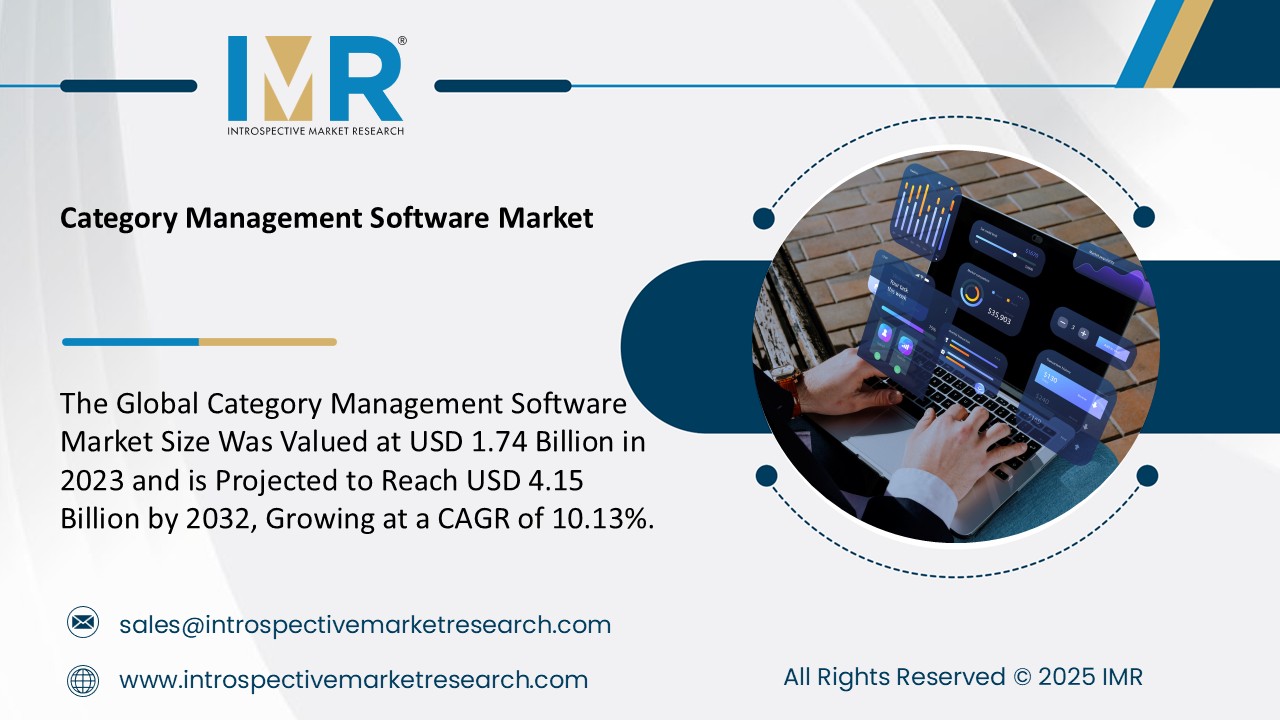
According to a new report published by Introspective Market Research, titled, Category Management Software Market by Deployment Mode, Application, and End-User, The Global Category Management Software Market Size Was Valued at USD 1.74 Billion in 2023 and is Projected to Reach USD 4.15 Billion by 2032, Growing at a CAGR of 10.13%. The Category Management Software Market is witnessing strong growth as organizations across industries embrace digital solutions to streamline procurement, supplier collaboration, and strategic sourcing. Category management tools enable companies to analyze spend data, optimize supplier relationships, and achieve cost efficiencies while improving decision-making in purchasing processes.
Unlike traditional manual approaches, category management software offers advanced analytics, automation, and AI-driven insights that reduce operational complexities and improve efficiency. These platforms are widely adopted in retail, manufacturing, healthcare, and FMCG industries to optimize inventory, strengthen supplier negotiations, and enhance profitability. With increasing demand for transparency and compliance in procurement processes, the market is expected to expand significantly over the coming years.
The Category Management Software Market is segmented into Deployment Mode, Application, and End-User.
- By Deployment Mode, the market is categorized into Cloud-Based and On-Premises.
- By Application, the market is categorized into Procurement, Supplier Relationship Management, and Spend Analytics.
- By End-User, the market is categorized into Retail, Manufacturing, Healthcare, FMCG, and Others.
One of the key growth drivers for the Category Management Software Market is the rising demand for digital procurement transformation. As enterprises strive for cost optimization and process efficiency, organizations are increasingly replacing manual tools with AI-driven software solutions. These platforms help businesses centralize supplier data, manage compliance, and improve category planning. The push toward automation and predictive analytics in procurement processes is accelerating adoption across both SMEs and large enterprises.
A significant market opportunity lies in the rapid adoption of cloud-based category management solutions. Cloud deployment offers scalability, remote accessibility, and cost-effectiveness, making it highly attractive for businesses operating across multiple geographies. Furthermore, the integration of category management tools with advanced analytics, IoT, and machine learning is opening new avenues for predictive insights, enabling organizations to improve supplier negotiations, enhance risk management, and achieve competitive advantage in global markets.
Category Management Software Market, Segmentation
The Category Management Software Market is segmented on the basis of Deployment Mode, Application, and End-User.
Deployment Mode
The Deployment Mode segment is further classified into Cloud-Based and On-Premises. Among these, the Cloud-Based sub-segment accounted for the highest market share in 2023. Cloud-based solutions are gaining dominance due to their flexibility, lower upfront costs, and ability to provide real-time collaboration across multiple locations. With increasing digitalization, organizations prefer cloud solutions that can be integrated with other enterprise software, ensuring scalability and faster deployment cycles.
Application
The Application segment is further classified into Procurement, Supplier Relationship Management, and Spend Analytics. Among these, the Procurement sub-segment accounted for the highest market share in 2023. Procurement applications are widely adopted as they streamline sourcing decisions, standardize processes, and provide actionable insights for cost reduction. Businesses are increasingly leveraging category management software to manage suppliers effectively and drive competitive procurement strategies.
Some of The Leading/Active Market Players Are-
- Oracle Corporation (US)
- SAP SE (Germany)
- GEP Worldwide (US)
- Coupa Software Inc. (US)
- JAGGAER (US)
- Proactis Holdings (UK)
- IBM Corporation (US)
- SynerTrade (France)
- Zycus Inc. (US)
- Ivalua Inc. (US)
- Scanmarket A/S (Denmark)
- Determine Inc. (US)
- BravoSolution (Italy)
- Basware Corporation (Finland)
- Corcentric Inc. (US)
- Other active players.
Key Industry Developments
In May 2024, SAP SE launched an enhanced version of its cloud-based procurement platform with advanced AI-driven insights for supplier risk management.The update introduced predictive analytics capabilities to help organizations anticipate market fluctuations, optimize supplier portfolios, and ensure compliance in global procurement operations.
In February 2024, Coupa Software announced the integration of machine learning algorithms into its category management solution to improve spend visibility.This innovation allows users to identify savings opportunities faster and streamline supplier negotiations, enhancing operational agility and cost efficiency.
Key Findings of the Study
- Cloud-based solutions dominate deployment due to scalability and cost-effectiveness.
- Procurement is the leading application segment in 2023.
- North America and Europe are key markets with strong adoption rates.
- Growth is driven by digital procurement transformation and demand for analytics.
- AI and automation are major trends shaping future opportunities.