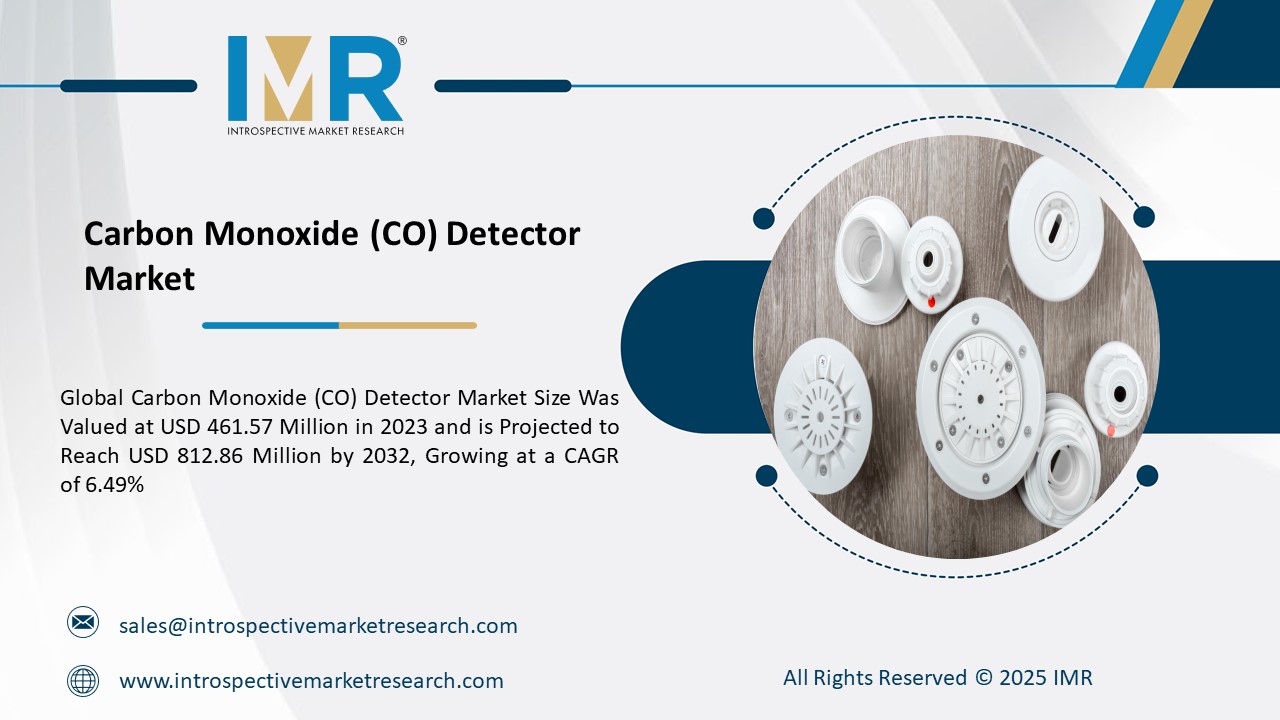
According to a new report published by Introspective Market Research, titled, Carbon Monoxide (CO) Detector Market by Type, Sensor Technology, and Application, The Global Carbon Monoxide (CO) Detector Market Size Was Valued at USD 461.57 Million in 2023 and is Projected to Reach USD 812.86 Million by 2032, Growing at a CAGR of 6.49%.The Carbon Monoxide (CO) Detector Market plays a vital role in ensuring residential, industrial, and commercial safety by detecting unsafe levels of carbon monoxide — a colorless, odorless, and potentially lethal gas. CO detectors are designed to provide early warnings against poisoning risks, safeguarding both consumers and professionals across a wide range of settings. The demand for CO safety solutions continues to surge amid growing urbanization, advancements in sensor technology, and widespread awareness campaigns about indoor air quality and safety.
Compared to traditional detection systems, modern CO detectors integrate advanced features such as wireless connectivity, smart home compatibility, and self-diagnostic capabilities, offering real-time alerts to users via mobile devices. Their growing incorporation into IoT-based home automation ecosystems and industrial safety frameworks enhances operational reliability, driving both replacement demand and new installations globally.
The Carbon Monoxide (CO) Detector Market is segmented into Type, Sensor Technology, and Application.
-
By Type: Battery-Powered CO Detectors, Hardwired CO Detectors, Plug-in CO Detectors, Smart CO Detectors (IoT-enabled).
-
By Sensor Technology: Electrochemical, Opto-Chemical, Semiconductor, and Biomimetic.
-
By Application: Residential, Commercial, Industrial, Medical, and Environmental Monitoring.
A key growth driver for the Carbon Monoxide (CO) Detector Market is the increasing adoption of safety regulations and building codes mandating the installation of CO alarms in residential and commercial spaces. Health organizations and safety authorities have reported a global rise in CO-related accidents, prompting stricter enforcement by governments. In parallel, manufacturers are innovating with improved power efficiency, expanded wireless connectivity, and enhanced lifespan sensors, collectively accelerating widespread adoption.
Expanding smart infrastructure development and the proliferation of IoT-based building management systems present immense opportunities for market growth. Smart CO detectors integrated with HVAC, fire alarms, and security networks deliver centralized monitoring and predictive maintenance benefits. Manufacturers entering emerging economies can tap into growing healthcare infrastructure, energy production, and industrial sectors, which emphasize continuous environmental surveillance and worker safety.
Carbon Monoxide (CO) Detector Market, Segmentation
The Carbon Monoxide (CO) Detector Market is segmented on the basis of Type, Sensor Technology, and Application.
Type
The Type segment is further classified into Battery-Powered, Hardwired, Plug-in, and Smart CO Detectors (IoT-enabled). Among these, the Smart CO Detectors (IoT-enabled) sub-segment accounted for the highest market share in 2023. Their growing appeal lies in real-time remote alerts, easy integration with mobile applications, and compatibility with smart home ecosystems such as Google Nest and Amazon Alexa. Continuous improvements in connectivity, sensor calibration, and data analytics have made these detectors the preferred choice in urban households and smart buildings.
Sensor Technology
The Sensor Technology segment is further classified into Electrochemical, Opto-Chemical, Semiconductor, and Biomimetic sensors. In 2023, the Electrochemical sub-segment held the largest market share due to its high detection accuracy and minimal cross-sensitivity. It remains the industry standard for residential and commercial applications, offering cost-efficient and reliable performance across varying environmental conditions.
Some of The Leading Market Players Are
- Honeywell International Inc. (United States)
- Kidde (United States)
- Nest Labs (Google LLC) (United States)
- Siemens AG (Germany)
- Carrier Global Corporation (United States)
- System Sensor (United States)
- MTI Industries, Inc. (United States)
- BRK Brands Inc. (United States)
- First Alert (United States)
- ABB Ltd. (Switzerland)
- X-Sense (China)
- New Cosmos Electric Co., Ltd. (Japan)
- Halma plc (United Kingdom)
- Ei Electronics (Ireland)
- Hochiki Corporation (Japan)
- Other active players.
Key Industry Developments
In March 2024, Honeywell introduced its next-generation smart carbon monoxide detector lineup, equipped with integrated wireless alarm connectivity and predictive maintenance analytics.
The detectors feature advanced self-calibrating sensors for extended durability, aiming to address growing demand for connected residential security solutions in North America and Europe.
In November 2024, Kidde announced a global expansion of its smart safety product range with a multi-sensor CO and smoke detector, offering enhanced integration with smart home ecosystems.
The product's compatibility with mobile app-based monitoring enables real-time alerts and reinforces Kidde’s market presence in both household and commercial sectors.
Key Findings of the Study
- Smart CO detectors and electrochemical sensors dominate the market by share.
- North America remains the leading region, supported by strict safety compliance measures.
- IoT adaptation and connected home integration drive new product innovations.
- Rising regulatory requirements and modernization of infrastructure continue to fuel steady market expansion.