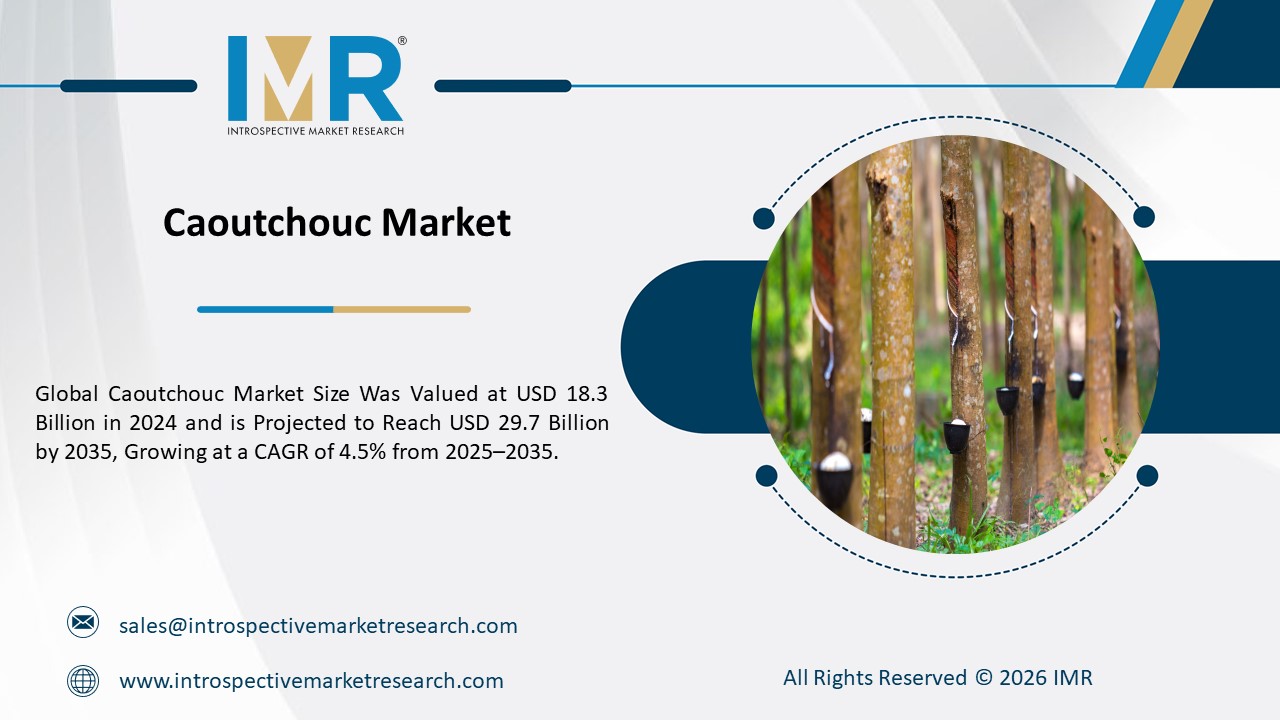
“According to a new report published by Introspective Market Research, titled, Caoutchouc Market by Type, Application, and End-Use Industry, The Global Caoutchouc Market Size Was Valued at USD 18.3 Billion in 2024 and is Projected to Reach USD 29.7 Billion by 2035, Growing at a CAGR of 4.5% from 2025–2035.”
Caoutchouc, commonly known as natural rubber, is a critical elastomer derived primarily from the latex of rubber trees. It is widely valued for its excellent elasticity, tensile strength, abrasion resistance, and durability. Compared to synthetic alternatives, caoutchouc offers superior resilience, flexibility across a wide temperature range, and enhanced performance in dynamic applications, making it indispensable in several industrial processes.
The material plays a vital role across key industries such as automotive, construction, healthcare, and industrial manufacturing. In the automotive sector, caoutchouc is extensively used in tire production, belts, hoses, and vibration-damping components. In healthcare, its biocompatibility supports applications such as gloves, catheters, and medical devices, while in construction it is used for sealing, insulation, and shock absorption.
Growing industrialization, rising vehicle production, and increasing demand for sustainable and bio-based materials are collectively driving the global caoutchouc market. Continuous improvements in processing technologies and plantation management practices are further enhancing supply efficiency and product quality.
Market Segmentation
The Caoutchouc Market is segmented into Type, Application, and End-Use Industry.
- By Type, the market is categorized into (Ribbed Smoked Sheet (RSS), Technically Specified Rubber (TSR), Latex Concentrate).
- By Application, the market is categorized into (Tires, Industrial Rubber Products, Footwear, Medical Products).
- By End-Use Industry, the market is categorized into (Automotive, Healthcare, Construction, Consumer Goods, Industrial Manufacturing).
Growth Driver
One of the key growth drivers of the caoutchouc market is the sustained expansion of the global automotive industry. Natural rubber remains a critical raw material for tire manufacturing due to its superior abrasion resistance, load-bearing capacity, and heat dissipation properties. Rising vehicle production, especially in emerging economies, combined with increasing demand for replacement tires, is significantly boosting caoutchouc consumption. Additionally, stricter safety and performance standards for automotive components are encouraging manufacturers to rely more on high-quality natural rubber, further supporting steady market growth over the forecast period.
Market Opportunity
A major market opportunity lies in the growing demand for sustainable and bio-based materials across industries. As environmental regulations tighten and companies pursue carbon-neutral strategies, caoutchouc is gaining preference over petroleum-based synthetic rubber. Innovations in sustainable rubber cultivation, traceability, and eco-friendly processing methods are opening new avenues for market expansion. Furthermore, rising demand for natural rubber in medical and healthcare applications, particularly in developing regions with expanding healthcare infrastructure, presents lucrative growth opportunities for market players.
Detailed Segmentation
Caoutchouc Market, Segmentation
The Caoutchouc Market is segmented on the basis of Type, Application, and End-Use Industry.
Type
The Type segment is further classified into Ribbed Smoked Sheet (RSS), Technically Specified Rubber (TSR), and Latex Concentrate. Among these, the Technically Specified Rubber (TSR) sub-segment accounted for the highest market share in 2024. TSR is widely preferred due to its consistent quality, standardized grading, and suitability for large-scale industrial applications, particularly tire manufacturing. Its ease of processing, reduced impurities, and compliance with international standards make it the dominant choice for automotive and industrial manufacturers globally.
Application
The Application segment is further classified into Tires, Industrial Rubber Products, Footwear, and Medical Products. Among these, the Tires sub-segment accounted for the highest market share in 2024. Tire manufacturing consumes a significant volume of caoutchouc due to its essential role in providing durability, traction, and load-bearing capacity. The steady rise in vehicle ownership, commercial transportation, and logistics activities continues to drive strong demand for natural rubber-based tires worldwide.
Some of The Leading/Active Market Players Are-
• Thai Rubber Latex Group (Thailand)
• Sri Trang Agro-Industry (Thailand)
• Halcyon Agri Corporation (Singapore)
• Von Bundit Co., Ltd. (Thailand)
• Southland Holdings (Malaysia)
• Sinochem International (China)
• Vietnam Rubber Group (Vietnam)
• Kumpulan Guthrie Berhad (Malaysia)
• Tradewinds Plantation Berhad (Malaysia)
• Bridgestone Natural Rubber Operations (Japan)
• Olam Group (Singapore)
• Indochina Rubber Ltd. (Cambodia)
• PT Perkebunan Nusantara (Indonesia)
• ECOM Agroindustrial Corp. (Switzerland)
and other active players.
Key Industry Developments
In March 2024, leading natural rubber producers announced investments in sustainable rubber farming and traceability programs to meet global ESG requirements.
These initiatives focus on improving yield efficiency, reducing deforestation risks, and ensuring transparent supply chains, strengthening long-term market sustainability and buyer confidence.
In October 2024, a major automotive tire manufacturer expanded its sourcing of certified natural rubber from Southeast Asia.
The move aims to reduce carbon footprint, ensure raw material stability, and support the growing demand for eco-friendly tires in global automotive markets.
Key Findings of the Study
• Technically Specified Rubber dominates the type segment due to standardized quality.
• Tires remain the largest application segment globally.
• Asia-Pacific leads the market, driven by rubber plantations and automotive demand.
• Sustainability and automotive growth are key market drivers.
• Healthcare and bio-based material demand present emerging opportunities.