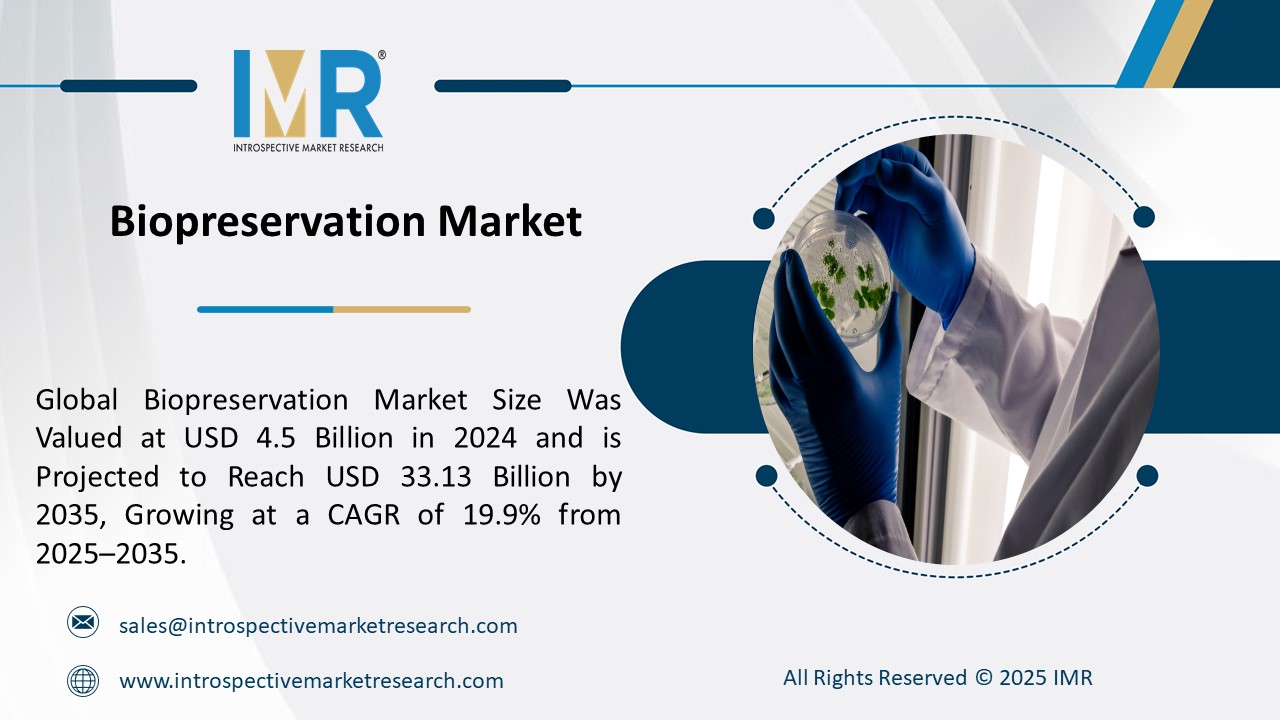
“According to a new report published by Introspective Market Research, titled, Biopreservation Market by Product Type, Application, and End User, The Global Biopreservation Market Size Was Valued at USD 4.5 Billion in 2024 and is Projected to Reach USD 33.13 Billion by 2035, Growing at a CAGR of 19.9% from 2025–2035.”
The biopreservation market encompasses products and technologies used to preserve biological materials such as cells, tissues, organs, and genetic material under controlled conditions. These solutions play a critical role in maintaining biological integrity for extended periods, enabling advancements in biomedical research, regenerative medicine, drug discovery, and clinical applications. Biopreservation techniques offer significant advantages over conventional storage methods by ensuring long-term viability, reduced contamination risk, and enhanced sample stability.
Rapid growth in biobanking activities, increasing adoption of cell and gene therapies, and rising demand for personalized medicine are accelerating market expansion. Biopreservation solutions are widely used across pharmaceutical and biotechnology companies, academic research institutions, and healthcare facilities for applications ranging from stem cell storage to vaccine development.
Furthermore, continuous innovations in cryopreservation media, equipment automation, and temperature-controlled logistics are strengthening the global biopreservation ecosystem. Supportive regulatory frameworks and increased investment in life sciences research are further reinforcing the market’s long-term growth potential.
Market Segmentation
The Biopreservation Market is segmented into Product Type, Application, and End User.
- By Product Type, the market is categorized into Equipment, Media, and Services.
- By Application, the market is categorized into Regenerative Medicine, Drug Discovery, Biobanking, and Clinical Research.
- By End User, the market is categorized into Biotechnology & Pharmaceutical Companies, Academic & Research Institutes, and Hospitals.
Growth Driver
The growing adoption of cell and gene therapies is a key driver of the biopreservation market. These advanced therapies require precise storage and transportation conditions to preserve cell viability and therapeutic efficacy. As regulatory approvals for cell-based treatments increase globally, the need for reliable biopreservation solutions has intensified. Pharmaceutical and biotechnology companies are increasingly investing in advanced preservation media and cryogenic storage systems to support large-scale manufacturing and global distribution, thereby fueling sustained market growth.
Market Opportunity
The rapid expansion of biobanking infrastructure presents a significant market opportunity. Governments, research institutions, and private organizations are investing heavily in large-scale biobanks to support genomics, precision medicine, and population health studies. Emerging economies are also strengthening healthcare research capabilities, creating demand for cost-effective and scalable biopreservation technologies. Advancements in automated storage systems and AI-enabled sample monitoring further open new revenue streams for market participants.
Detailed Segmentation
Biopreservation Market, Segmentation
The Biopreservation Market is segmented on the basis of Product Type, Application, and End User.
Product Type
The Product Type segment is further classified into Equipment, Media, and Services. Among these, the Equipment sub-segment accounted for the highest market share in 2024. This dominance is attributed to the widespread adoption of ultra-low temperature freezers, cryogenic storage tanks, and controlled-rate freezers across biobanks and pharmaceutical facilities. Continuous technological advancements, improved energy efficiency, and automation capabilities are further strengthening the demand for biopreservation equipment globally.
Application
The Application segment is further classified into Regenerative Medicine, Drug Discovery, Biobanking, and Clinical Research. Among these, the Biobanking sub-segment accounted for the highest market share in 2024. The increasing number of public and private biobanks, rising collection of biological samples, and growing focus on long-term disease research have driven demand. Biobanking plays a critical role in supporting personalized medicine, epidemiological studies, and translational research worldwide.
Some of The Leading/Active Market Players Are-
• Thermo Fisher Scientific (USA)
• Merck KGaA (Germany)
• BioLife Solutions (USA)
• PHC Holdings Corporation (Japan)
• Azenta Life Sciences (USA)
• VWR International (USA)
• Chart Industries (USA)
• Custom Biogenic Systems (USA)
• Hamilton Company (USA)
• Brooks Automation (USA)
and other active players.
Key Industry Developments
In March 2024, leading biopreservation solution providers expanded their cryogenic storage portfolios to support large-scale cell therapy manufacturing.
These developments focused on improving temperature stability, automation, and monitoring capabilities, addressing the growing demand from pharmaceutical companies engaged in advanced therapy production.
In October 2024, several biobanking organizations partnered with technology firms to integrate AI-driven sample tracking systems.
This initiative enhanced sample traceability, reduced human error, and improved operational efficiency, strengthening the overall biopreservation infrastructure.
Key Findings of the Study
• Equipment remains the dominant product segment due to widespread cryogenic storage adoption
• North America leads the market owing to strong biopharmaceutical research activity
• Rising cell and gene therapy development is a primary growth driver
• Expansion of global biobanking networks is a major market trend