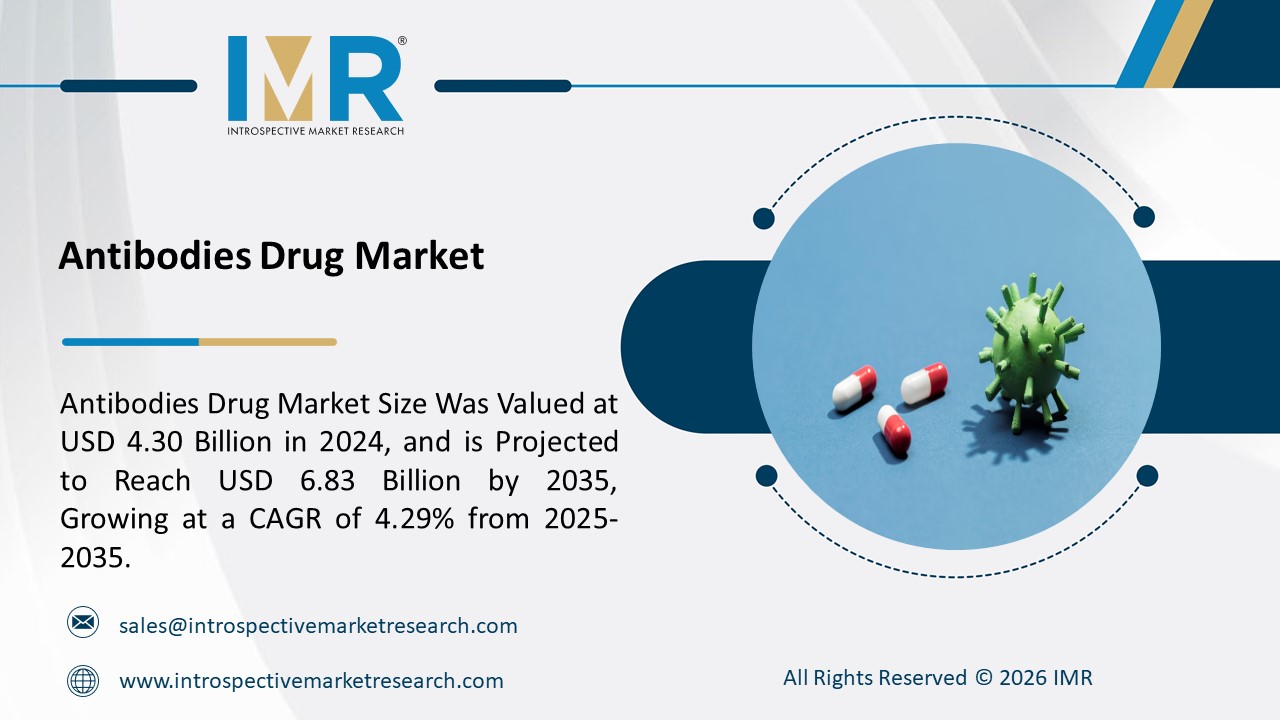
According to a new report published by Introspective Market Research, titled, “Antibodies Drug Market by Product, Application, and End-User,” The Global Antibodies Drug Market Size Was Valued at USD 4.30 Billion in 2024 and is Projected to Reach USD 6.83 Billion by 2035, Growing at a CAGR of 4.29% From 2025–2035.
The Antibodies Drug market comprises diagnostic and therapeutic products that utilize monoclonal and polyclonal antibodies. This includes primary and secondary antibodies for research, in-vitro diagnostic (IVD) kits and reagents, and a wide array of monoclonal antibody (mAb) therapies. The central advantage of antibody-based products is their high specificity and affinity for target molecules, enabling them to precisely detect, measure, or modulate biological processes with minimal off-target effects. In diagnostics, this ensures high accuracy; in therapeutics, it allows for targeted action with potentially fewer side effects compared to conventional small-molecule drugs.
The primary growth driver for the antibodies drug market is the relentless and continuous expansion of the therapeutic monoclonal antibody (mAb) pipeline and the sustained high global demand for targeted biologic therapies. Pharmaceutical companies are heavily investing in mAb development due to their clinical success and commercial viability. Each new mAb approved for cancer, autoimmunity, or other conditions represents a multi-billion dollar product that requires not only manufacturing but also companion diagnostic antibodies for patient stratification and treatment monitoring. This dual demand from both the therapeutic and diagnostic sides, driven by the superior efficacy and safety profile of mAbs in treating complex diseases, creates a robust, innovation-led growth cycle that powers the entire market.
A significant market opportunity lies in the development of novel antibody formats and bispecific/multi-specific antibodies for therapeutic applications, and the expansion of high-quality, validated research antibodies for emerging fields. Beyond traditional mAbs, the next frontier includes antibody-drug conjugates (ADCs), bispecific antibodies that engage two targets simultaneously, and fragments and engineered antibodies with improved tissue penetration or extended half-life. These next-generation formats address unmet needs in oncology and beyond. In parallel, as research delves into proteomics, single-cell analysis, and spatial biology, there is a growing need for highly specific, validated antibodies against novel targets, creating a premium segment for reliable research tool suppliers.
Antibodies Drug Market, Segmentation
The Antibodies Drug Market is segmented on the basis of Product, Application, and End-User.
Product
The Product segment is further classified into Primary Antibodies, Secondary Antibodies, IVD Reagents, and Therapeutic mAbs. Among these, the Therapeutic mAbs sub-segment accounted for the highest market share in 2024. Therapeutic monoclonal antibodies dominate the market in terms of revenue due to their extremely high cost per dose and blockbuster status in treating major diseases like cancer and autoimmune disorders. Drugs such as adalimumab, pembrolizumab, and trastuzumab generate tens of billions in annual sales, far outweighing the revenue from research or diagnostic antibodies. This high-value segment drives the overall market size and attracts the most significant R&D investment.
Application
The Application segment is further classified into Oncology, Immunology, Infectious Diseases, and Research. Among these, the Oncology application sub-segment accounted for the highest market share in 2024. Oncology is the largest and fastest-growing therapeutic area for antibodies, particularly monoclonal antibodies and antibody-drug conjugates (ADCs). mAbs like checkpoint inhibitors (e.g., anti-PD-1/PD-L1) have revolutionized cancer treatment, and ADCs offer targeted delivery of potent cytotoxic agents. The high prevalence of cancer, combined with the clinical success and premium pricing of these therapies, makes oncology the primary revenue-generating application for antibody drugs.
Some of The Leading/Active Market Players Are-
• F. Hoffmann-La Roche Ltd (Switzerland)
• Johnson & Johnson (US)
• AbbVie Inc. (US)
• Merck & Co., Inc. (US)
• Novartis AG (Switzerland)
• Thermo Fisher Scientific Inc. (US)
• Danaher Corporation (US) [Cytiva, Beckman Coulter]
• Abcam plc (UK)
• Bio-Rad Laboratories, Inc. (US)
• and other active players.
Key Industry Developments
In February 2024, a major biopharmaceutical company announced positive Phase III results for its novel bispecific antibody targeting two distinct pathways in a hard-to-treat solid tumor. The drug demonstrated significantly improved progression-free survival, highlighting the clinical potential of next-generation antibody formats to address complex cancer biology and overcome resistance to single-target therapies.
In March 2024, a leading life science tools provider acquired a niche antibody discovery and manufacturing platform specializing in rabbit monoclonal antibodies. The move aims to strengthen its portfolio of high-specificity research and diagnostic antibodies, catering to the growing demand for superior validation and performance in preclinical research and companion diagnostics.
Key Findings of the Study
• Therapeutic mAbs and the Oncology application are the dominant market segments.
• North America holds the largest market share, driven by high biologic drug adoption and major biopharma R&D hubs.
• The key growth driver is the continuous expansion and clinical success of the therapeutic monoclonal antibody pipeline.
• Major trends include the development of next-generation formats (bispecifics, ADCs) and the demand for highly validated research antibodies.